
Sinéad O'Connor
She was right
By Rebobinados · Published on September 9, 2026
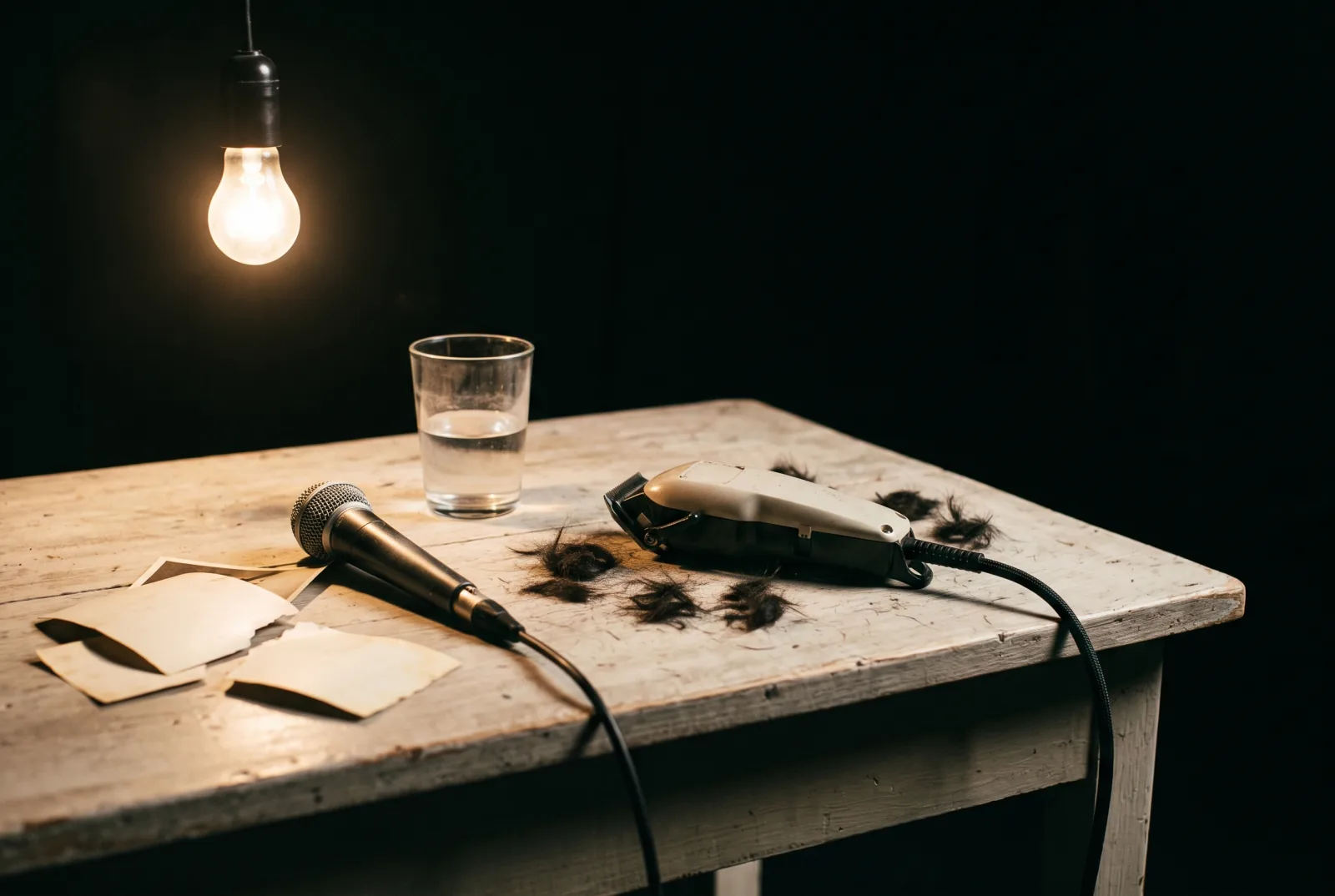
Ilustración: Rebobinados
On 3 October 1992, on Saturday Night Live, Sinéad O'Connor sang Bob Marley's "War" a cappella, with the words changed to speak about the abuse of children.
When she finished she held up a photograph of Pope John Paul II, tore it into pieces in front of the camera and said: "Fight the real enemy."
She was protesting against the sexual abuse of children inside the Catholic Church. It was 1992. Almost nobody was saying that out loud.
The response was brutal. She was banned from the show. She was ridiculed. Two weeks later, at the concert marking thirty years of Bob Dylan's career, at Madison Square Garden, she was booed so loudly she could not sing what she had prepared. Kris Kristofferson walked out on stage and put his arm around her.
Her mass career, in practice, ended that night.
What came before
She was born in Dublin in 1966 and had a hard childhood, marked by abuse, which she denounced publicly.
At fifteen she was placed for eighteen months in the Grianán Training Centre, in Drumcondra, run by the Order of Our Lady of Charity: the same congregation that ran the Magdalene laundries, the institutions where Ireland shut away, for decades, the girls it considered troublesome. Inside there, a nun gave her her first guitar.
Yes: the Church against which she would raise that photograph is also the one that put the instrument in her hands. Her whole life is made of knots like that.
She did not want to be pretty
She was different from the start. She said she shaved her head when it was suggested that she should look more feminine, prettier, more commercial.
She did not want to be pretty. She wanted to be heard for her music, not looked at for her face. That shaved skull was her statement of principle, and she kept it all her life.
She had a voice that cut: high, enormous, able to go from a whisper to a scream inside a single line. In 1990 she recorded "Nothing Compares 2 U", which Prince had written years earlier for a project of his own, and she made it hers for good. It was number one across half the world, and the video — that bare face in close-up, the eyes filling with real tears — was burned into a generation's memory.
She was at the top. And from there she did the thing that cost her everything.
She was right
And here is what has to be said loudly, the thing that gives her whole story its meaning: she was right.
Over the years the whole world discovered that the sexual abuse of children in the Catholic Church was real, enormous, systematic and covered up for decades. The scandals broke in one country after another; in Ireland, official reports ended up documenting exactly what she had shouted alone in front of millions of people.
She never apologised. In her memoir she wrote that she did not regret the protest, and over the years she maintained that tearing up that photograph had not ruined anything: it had put her back on the right road. She preferred the truth and contempt to success and silence.
That is the exact measure of her courage.
What it cost
Courage gets charged for, and she paid dearly.
She was deliberately uncomfortable all her life. She boycotted the 1991 Grammys — she won and did not go to collect, and wrote an open letter explaining why she thought the award celebrated the commercial rather than the artistic. She used every microphone she was given to talk about human rights, about Ireland, about mental health.
And inside she carried an immense pain. She spoke openly about her mental illness, her diagnosis and her suffering, with an honesty almost nobody had in public in those years.
In October 2018 she converted to Islam and took the name Shuhada' Sadaqat, though to the world she remained Sinéad.
In January 2022 the worst thing that can happen to a mother happened to her: her son Shane, aged seventeen, took his own life. She wrote that he was the love of her life and the lamp of her soul, and that she could find no sense in going on without him. A year and a half later, on 26 July 2023, Sinéad O'Connor died in London, aged fifty-six, of natural causes.
Let us listen this time
Sinéad O'Connor was not "the one who tore up the Pope's photograph".
She was the one who dared to say a truth the world was not ready to hear, and which turned out to be true. The one who refused to be pretty, quiet and safe so that she could be honest. The one who gave victims a voice when no star dared to name them.
If you only know her from "Nothing Compares 2 U", go to The Lion and the Cobra, to "Mandinka", to her version of "War". You will find a woman with a voice that wounds by being so true, who was fragile and ferocious at once, who suffered more than anyone should, and who had the courage to say out loud, alone, what everyone knew and nobody said.
They booed her while she lived. History proved her right. Let us not boo her again as we remember her: let us listen.
If you are going through a difficult time, you are not alone. In Chile you can call Salud Responde, 600 360 7777 (mental health option), available 24 hours a day.
This text mentions sexual violence. If you or someone you know has been through something like this, you are not alone and help is available. In Chile, the SernamEG Gender Violence Helpline is 1455, from 08:00 to 00:00 every day, with a silent WhatsApp service at +56 9 9700 7000. For emergencies during the night there are Carabineros' 149, plus 133 and 134. And in the case of a recent sexual assault you can go directly to any emergency service, without needing to have filed a report: care is guaranteed within the first 72 hours. Seeking support is an act of strength.
Sources
Sinéad Marie Bernadette O'Connor (Dublin, 8 December 1966 – London, 26 July 2023), Irish singer-songwriter; in October 2018 she converted to Islam and took the name Shuhada' Davitt, later Shuhada' Sadaqat, but remained known as Sinéad O'Connor. She had a difficult childhood and publicly denounced the abuse she suffered; at fifteen she spent eighteen months at the Grianán Training Centre in Drumcondra, run by the Order of Our Lady of Charity, the congregation linked to the Magdalene laundries. By her own account, she shaved her head in rejection of industry pressure to look more feminine. She debuted with "The Lion and the Cobra" (1987), which includes "Mandinka". Her version of "Nothing Compares 2 U", a song written by Prince, appeared on "I Do Not Want What I Haven't Got" (1990) and was an international number one. On 3 October 1992, on "Saturday Night Live", she performed Bob Marley's "War" a cappella, with the lyrics adapted to refer to child abuse, and then tore up a photograph of Pope John Paul II saying "Fight the real enemy", in protest at child sexual abuse in the Catholic Church; she was banned from the show and heavily criticised. Two weeks later she was booed at the concert marking the thirtieth anniversary of Bob Dylan's career, at Madison Square Garden, where Kris Kristofferson came on stage to put his arm around her. Over the years the scale of abuse in the Church became public in numerous countries, including Ireland, proving her right; in her memoir "Rememberings" (2021) she restated that she did not regret the protest. She boycotted the 1991 Grammys, which she won, with an open letter to the Academy. She spoke publicly about her mental illness. Her son Shane, aged 17, died by suicide in January 2022. O'Connor died on 26 July 2023, aged 56, of natural causes. Externally authored text, edited and verified for Rebobinados. Interpretations of the meaning of her work are offered as the author's reading. No song lyrics are reproduced, for copyright reasons. Information drawn from Wikipedia, Time, NBC News, CBS News and other press coverage.
Keep rewinding
90s
indie
Portishead
A short film got them the record deal
Before the record they shot *To Kill a Dead Man*, eleven minutes of film noir written by the three of them: Geoff Barrow plays a sniper and Beth Gibbons a widow. That soundtrack got them the record deal, and the cover of *Dummy* is a still from the short. The rest is told wrong too: *Dummy* sold 3,600,000 copies and won the 1995 Mercury ahead of Oasis, Tricky and PJ Harvey. Three records in fourteen years, and eighteen without a fourth.
00s
indie
Peter Bjorn and John
The whistle was provisional
Björn Yttling whistled the melody of "Young Folks" as a placeholder, only so as not to forget it, and they decided to keep it. The single came out on 7 August 2006, with Victoria Bergsman as guest, and it was not no. 1 anywhere: no. 13 in the United Kingdom, no. 9 in Finland. Live it is whistled by Peter Morén, and the trio never broke up: nine albums.
00s
indie
Florence + the Machine
The catharsis had a name
The band formed in London in 2007 and "the Machine" comes from the keyboard player Isabella Summers. Florence Welch has said that she stopped eating at seventeen and that she stopped drinking around 2014: the catharsis in her music has a concrete content. She has five British number ones, the last with Everybody Scream (31 October 2025), nominated for the 2026 Mercury.
Rewind with us
Comments · 0
No one has commented yet. Open the conversation.