
The Beach Boys
The piano inside the sandbox
By Rebobinados · Published on September 27, 2026
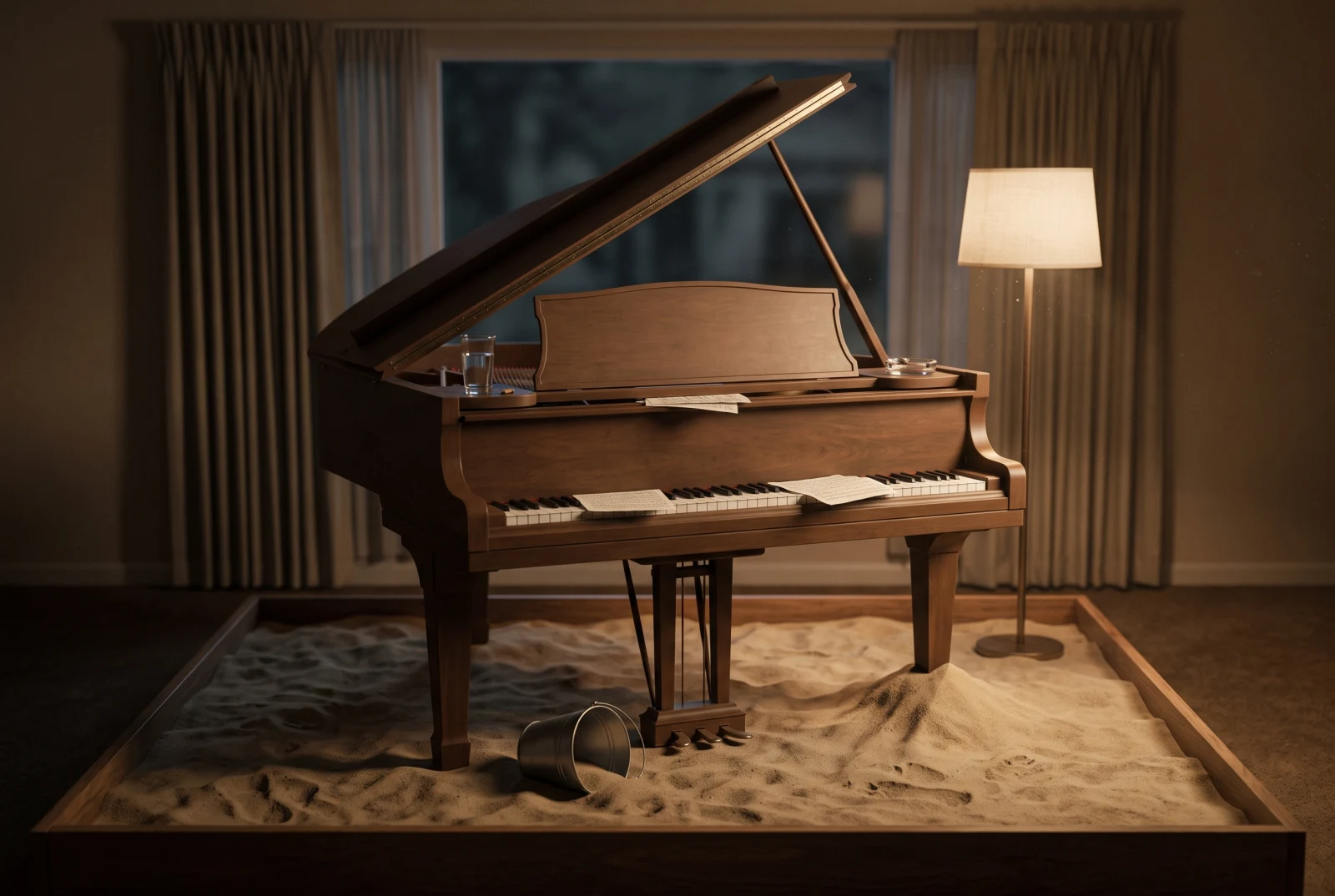
Ilustración: Rebobinados
In 1966 Brian Wilson had a sandbox built in his house and put the piano inside it, so he could compose with his feet buried. It gets told as a genius's eccentricity and it is something else: the man who had sold the world the California summer needed to manufacture himself a beach in the living room, because he never went to the real one. The Beach Boys sold sun, cars and eternal youth, and almost none of them lived it; least of all the one who wrote it.
Hawthorne, and the father
A detail that nearly every biography ruins: Hawthorne, where they formed in 1961, is not a Los Angeles neighbourhood but a city in the county, inland. They were three brothers — Brian, Dennis and Carl Wilson — a cousin, Mike Love, and a school friend, Al Jardine. The only one who surfed was Dennis, and it was he who suggested to Brian that he write about it.
The harmonies came out of that house, which was not a kind place. Murry Wilson, the father, was also the group's first manager, and his sons described years of physical and verbal abuse. "Surfin' U.S.A.", "I Get Around", "California Girls": anthems to an imaginary country, learned in the living room of a man who hit.
The architect, and the man who managed him
Brian was one of the first pop musicians to treat the studio as an instrument. He came off the road very young and stayed in Los Angeles writing, arranging and producing with session musicians. Out of that came Pet Sounds, in 1966, and "Good Vibrations", recorded in sections over months and number one in the United States. Then came SMiLE, which he did not finish: he carried that ghost for almost forty years, until he premiered it in 2004.
The next chapter tends to be told in vague terms, along the lines of "people who controlled him more than they should have". The vagueness has a name: Eugene Landy. He was his psychologist and, at the same time, his manager, his executive producer and his co-writer, a dual relationship that professional ethics expressly forbid. He lost his licence in California in 1989 and in 1991 a restraining order was issued. Only after Landy did Brian receive the correct diagnosis: schizoaffective disorder. Saying the name matters: vagueness protects the person responsible.
The losses have to be stated without ornament. Dennis Wilson died on 28 December 1983 in Marina del Rey, diving to recover objects he had thrown into the water himself, with a blood alcohol level of 0.26. Carl Wilson died on 6 February 1998 of lung cancer with brain metastases. Brian died on 11 June 2025, aged 82: respiratory arrest, with sepsis and cystitis, and a neurodegenerative disorder among the factors. His dementia had been made public in February 2024 and since May he had been under court-appointed conservatorship.
Monterey was not the crossing; "Kokomo" was
The Beach Boys were to close the night of 17 June 1967 at the Monterey Festival, co-organised by John Phillips, of The Mamas and the Papas. They did not play. The romantic explanation — that they felt out of place — is not the best documented one: Carl Wilson had a court hearing that week for refusing to be drafted, and on top of that came the dispute with Capitol and Brian's condition. And the usual punchline, the one about how there one band caught the wave of the future and the other let it go by, falls apart on a date: The Mamas and the Papas broke up in 1968, a year later.
The real crossing came twenty-one years later and it is called "Kokomo". It was co-written by John Phillips, Scott McKenzie, Mike Love and Terry Melcher, and it was number one on the Hot 100 on 5 November 1988: the Beach Boys' first in twenty-two years and the last of their career. Brian Wilson had no part in it. The whole story is right there: the founder of The Mamas and the Papas wrote the Beach Boys the hit of their old age, and he wrote it for Mike Love's side, not for that of the man who invented the band's sound.
The two families knew each other closely. There is an image from 1968 that says everything: Brian Wilson and John Phillips playing basketball in the Hollywood Hills while their wives pushed two newborn girls in prams, Carnie Wilson and Chynna Phillips, who twenty-two years later would be number one together as Wilson Phillips. As for the other band — how Cass Elliot died and the lie that was told about her — that is told separately.
What to remember
The Beach Boys were not a beach band. They were one of the most ambitious projects in American music, pushed along by a man who heard arrangements nobody else imagined and who paid dearly for getting them out. They put a sound to the sun without ever having had a clear sky.
And the ending is not the one usually told. At Monterey there was no band that climbed aboard the future and another that let it pass: there was one that broke up in 1968 and another that arrived, twenty years later, at a last number one written by the founder of the first. The architect of all of it was not at that session.
Sources
The Beach Boys formed in 1961 in Hawthorne, a city in Los Angeles County, with the brothers Brian, Dennis and Carl Wilson, their cousin Mike Love and Al Jardine. Murry Wilson, the brothers' father and first manager, subjected his sons to physical and verbal abuse that they recounted publicly. "Pet Sounds" was released in 1966 and "Good Vibrations" was number one in the United States that same year; "SMiLE" was left unfinished and Brian Wilson completed and premiered it in 2004. The psychologist Eugene Landy was at once his therapist, manager, executive producer and co-writer, a dual relationship that professional ethics forbid; he lost his licence in California in 1989 and in 1991 a restraining order was issued against him. Afterwards Wilson received a diagnosis of schizoaffective disorder; his dementia was made public in February 2024 and he was placed under court-appointed conservatorship in May. Dennis Wilson died on 28 December 1983 in Marina del Rey while diving to recover objects he had thrown into the water himself, with a blood alcohol level of 0.26; Carl Wilson, on 6 February 1998, of lung cancer with brain metastases; Brian Wilson, on 11 June 2025, aged 82, of respiratory arrest, with sepsis, cystitis and a neurodegenerative disorder among the factors. The group, announced to close the night of 17 June 1967 at the Monterey Festival, co-organised by John Phillips, did not appear; among the causes cited are Carl Wilson's court hearing for refusing to be drafted, the dispute with Capitol and Brian Wilson's state of health. The Mamas and the Papas broke up in 1968. "Kokomo", co-written by John Phillips, Scott McKenzie, Mike Love and Terry Melcher and recorded without Brian Wilson's participation, was number one on the Billboard Hot 100 on 5 November 1988, the group's first in twenty-two years and its last. In 1968 Brian Wilson and John Phillips played basketball in the Hollywood Hills while their wives walked their newborn daughters, Carnie Wilson and Chynna Phillips. Profile compiled for Rebobinados with fact-checking; interpretations of the meaning of the work are offered as the author's reading. No song lyrics are reproduced, for copyright reasons. Information drawn from Billboard, Rolling Stone, the Los Angeles Times, Variety, Wikipedia and other coverage.
If you or someone you know is going through a crisis, in Chile you can call the Ministry of Health's *4141 free of charge, 24 hours a day. And if a child or adolescent is at risk, Carabineros' 147 Fono Niños answers 24 hours a day.
Keep rewinding

10s
pop
Bruno Mars
Eleven names in the credits
"Uptown Funk" came out on 10 November 2014 with six writers and today it has eleven. In February 2015 The Gap Band's publisher filed a claim over "Oops Up Side Your Head" in YouTube's copyright system —there was never a lawsuit— and on 28 April five names were added, with 17 % of the publishing. It happened weeks after the "Blurred Lines" verdict, and the song had been fourteen weeks at number one.

00s
pop
André Rieu
It was not from the jazz suite
The waltz with which André Rieu reached half the world is not from Shostakovich's Suite for Jazz Orchestra No. 2: it is from the Suite for Variety Orchestra, which the composer did not assemble, and it was born in 1956 as music for a Soviet film about settlers in Kazakhstan. The error comes from a misprint in volume 10 of the complete works (Muzyka, Moscow, 1984), corrected only in 2001. And the title "The Second Waltz" was invented by his wife, because the real one did not sell.

90s
pop
Daniela Mercury
She took the neighbourhood out of the song
"O Canto da Cidade" was written by Tote Gira, a composer from Nordeste de Amaralina who recorded the demo on a borrowed cassette, marking the beat on the door of a refrigerator; Mercury's team almost threw the tape away. She shares the credit because she deleted the references to the Pelourinho so that the song would serve all of Brazil. The album, from 20 September 1992, sold more than 2 million copies and nationalised axé. But she did not invent it: the name was a journalist's insult in 1987.
Rewind with us
Comments · 0
No one has commented yet. Open the conversation.