
Decade 90s · Rhythm disco dance
The Prodigy
The dancer who took the mic
By Rebobinados · Published on September 22, 2026
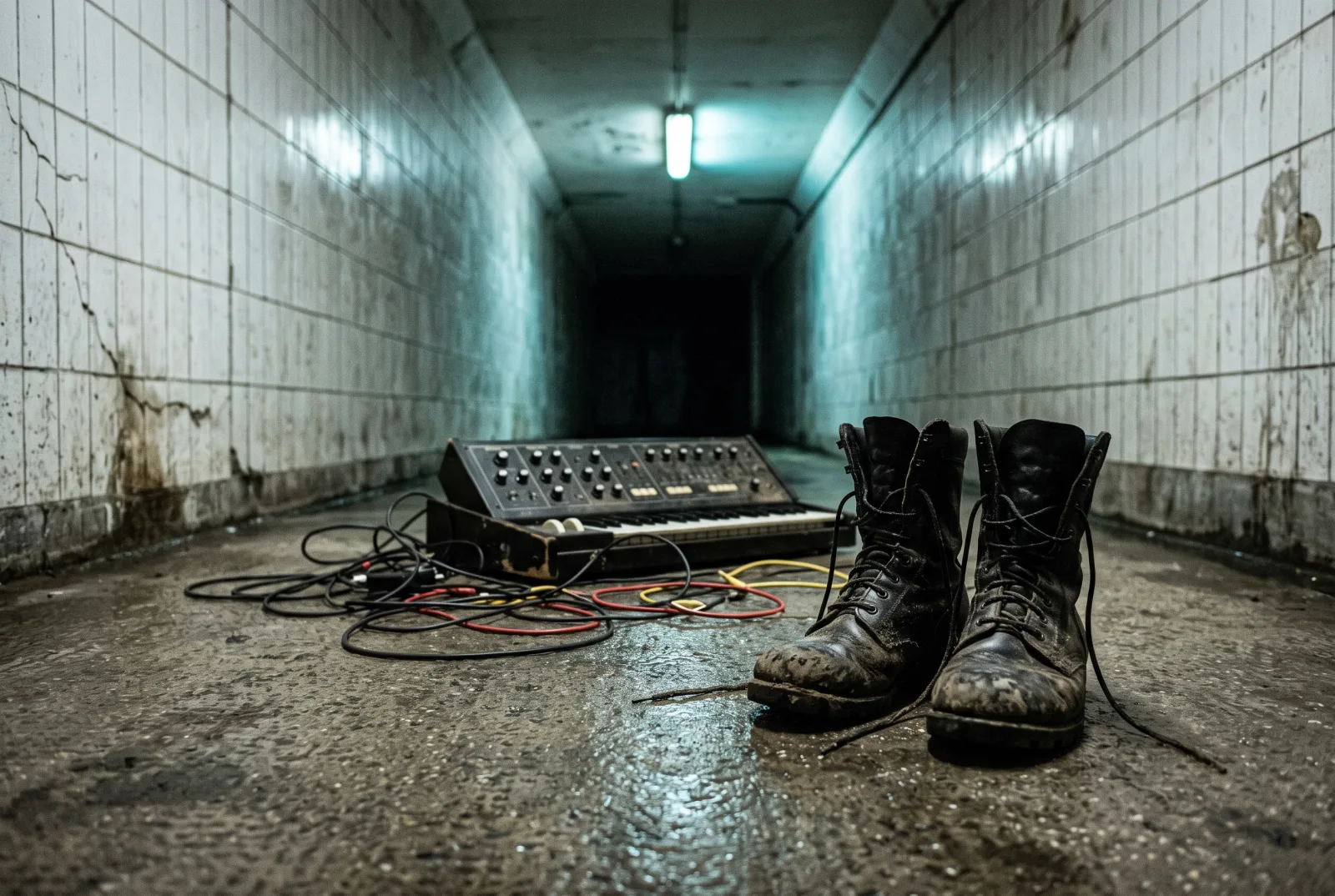
Ilustración: Rebobinados
The Prodigy did something that looked impossible: they took electronic dance music, the kind that played at the United Kingdom's underground rave parties, and made it fierce, aggressive, almost punk, without softening it one bit.
They did not make electronic music to relax to. They made electronic music to hit you with: distorted guitars, synthesizers that sounded like alarm sirens, rhythms like hammer blows.
They were the bridge between rock and the dance floor. And their story ends in a place more uncertain and sadder than the one usually told.
The brain was never up front
Here is something that turns the idea you have of the band upside down.
The author of The Prodigy, the one who wrote, produced and played absolutely everything, was Liam Howlett, a guy who stayed at the back, behind the keyboards, almost invisible. He was the musical genius, and the group's name comes precisely from a synthesizer he used, the Moog Prodigy.
The ones up front, the ones people believed "were" The Prodigy, had joined the band as dancers.
Yes: Keith Flint and Leeroy Thornhill started out as the ones dancing onstage while Howlett handled the music from behind. Maxim joined as MC at the first live show, in early 1991.
In time, one of those dancers grabbed the microphone and turned into one of the most recognisable figures of the nineties.
From dancing to fire
That dancer was Keith Flint.
In 1996, for "Firestarter", Flint invented a character for himself: hair standing up in two coloured spikes, eyes painted black, a demonic grin, the energy of a bomb about to go off.
The video, in black and white, directed by Walter Stern, was filmed in a London Underground tunnel, next to the abandoned Aldwych station. There was so much dust in the tunnel that the crew had to work in face masks. The result terrified half of England and fascinated the other half: the BBC ended up pulling it, after being accused of encouraging pyromania.
"Firestarter" was number one in the United Kingdom for three weeks—in the United States it only got to number thirty—and Flint went from anonymous dancer to the face of rave for a whole generation.
Then came "Breathe", another British number one, and the album "The Fat of the Land", from 1997, which reached number one in sixteen countries, the United States included. Quite a feat for an aggressive British electronic band.
They also had their controversy with "Smack My Bitch Up", whose title and video were accused of promoting violence against women. Several chains pulled the album from their stores and several radio stations restricted its airplay.
What is known, and what is not
And here is the difficult part, the one that has to be told carefully, because it is almost always told wrong.
On 4 March 2019, Keith Flint was found dead at his home in Essex, at the age of forty-nine.
That same day, Liam Howlett wrote on Instagram that his brother had taken his own life, and that he was in shock, furious, confused and heartbroken. It was the immediate reaction of a devastated friend, published the same day and before any investigation.
Two months later, the inquest closed in a different way. On 8 May 2019, the senior coroner for Essex, Caroline Beasley-Murray, recorded an open conclusion. And she explained why: to record a suicide she would have had to establish that Flint formed the idea and acted deliberately knowing it would cause his death, and she did not find sufficient evidence of that.
Her words were that we will never know quite what was going on in Flint's mind that day.
It is worth putting it that way, and not the way it gets repeated: what was left is not a certainty, it is a gap. The post-mortem recorded the medical cause and the presence of cocaine, alcohol and codeine, and that is where what can be stated stops.
What did happen afterwards is that fans pushed a campaign to return "Firestarter" to the charts—it re-entered at number fifty-eight—and many took that moment to talk about something that is rarely talked about: men's mental health, and how easy it is to assume that someone who looks like pure fire onstage is invincible.
That conversation is worth just as much, and perhaps more, without the certainty that nobody has.
What to remember
The Prodigy are the proof that electronic music could be as rebellious and as physical as the best rock, and that there was no need to ask anyone's permission.
If you put on "Firestarter", "Breathe" or "Out of Space", you will hear the sound of a revolution: the moment dance music stopped being only for dancing.
And you will hear Keith Flint, the dancer who grabbed the microphone, the fierce and endearing face of a music that never asked permission.
The band carried on afterwards, with Howlett and Maxim, honouring the memory of their friend.
May his energy be remembered. And may his story serve, above all, to make you ask how someone is doing when they look like they do not need it.
This piece mentions suicide. If you are going through a difficult time or having thoughts of harming yourself, you are not alone and help is available. In Chile you can call *4141 free of charge, the Ministry of Health's suicide-prevention line, available 24 hours a day from mobile phones.
Sources
The Prodigy, British electronic music group (big beat / rave) formed on 5 October 1990 in Braintree, Essex, by Liam Howlett, composer, producer and keyboardist, author of the band's music; the name comes from a Moog Prodigy synthesizer. Keith Flint and Leeroy Thornhill joined as dancers, and Maxim as MC at the first live show, in February 1991; Thornhill left the group in April 2000. "Firestarter" (March 1996) was the group's first song with full vocals and their first number one in the United Kingdom, where it stayed three weeks; in the United States it reached number 30. Its video, directed by Walter Stern and shot in a London Underground tunnel next to the abandoned Aldwych station, was pulled from the schedule by the BBC after complaints from the public. "Breathe" (November 1996) was also a British number one. The album "The Fat of the Land" (30 June 1997) reached number one in sixteen countries, including the United Kingdom and the United States. "Smack My Bitch Up" caused controversy and censorship over its title and its video: the National Organization for Women criticised it publicly, and chains such as Walmart and Kmart withdrew the album. Keith Flint was found dead at his home in North End, Essex, on 4 March 2019, at the age of 49. The same day, Liam Howlett wrote on Instagram that Flint "took his own life". The inquest, held on 8 May 2019 before the senior coroner for Essex, Caroline Beasley-Murray, recorded an open conclusion for lack of sufficient evidence of intent; the coroner stated that to record a suicide she would have had to establish that Flint acted deliberately knowing it would cause his death, and that "we will never know quite what was going on in his mind on that date". The post-mortem recorded the medical cause and the presence of cocaine, alcohol and codeine. After his death, a fan campaign returned "Firestarter" to the British chart, at number 58. This text does not assert as established a cause that the investigation did not establish. Externally authored text, edited and verified for Rebobinados. Interpretations of the meaning of their work are offered as the author's reading. No song lyrics are reproduced, for copyright reasons. Information drawn from Wikipedia, ITV News, NME, DJ Mag, BBC, Dazed and other press coverage.
Keep rewinding
90s
disco dance
Era
The fake Latin was written by an expert witness
The pseudo-Latin lyric of "Ameno" is co-credited to Guy Protheroe, director of the English Chamber Choir, who also sings it and is a forensic musicologist: the expert witness The New York Times profiled on 11 October 2016 as the man they call when two tunes sound alike. And Era was not born in a studio: the choral piece from "Les Visiteurs" (27 January 1993) reappeared on the first album, recorded with what the film paid for.
90s
disco dance
Enigma
The same mistake twice
The Munich choir's suit over the Gregorian chants on "Sadeness" was closed with a settlement in August 1991, a public apology from Virgin included. "Return to Innocence" came out in December 1993 with the chant of an Amis couple from Taitung recorded solely for cultural preservation: Difang and Igay Duana found out because some friends heard their voices on the radio, sued in California with the International Olympic Committee among the defendants and settled in July 1999.
80s
disco dance
Modern Talking
Half the duo went on at Viña del Mar
In February 1988 the Quinta Vergara announced Modern Talking, but only Thomas Anders walked onto the stage: the contract predated the 1987 break-up. And the duo was never two. The falsetto of the chorus was sung by Rolf Köhler, Michael Scholz, Detlef Wiedeke and Birger Corleis, without appearing in any credits, while Dieter Bohlen mouthed along. They sued in Berlin and collected one hundred thousand marks in 2001, but the case was about samples: no court ever ruled on who sang what.
Rewind with us
Comments · 0
No one has commented yet. Open the conversation.