
Decade 70s · Rhythm blues rock
ZZ Top
The razor they never used
By Rebobinados · Published on September 30, 2026
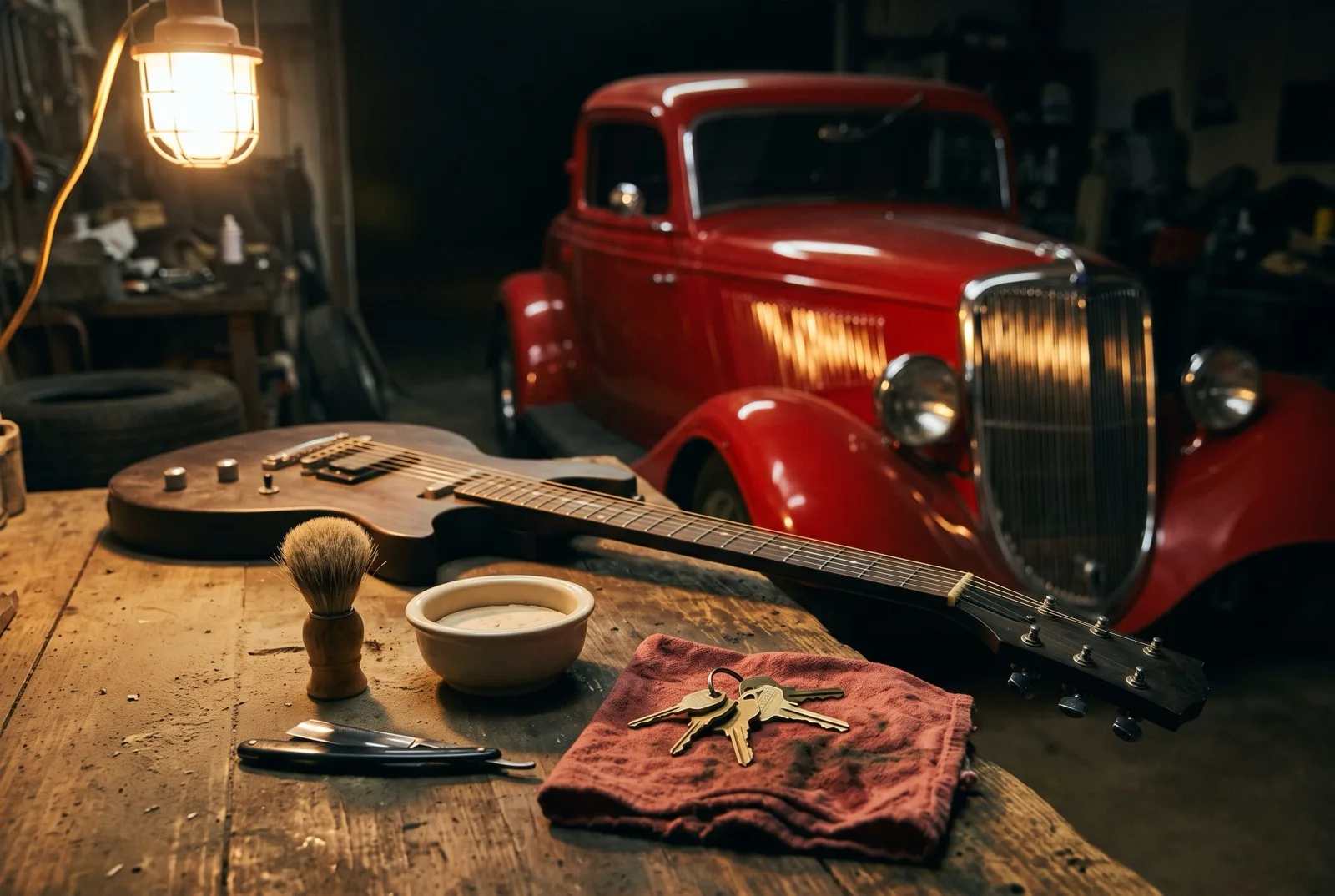
Ilustración: Rebobinados
Three guys, two enormous beards, dark glasses, hats, and a sound that smells of dusty roads and hot engines. ZZ Top is one of the most recognisable images in rock, but behind the postcard there is something bigger: one of the finest blues-rock bands that ever existed, and an extremely rare case of three people who played together for half a century without changing a single piece. They gave Texas blues rhythm and humour, and when the world changed they were shrewd enough to change with it without ceasing to be themselves.
The little big band from Texas
The story begins in Houston in 1969, though it does not begin with the three everybody knows. The first line-up was Billy Gibbons on guitar, Lanier Greig on bass and organ and Dan Mitchell on drums. Frank Beard arrived a few months later, replacing Mitchell, and at the end of that year Dusty Hill came in on bass. Only then was the trio complete, and once complete it never moved again: more than fifty years with the same people, something that barely exists in rock.
Gibbons came out of The Moving Sidewalks, a psychedelic garage band that in 1968 opened four dates for the Jimi Hendrix Experience. A friendship came out of that tour: Hendrix taught him things and gave him a pink Stratocaster, which Gibbons kept. The anecdote is often told another way — that Hendrix declared on television that Gibbons was the best young guitarist in the United States — but that interview turns up nowhere and the same story circulates attached to half a dozen different guitarists. What can be verified is more modest and more touching: they played together four nights and the greater man gave him a guitar.
Their music was blues-rock with swing, what the Americans call boogie: greasy guitars, a groove to move your body, and an unmistakably Southern sound of roadhouses and sticky heat. "La Grange", from 1973, and "Tush", from 1975, showed a band that played the blues with a cheek all its own. They were not solemn about the genre; they made it fun, dirty, pleasure-seeking.
The razor they never used
And there was the detail everyone remembers: those giant beards of Gibbons and Hill, grown down to their chests. The irony always repeated — that the only clean-shaven one was the drummer, whose surname means "beard" — is funnier than it is accurate. Frank Beard wore a moustache for almost all of his career, and had a beard until the late seventies. He shaved it off, he said, after coming back from a break and seeing what the other two had grown: "I had a beard, but it wasn't even close to theirs. So I shaved." He said that thanks to that he could go to the supermarket without being recognised.
Those beards ended up having a price. Gibbons has said more than once that in the eighties Gillette offered each of them a million dollars to shave them off in a commercial, and that they said no. It is worth telling it the way he does: the company denies the offer ever existed. True or not, the answer is the same, and that is why the story survives: the beards were no longer a hairstyle, they were part of who they were.
Eliminator: the blues enters the MTV era
The global leap came in 1983 with Eliminator. There they did something brilliant: they took the blues-rock they had always played and dressed it in synthesisers and a drum machine, without losing the soul. "Gimme All Your Lovin'", "Sharp Dressed Man" and "Legs" became worldwide hits and, above all, videos that the newborn MTV played over and over.
Those videos built an entire universe: a 1933 Ford three-window coupé, red and gleaming — the "Eliminator" of the title, built to Gibbons's order — the spinning guitars covered in fur, the three bearded men turning up like fairy godfathers to turn some young loser into a heart-throb. It was funny, sexy and catchy all at once. ZZ Top pulled off something very hard: being a veteran blues band and, at the same time, one of the most watched acts of the MTV era.
Five decades and two farewells
The most astonishing thing about ZZ Top is the constancy. For more than fifty years they were the same three, no replacements, no public fights, no parallel line-ups. That brotherhood was their real secret, and in 2004 it took them into the Rock and Roll Hall of Fame, where Keith Richards inducted them.
The end of that era came in two blows. On 28 July 2021 Dusty Hill died, aged 72, and the band carried on with Elwood Francis on bass, their lifelong guitar tech, fulfilling a wish Hill himself had left on record. And on 17 August 2026 Frank Beard died, aged 77, on his ranch in Texas with his family around him. That closed more than five decades of one of the most loyal partnerships in rock, and left Billy Gibbons as the only original member still standing.
What to remember
ZZ Top taught the world that the blues does not have to be sad or solemn: it can be funny, sexy and make you dance without stopping. Three Texans with impossible beards took the deepest music of their land and turned it into a party, and when music television arrived they were shrewd enough to reinvent themselves without ceasing to be themselves.
What remains, besides a handful of unbeatable anthems, is a lesson about permanence. Almost every band breaks; this one did not. When the riff of "Sharp Dressed Man" kicks in and the beards appear, along with the red car and the spinning guitars, there is the best of rock: proof that you can be deep and have a good time at once, and that sometimes the secret is simply not letting go.
Sources
ZZ Top is an American blues-rock band formed in Houston, Texas, in 1969. Its first line-up was Billy Gibbons (guitar and vocals), Lanier Greig (bass and organ) and Dan Mitchell (drums); Frank Beard replaced Mitchell a few months later and Dusty Hill joined at the end of 1969, completing the trio that stayed unchanged for more than fifty years. Before ZZ Top, Gibbons led The Moving Sidewalks, a band that in 1968 opened four dates for the Jimi Hendrix Experience; the Stratocaster Hendrix gave him dates from that relationship. The version according to which Hendrix publicly declared Gibbons the best young guitarist in the United States has no traceable interview, recording or transcript, and also circulates attributed to other guitarists. Their seventies classics include "La Grange" (1973) and "Tush" (1975). Frank Beard wore a moustache for most of his career and had a beard until the late seventies; he was the only one of the three without the long beard. Billy Gibbons has said in various interviews that in the eighties Gillette offered each member a million dollars to shave in a commercial, an offer they turned down and whose existence the company denies. The album "Eliminator" (1983) brought in synthesisers and a drum machine and included "Gimme All Your Lovin'", "Sharp Dressed Man" and "Legs"; the car in their videos is a 1933 Ford three-window coupé commissioned by Gibbons. The band was inducted into the Rock and Roll Hall of Fame in 2004, presented by Keith Richards. Dusty Hill died on 28 July 2021, aged 72, and was replaced by guitar tech Elwood Francis at Hill's express wish. Frank Beard died on 17 August 2026, aged 77, on his ranch in Richmond, Texas; no cause of death was released. Billy Gibbons is the only surviving original member. Profile compiled for Rebobinados with fact-checking; interpretations of the meaning of the work are offered as the author's reading. No song lyrics are reproduced, for copyright reasons. Information drawn from Rolling Stone, Deadline, Guitar Player, Wikipedia and other coverage.
Keep rewinding
50s
blues rock
Jerry Lee Lewis
He married his bass player's daughter
He married on 12 December 1957 in Hernando, Mississippi, Myra Gale Brown, aged 13, the daughter of J.W. Brown, his first cousin and bass player; he was 22 and still married to another woman, and the ceremony had to be repeated on 4 June 1958. The scandal did not break then, but on 22 May 1958 at Heathrow. And his two anthems are not his: "Great Balls of Fire" is credited to Otis Blackwell and Jack Hammer, and "Whole Lotta Shakin' Goin' On" was recorded first by Big Maybelle in 1955.
90s
blues rock
Gary Moore
A German court took his blues away
On 3 December 2008 a Munich court ruled that the solo in "Still Got the Blues" was too close to "Nordrach", a 1974 track by the German group Jud's Gallery. The 1990 album had been his rebirth: no. 13 in the United Kingdom, no. 83 on the Billboard 200 and the only single of his entire career on the Hot 100. Before that he had joined and left Thin Lizzy three times and walked off the tour in Oakland, on 4 July 1979.
70s
blues rock
Keith Richards
The sentence was to play for the blind
The Royal Canadian Mounted Police found 22 grams of heroin in his Toronto suite on 27 February 1977, on a trafficking charge that carried exposure to a life sentence. On 24 October 1978 Judge Lloyd Graburn kept him out of prison with an extraordinary condition: a benefit concert for the Canadian National Institute for the Blind. He complied on 22 April 1979 in Oshawa, with two shows that some 1,400 blind people got into free.
Rewind with us
Comments · 0
No one has commented yet. Open the conversation.