
Decade 70s · Rhythm blues rock
Keith Richards
The sentence was to play for the blind
By Rebobinados · Published on October 7, 2026
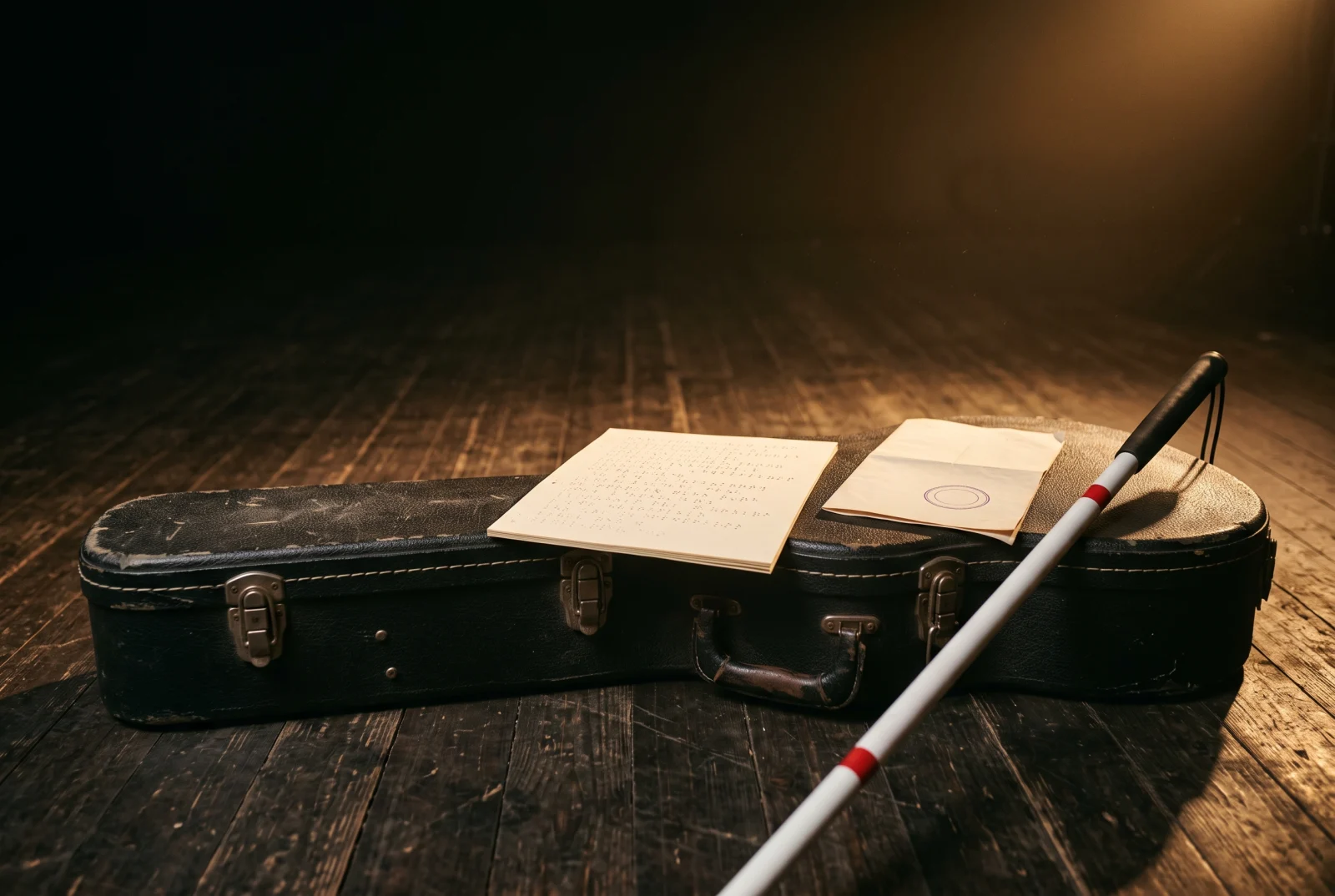
Ilustración: Rebobinados
In October 1978, a York County judge told Keith Richards he would not be going to prison. He had been arrested with twenty-two grams of heroin in a Toronto hotel suite, on a charge that in Canada theoretically carried a life sentence, and the sentence was a one-year suspended sentence, a year of probation, compulsory treatment and one more thing: two free concerts for the Canadian National Institute for the Blind. He played them on the twenty-second of April 1979 in Oshawa, east of Toronto. It is probably the strangest sentence a court has ever written about a rock guitarist, it is the episode that came close to finishing off the Rolling Stones, and it is almost never told with the paperwork in view.
Platform two at Dartford
Before all of that there is a platform. Richards and Mick Jagger knew each other as children, around 1951, from the Wentworth Primary School in Dartford, Kent, and they lived a street apart, but they had lost track of each other. The reunion that matters was on the seventeenth of October 1961 on platform two of Dartford railway station, the London-bound one: Jagger was eighteen and on his way to the London School of Economics, Richards seventeen and on his way to Sidcup Art College, and under his arm Jagger was carrying two imported records on the Chess label, Rockin' at the Hops by Chuck Berry and The Best of Muddy Waters. There has been a blue plaque on the platform since February 2015 saying exactly that. What should not be added to it is the causality that usually comes attached: the band's name did not come out of those records but out of a phone call Brian Jones made to the magazine Jazz News in 1962, in which he improvised a name out of Muddy Waters' "Rollin' Stone".
The Rolling Stones' first concert was on the twelfth of July 1962 at the Marquee Club on Oxford Street, London, standing in for Alexis Korner's Blues Incorporated: Jagger on vocals, Richards and Brian Jones —billed that night as "Elmo Lewis"— on guitars, Dick Taylor on bass and Ian Stewart on piano. Who played the drums that night is still in dispute. Charlie Watts came in in January 1963. From that first concert to today it is sixty-four years with the same guitar beside the same singer, and it is worth saying the number instead of "more than sixty". A minor and revealing detail of the era: his manager, Andrew Loog Oldham, took the "s" off his surname because "Richards" sounded too formal to him for a pop rebel, and for two decades the records credited him as "Keith Richard". The last one to do so is the live album Love You Live, from 1977; he got the "s" back from Some Girls, in 1978.
The sixth string, removed
What makes him recognizable in two seconds is not a solo: it is a setup. He tunes to open G —G, D, G, B, D— and removes the sixth string, the low E, altogether, because he found it muddy. He does not detune it: he takes it off, and plays with five. The first released track with that setup is "Honky Tonk Women", from 1969. It is best not to confuse it with the other famous trick of those years: "Street Fighting Man", from 1968, is an acoustic Gibson Hummingbird recorded through an overloaded Philips cassette recorder, and in standard tuning. They are two different things and they get mixed up all the time.
Who he learned the tuning from is thornier than it is usually told. Ry Cooder played on the Let It Bleed sessions, in 1969, and it is to him that the most repeated version attributes having shown him the open G approach; Cooder, years later, in Rolling Stone, complained that his contribution to the record went uncredited and said that "Honky Tonk Women" is taken from one of his licks. His credits on the record are the mandolin on "Love in Vain" and the slide on "Sister Morphine". Richards, in Life, tells it otherwise: that the tuning was shown to him by Don Everly, of the Everly Brothers, and that Everly had learned it from Bo Diddley. They are two accounts held up by different witnesses, neither of them was ever settled, and the song's credit never moved.
Three riffs with the credit in dispute
Something similar happens with "(I Can't Get No) Satisfaction", although the cassette anecdote is true. Richards woke up in the night in May 1965, grabbed a Philips cassette recorder, played the riff, mumbled the title phrase once and went back to sleep; the tape kept running and some forty-five minutes of snoring were left on it. Where that night happened is another story: the version the press repeats places it in a motel in Clearwater, Florida, during the tour of that state, and Richards, in Life, places it in his flat on Carlton Hill, in St John's Wood, London. Both versions come from him. The detail almost nobody tells is the other one: he wanted that riff to be played by horns, Stax style, and the Gibson Maestro Fuzz-Tone pedal was only a sketch of what the brass would do. The rest of the band and Andrew Loog Oldham refused to replace it, and the sketch was the single. Richards never said he hated it; he said he considered it unfinished.
And "Jumpin' Jack Flash", which every riff list attributes to him without further ado, has an authorship claim against it that has to be stated. Bill Wyman, the bassist, recounted in his autobiography Stone Alone, from 1990, that he came up with that riff on an organ, at Olympic Studios in London, with Brian Jones and Charlie Watts present and before Jagger and Richards arrived, and that the credit for one of the band's best songs ended up reading Jagger-Richards all the same. There is no response from either of them on the record to that specific claim, and the credit remains identical in every official edition. The song was recorded on the twentieth of April 1968 and came out as a single on the twenty-fourth of May in the United Kingdom, where it reached number one. The title is indeed his: it came from the gardener at his country house, Jack Dyer, whose footsteps woke them one morning.
Honesty in the other direction counts too. The hook of "Paint It Black" is Brian Jones' sitar, which never received a composition credit. "Sympathy for the Devil" is above all a Jagger song, born in a folk key, before Richards and Watts pushed it towards samba rock. Mick Taylor, the band's guitarist between 1969 and 1974, claimed uncredited co-authorship of "Sway", "Moonlight Mile", "Winter", "Time Waits for No One", "Till the Next Goodbye" and "Shine a Light", and said in Mojo that without his contribution those songs would not have existed; it is cited as one of the reasons for his departure, and no credit was changed there either. "Start Me Up" is indeed his in origin: a reggae lick that had been going around since the Black and Blue sessions, in 1976, and that ended up on Tattoo You.
Glimmer Twins was the production credit
Here two things that are almost always told as one have to be separated. "Glimmer Twins" is not the Rolling Stones' songwriting signature. The signature is, and always was, Jagger/Richards. "The Glimmer Twins" is a production alias, and it appears for the first time on It's Only Rock 'n Roll, released on the eighteenth of October 1974, the first record the Stones produced themselves. They are two different trades on two different lines of the back cover, and merging them erases precisely the moment when those two took control of the sound of their own band.
The nickname was born on a boat to Rio de Janeiro, on a trip with Marianne Faithfull and Anita Pallenberg aboard, when a couple of upper-class English passengers would not stop pressing them to say who they were and the woman kept asking them to give her at least a glimmer, just give us a glimmer. Jagger told Richards they were the Glimmer Twins and the name stuck. Neither the exact year of the trip nor the name of the boat is documented: it is oral history, told by them. The hard date is the other one, the one on the 1974 back cover.
Toronto, and a sentence without prison
The court papers are three and they are dated. On the twelfth of February 1967, on a tip-off from the News of the World, Detective Sergeant Norman Pilcher led a raid of eighteen officers on Redlands, Richards' house in West Wittering, Sussex. Jagger was charged with illegal possession of amphetamines without a prescription; Richards, with allowing his property to be used for smoking cannabis. The trial ran from the twenty-seventh to the twenty-ninth of June 1967 before Judge Leslie Block: Jagger, one hundred pounds in fines and three months in prison; Richards, five hundred pounds and a year. On the first of July, William Rees-Mogg published in The Times the editorial "Who Breaks a Butterfly on a Wheel?" against the disproportion of the punishment, and on appeal Jagger's was commuted to a conditional discharge and Richards' conviction was quashed entirely. On the twenty-sixth of June 1973 came the second: a raid on his house on Cheyne Walk, in Chelsea, where besides drugs there was a thirty-eight calibre Smith & Wesson revolver, a shotgun and one hundred and ten rounds of ammunition. Twenty-five charges, and on the twenty-fourth of October that year the Marlborough Street court resolved it with two hundred and five pounds in fines and conditional discharges on the rest.
The third was in Toronto. On the twenty-seventh of February 1977, while the Stones were in the city, the Royal Canadian Mounted Police searched his suite at the Harbour Castle Hotel and found some twenty-two grams of heroin at thirty-two per cent purity and five grams of cocaine. The charge was not simple possession: it was possession of heroin for the purpose of trafficking, which in Canada theoretically carried a life sentence. He got out on twenty-five thousand dollars bail. A week later, on the fourth and the fifth of March, the band played two secret concerts at Toronto's El Mocambo club billed as "The Cockroaches", and it is best not to confuse them with the concert the judge would later order: that was two years later and in another city.
The sentence came on the twenty-fourth of October 1978. Richards pleaded guilty to a reduced charge of simple possession of heroin —the trafficking charge and the cocaine charge were withdrawn— and York County Judge Lloyd Graburn gave him a one-year suspended sentence and a year of probation, reasoning that neither imprisonment nor a fine would be appropriate given the treatment under way for his addiction and his long-term benefit to the community. The conditions were three: to continue that treatment at the Stevens Psychiatric Center in New York, to report to a probation officer in Toronto and to give a benefit concert for the Canadian National Institute for the Blind within six months. Several accounts attribute the clemency to the intervention of Rita Bedard, a twenty-four-year-old fan from Montreal, legally blind, who had followed the tour and asked the court not to jail him; Richards called her his "blind angel". That is an account and not a sentence: how much she weighed against the judge's own initiative changes depending on who tells it.
The leniency of the punishment set off a public scandal. The Attorney General of Ontario, Roy McMurtry, received hundreds of letters of complaint; the federal Minister of Justice, Otto Lang, ordered the sentence to be challenged, and federal prosecutor John Scollin obtained until the thirty-first of May 1979 to appeal. The concerts took place before that deadline: on the twenty-second of April 1979, two shows the same day at the Oshawa Civic Auditorium, with a capacity of some five thousand two hundred people, on a double bill. First The New Barbarians —Richards with Ronnie Wood, Stanley Clarke, Ian McLagan, Ziggy Modeliste and Bobby Keys, introduced by John Belushi— and then the Rolling Stones. Some one thousand four hundred blind people and their companions got in free.
About the rest it is worth being exact, because exactness is the opposite of legend. Richards has said that he quit heroin between 1977 and 1978, starting from the treatment that the Toronto arrest made compulsory. The story that he had all of his blood changed at a Swiss clinic to clean himself out is false, and it is false because he invented it: he told it in order to stop answering the same question over and over and afterwards explained that he was joking. The eternal joke that he would survive a nuclear catastrophe alongside the cockroaches is of the same family, a caricature he fed himself, and it covers up what is really in the file: three court dates, a charge that led to a life sentence and a thirty-five-year-old man playing for free for one thousand four hundred blind people because a judge ordered him to.
What to remember
Keith Richards is the author of a way of playing rhythm guitar that is recognized in two seconds and that nobody copies quite right: open G, five strings, few notes in exactly the right place. Out of that tuning came "Honky Tonk Women" and, by another route, "Start Me Up"; out of a cassette recorder, "Satisfaction". It is also true that two of the riffs attributed to him have a claim against them, that "Glimmer Twins" named the producers and not the songwriters, and that the songbook's signature was always Jagger/Richards. None of that takes anything away from the work; it takes away the retouching.
The rest is work and paperwork. Talk Is Cheap, in 1988, reached number twenty-four on the Billboard 200; Main Offender, in 1992, number ninety-nine; Crosseyed Heart, in 2015, number eleven, his best placing as a solo artist, and that one is not credited to the X-Pensive Winos even though the Winos play on it. Life, the autobiography he wrote with the journalist James Fox, came out on the twenty-sixth of October 2010 and was number one on The New York Times list within a week. Charlie Watts died on the twenty-fourth of August 2021, aged eighty, in a London hospital, and managed to record the drums on two tracks of Hackney Diamonds: "Mess It Up" and "Live by the Sword", on the second one with Bill Wyman on bass, so that the band's original rhythm section was put on record one last time. The album came out on the twentieth of October 2023, reached number three on the Billboard 200 and number one in the United Kingdom, with Paul McCartney, Stevie Wonder, Elton John and Lady Gaga as guests.
When that five-string strum sounds and a stadium recognizes it before the first bar, that is where what he did lies. And when someone tells the legend of the indestructible pirate, it is worth keeping to hand the date of the twenty-second of April 1979, which is the date of a man serving a sentence with a guitar slung on. If you or someone you know is facing problem drug or alcohol use, in Chile you can call the SENDA Fono Drogas y Alcohol free of charge and in confidence on 1412, twenty-four hours a day.
Sources
Keith Richards was born on 18 December 1943 in Dartford, Kent, England, the only child of Herbert William Richards and Doris Maud Lydia Richards (née Dupree). He met Mick Jagger again on 17 October 1961 on platform 2 of Dartford railway station, an episode marked by a blue plaque unveiled in February 2015; Jagger was carrying "Rockin' at the Hops" by Chuck Berry and "The Best of Muddy Waters", both on the Chess label. The band's name was supplied by Brian Jones, from Muddy Waters' "Rollin' Stone", in a call to the magazine "Jazz News" in 1962. The Rolling Stones' first concert was on 12 July 1962 at the Marquee Club in London, with Jagger (vocals), Richards and Brian Jones, billed as "Elmo Lewis" (guitars), Dick Taylor (bass) and Ian Stewart (piano); the drummer that night is in dispute. Charlie Watts joined in January 1963. Andrew Loog Oldham credited him as "Keith Richard" from the 1960s onwards; the last record with that spelling is the live album "Love You Live" (1977) and he recovered the "s" from "Some Girls" (1978). His signature tuning is five-string open G (G-D-G-B-D), with the sixth string removed; the first released track with it is "Honky Tonk Women" (1969). "Street Fighting Man" (1968) was recorded with an acoustic Gibson Hummingbird through an overloaded Philips cassette recorder, in standard tuning. Ry Cooder took part in the "Let It Bleed" sessions (1969) —credited on mandolin on "Love in Vain" and slide on "Sister Morphine"— and claimed in "Rolling Stone" that the lick of "Honky Tonk Women" was his; Richards, in "Life", attributes the tuning to Don Everly and, through him, to Bo Diddley. The credit was never modified. The riff of "(I Can't Get No) Satisfaction" was recorded on a Philips cassette recorder in May 1965; there are two versions of the place, both attributed to Richards: a motel in Clearwater, Florida (the Jack Tar Harrison Hotel, today the Fort Harrison), and his flat on Carlton Hill, St John's Wood, London. It was recorded at Chess (Chicago) on 10 May and at RCA (Hollywood) on 12 May 1965; Richards was after a Stax-style horn line and used the Gibson Maestro FZ-1 Fuzz-Tone pedal as a sketch. "Jumpin' Jack Flash" was recorded on 20 April 1968 at Olympic Studios, London, and released as a single on 24 May 1968 in the United Kingdom (Decca) and on 31 May in the United States (London Records): no. 1 on UK Singles and no. 3 on the Billboard Hot 100. Bill Wyman maintains in his autobiography "Stone Alone" (1990) that the riff is his, worked out on an organ with Brian Jones and Charlie Watts before Jagger and Richards arrived; the official credit remains Jagger-Richards. The title comes from Jack Dyer, Richards' gardener. The hook of "Paint It Black" is Brian Jones' sitar, with no composition credit. Mick Taylor, a member between 1969 and 1974, claimed in "Mojo" (1997) uncredited co-authorship of "Sway", "Moonlight Mile", "Winter", "Time Waits for No One", "Till the Next Goodbye" and "Shine a Light"; the credits were not modified. "Start Me Up" began as a reggae lick in the "Black and Blue" sessions (1976) and was released on "Tattoo You" (1981). "The Glimmer Twins" is a production alias, not a songwriting one: its first use is "It's Only Rock 'n Roll", 18 October 1974, the first album self-produced by Jagger and Richards; the songwriting signature is Jagger/Richards. The nickname arose on a boat trip to Rio de Janeiro with Marianne Faithfull and Anita Pallenberg, with no documented year or vessel. Redlands raid (West Wittering, Sussex): 12 February 1967, led by Detective Sergeant Norman Pilcher with 18 officers, after a tip-off from the "News of the World"; trial at the West Sussex Quarter Sessions from 27 to 29 June 1967 before Judge Leslie Block, with a 100-pound fine and 3 months in prison for Jagger and 500 pounds and 1 year for Richards. William Rees-Mogg's editorial "Who Breaks a Butterfly on a Wheel?" was published in "The Times" on 1 July 1967; on appeal, Jagger's sentence was commuted to a conditional discharge and Richards' conviction was quashed. Cheyne Walk raid, Chelsea: 26 June 1973, with Anita Pallenberg; cannabis resin, heroin, Mandrax pills, a Smith & Wesson .38 revolver, a shotgun and 110 rounds of ammunition were seized. Richards faced 25 charges and the Marlborough Street Magistrates' Court resolved the matter on 24 October 1973 with a 205-pound fine and conditional discharges. Toronto arrest: 27 February 1977, RCMP search of his suite at the Harbour Castle Hotel, with some 22 grams of heroin at 32% purity and 5 grams of cocaine; charge of possession of heroin for the purpose of trafficking, with theoretical exposure to a life sentence, and bail of 25,000 dollars. On 4 and 5 March 1977 the band played two secret concerts at El Mocambo in Toronto under the name "The Cockroaches", released much later as "El Mocambo 1977". Sentence of 24 October 1978: guilty plea to a reduced charge of simple possession —the trafficking and cocaine charges withdrawn—, with a 1-year suspended sentence and 1 year of probation handed down by York County Judge Lloyd Graburn, plus treatment at the Stevens Psychiatric Center in New York, reporting to a probation officer in Toronto and a benefit concert for the Canadian National Institute for the Blind within 6 months. The clemency is linked in several accounts to the intervention of Rita Bedard, a 24-year-old fan from Montreal, legally blind; her causal weight against the judge's initiative varies according to the source. The Attorney General of Ontario, Roy McMurtry, received hundreds of letters of complaint; the federal Minister of Justice, Otto Lang, ordered the sentence to be challenged and federal prosecutor John Scollin obtained until 31 May 1979 to appeal. The two benefit concerts were held on 22 April 1979 at the Oshawa Civic Auditorium (approximate capacity of 5,200 people), on a double bill with The New Barbarians —Richards, Ronnie Wood, Stanley Clarke, Ian McLagan, Ziggy Modeliste and Bobby Keys, introduced by John Belushi— and The Rolling Stones; some 1,400 blind people and companions got in free. Richards has stated that he quit heroin between 1977 and 1978. The story of a complete blood transfusion in Switzerland is an invention of his own, which he himself denied. Solo discography: "Talk Is Cheap" (1988, Virgin, no. 24 on the Billboard 200), "Main Offender" (1992, Virgin, no. 99) and "Crosseyed Heart" (2015, Republic/Mindless, no. 11), the last of these credited to Keith Richards and not to the X-Pensive Winos. His autobiography "Life", written with the journalist James Fox, was published on 26 October 2010 (Weidenfeld & Nicolson in the United Kingdom, Little, Brown and Company in the United States) and reached no. 1 on "The New York Times" list within a week. Charlie Watts died on 24 August 2021, aged 80, in a London hospital; the statement did not report a cause of death. Watts recorded the drums on "Mess It Up" and "Live by the Sword" for "Hackney Diamonds", released on 20 October 2023 by Polydor with production by Andrew Watt: no. 3 on the Billboard 200 with 101,000 equivalent units (94,000 in pure sales) and no. 1 on UK Albums. On "Live by the Sword" Bill Wyman plays bass, in his first recording with the band in some 30 years. The album's guests include Paul McCartney, Stevie Wonder, Elton John and Lady Gaga. Steve Jordan plays the drums on the rest of the record. "Hackney Diamonds" was the band's first album of original material in 18 years, since "A Bigger Bang" (2005). From the first concert in 1962 to October 2026 is 64 years of career. Profile compiled for Rebobinados with fact-checking; interpretations of the meaning of the work are offered as the author's reading. No song lyrics are reproduced, for copyright reasons. Information drawn from Wikipedia, Rolling Stone, Billboard, Official Charts, Music Week, Ultimate Classic Rock, CBC Archives, PopMatters, American Songwriter, uDiscoverMusic, MusicRadar, Snopes, Kent Online, Uncut, Discogs and other press coverage.
Keep rewinding
50s
blues rock
Jerry Lee Lewis
He married his bass player's daughter
He married on 12 December 1957 in Hernando, Mississippi, Myra Gale Brown, aged 13, the daughter of J.W. Brown, his first cousin and bass player; he was 22 and still married to another woman, and the ceremony had to be repeated on 4 June 1958. The scandal did not break then, but on 22 May 1958 at Heathrow. And his two anthems are not his: "Great Balls of Fire" is credited to Otis Blackwell and Jack Hammer, and "Whole Lotta Shakin' Goin' On" was recorded first by Big Maybelle in 1955.
90s
blues rock
Gary Moore
A German court took his blues away
On 3 December 2008 a Munich court ruled that the solo in "Still Got the Blues" was too close to "Nordrach", a 1974 track by the German group Jud's Gallery. The 1990 album had been his rebirth: no. 13 in the United Kingdom, no. 83 on the Billboard 200 and the only single of his entire career on the Hot 100. Before that he had joined and left Thin Lizzy three times and walked off the tour in Oakland, on 4 July 1979.
70s
blues rock
ZZ Top
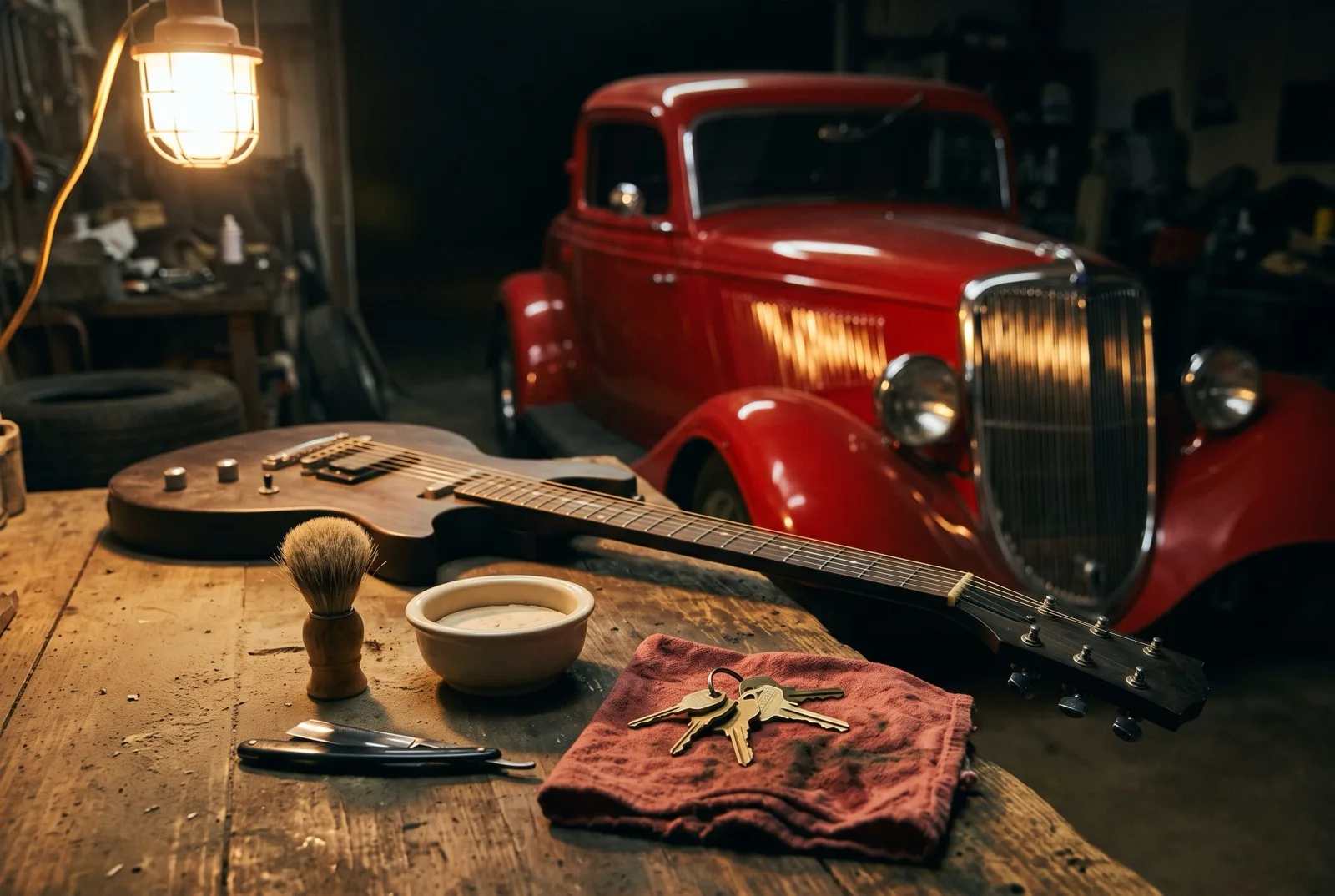
The razor they never used
Gillette offered them a million dollars each to shave their beards for a commercial, and they said no. Half a century with the same line-up, a red 1933 hot rod, and the Hendrix anecdote everyone repeats that never happened.
Rewind with us
Comments · 0
No one has commented yet. Open the conversation.