
Paul McCartney
The lawsuit nobody understood
By Rebobinados · Published on September 9, 2026
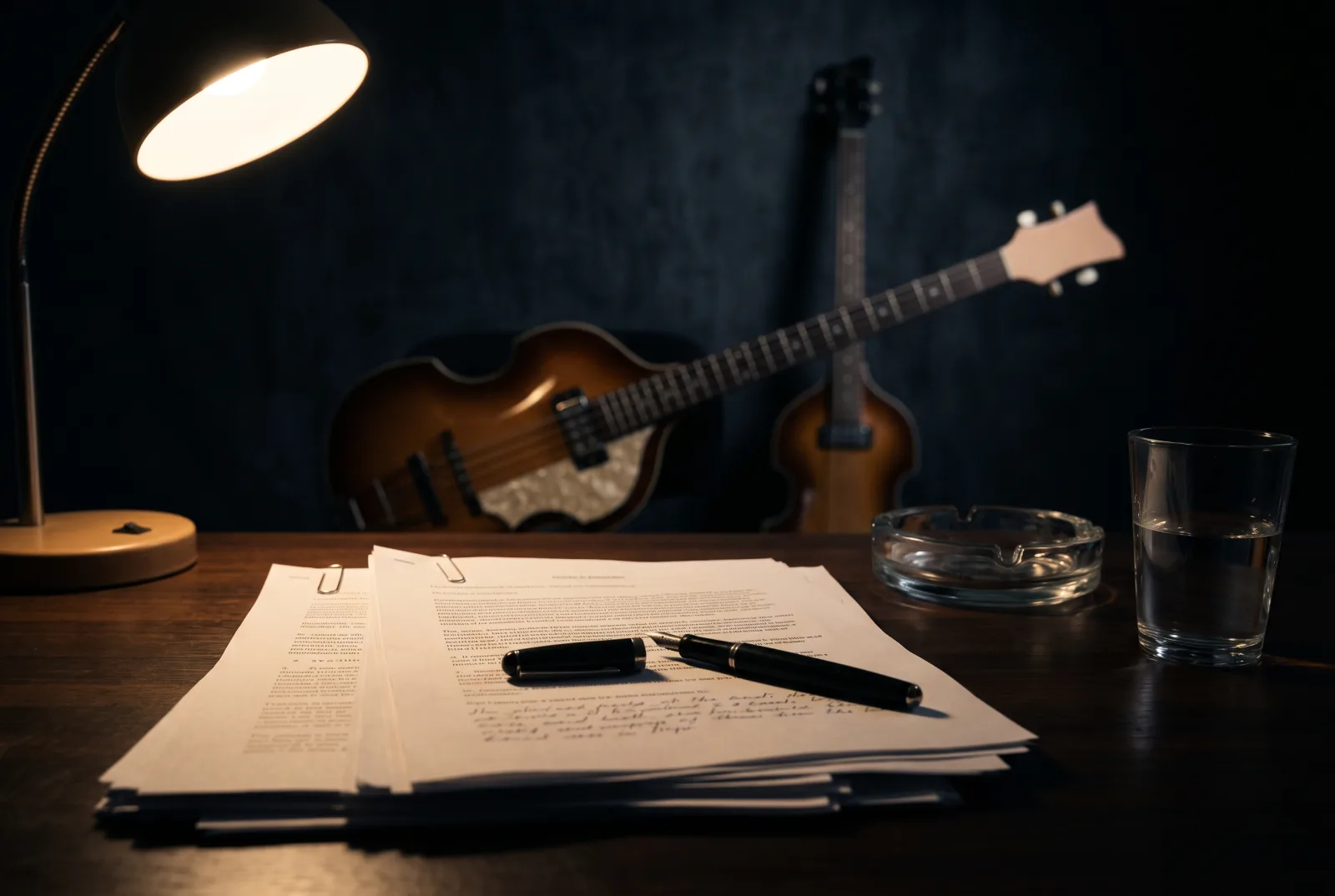
Ilustración: Rebobinados
On 31 December 1970, Paul McCartney sued his three best friends.
For half a century that date was told as the day a man took to court the band he had helped build. The villain of the break-up.
It was not that. It was almost the opposite, and it is hard to explain without the boring detail, which is the one that matters.
What was at stake
The Beatles had not played together for months. What was still alive was the legal partnership that administered everything they had recorded.
John Lennon, George Harrison and Ringo Starr had put their affairs in the hands of Allen Klein. McCartney did not want Klein anywhere near them, and as a minority partner he had no way of stopping it.
There was only one: to ask a court to dissolve the partnership and appoint someone to hold the money while it was decided.
That is what he did. He won, and the court appointed a receiver in March 1971.
Years later, when Klein's relationship with the band ended in lawsuits and in a conviction over another matter, the other three admitted McCartney had been right. Lennon said it with his usual dryness: let us say Paul's suspicions turned out to be correct.
He sued to get the catalogue out of hands he did not want to leave it in. Not to break anything: what was broken was already broken.
The most stubborn myth
There is something else repeated even more often that is flatly false: that Lennon and McCartney never made up, and that Paul is haunted by that friendship left half finished.
They made up in 1974.
McCartney went to see him in Los Angeles and on 28 March of that year the two of them walked into a Burbank studio together, with Stevie Wonder and Harry Nilsson, and played. It is on tape. It is the only time Lennon and McCartney played together again after the Beatles.
From then on they saw each other normally until 1980. McCartney has told it many times: he would go to the Dakota building, they would sit watching television, Lennon had Sean in his arms, they talked about baking bread.
The last phone conversation was friendly and silly, the kind you do not know is the last one.
That Lennon was murdered in December 1980 is a complete tragedy on its own. It does not need us to add a grudge that did not exist. McCartney has spent decades denying it and the myth will not die.
The melody he thought he had stolen
What is true is the gift.
The melody of "Yesterday" came to him in his sleep, in the Wimpole Street house where he was living at the time. He woke up, sat at the piano and played it right through.
And then he spent weeks playing it to everybody to ask whose it was. He could not believe something like that had come to him out of nothing, and he was convinced he had heard it somewhere and was copying it without realising.
In the meantime he sang it with a stand-in lyric about scrambled eggs, so as not to forget where each syllable fell.
It was nobody's. It ended up as the most covered song in the history of popular music.
A condition he did not set
In 1973 he was asked for a song for a James Bond film, and out came "Live and Let Die", written with Linda.
The story is usually told by saying Paul demanded to record it with his band. It was not like that.
The producer of the saga took it for granted that McCartney would write the theme and somebody else would sing it, as was always done. The man who dug his heels in was George Martin, the Beatles' producer, who was arranging the song: either the Wings version came out, or there was no song.
The Wings version came out. It was the first James Bond theme nominated for an Oscar.
Linda
They married in 1969 and were together for twenty-nine years.
Linda played keyboards in Wings without being a brilliant instrumentalist, and she was reminded of it mercilessly for years. He never cared: he wanted her on stage because he wanted her beside him.
She was diagnosed with breast cancer in 1995 and died in April 1998, at fifty-six.
It is the loss that splits his life in two, and the one he speaks about with a frankness that is surprising in someone so guarded about his own affairs.
What to remember
McCartney is proof that a life can be told wrong for fifty years and go on being told wrong even though the man himself corrects it every time he is asked.
Put on "Yesterday", "Blackbird", "Maybe I'm Amazed" or "Hope of Deliverance", which came out at the end of 1992 and was sung in Latin America more than anywhere else, and you will hear somebody to whom melodies occur the way a sentence occurs to other people.
But when the end of the Beatles is discussed, it is worth being clear about two things. The lawsuit was not against his friends: it was against the man handling what they had made together. And the friendship with Lennon was not left half finished, because they mended it six years before there was no more time.
Remember him like this: the melodist, yes. And also the only one of the four who, at the worst moment, read the papers.
Sources
Paul McCartney, full name James Paul McCartney, born in Liverpool on 18 June 1942. British singer, songwriter and multi-instrumentalist, a member of The Beatles and, together with John Lennon, of the Lennon-McCartney songwriting partnership. On 31 December 1970 he filed a suit in the High Court in London to dissolve the partnership binding the four Beatles and to prevent their assets from falling under the control of the manager Allen Klein; the court ruled in his favour and appointed a receiver in March 1971. The other three members later acknowledged that McCartney had been right about Klein. The claim that Lennon and McCartney never reconciled is false: they met again in 1974, and on 28 March of that year they recorded together at Burbank Studios in Los Angeles, in an informal session with Stevie Wonder and Harry Nilsson — the only documented occasion on which they played together again after the split — and remained on cordial terms until Lennon's murder in December 1980. The melody of "Yesterday" came to him while he was asleep, in the Wimpole Street house where he was living; for weeks he played it to other musicians fearing he had copied it unconsciously, and he sang it with the stand-in lyric "Scrambled Eggs". It is the most covered song in popular music. "Live and Let Die" (1973), written with Linda McCartney for the James Bond film and arranged by George Martin, was released in the Wings version because Martin made his involvement conditional on it, against the production's initial intention of having another artist perform it; it was the first theme in the saga nominated for an Oscar. "Hope of Deliverance", from the album "Off the Ground", was released as a single in December 1992 and had particular impact in Latin America and continental Europe. Paul and Linda McCartney married in 1969 and were animal rights activists; Linda was diagnosed with breast cancer in 1995 and died in April 1998, at the age of 56. John Lennon and George Harrison have profiles of their own in this series. Externally authored text, edited and verified for Rebobinados. Interpretations of the meaning of his work are offered as the author's reading. No song lyrics are reproduced, for copyright reasons. Information drawn from Britannica, Wikipedia, Beatles Bible, Rolling Stone and other coverage.
Keep rewinding

10s
pop
Bruno Mars
Eleven names in the credits
"Uptown Funk" came out on 10 November 2014 with six writers and today it has eleven. In February 2015 The Gap Band's publisher filed a claim over "Oops Up Side Your Head" in YouTube's copyright system —there was never a lawsuit— and on 28 April five names were added, with 17 % of the publishing. It happened weeks after the "Blurred Lines" verdict, and the song had been fourteen weeks at number one.

00s
pop
André Rieu
It was not from the jazz suite
The waltz with which André Rieu reached half the world is not from Shostakovich's Suite for Jazz Orchestra No. 2: it is from the Suite for Variety Orchestra, which the composer did not assemble, and it was born in 1956 as music for a Soviet film about settlers in Kazakhstan. The error comes from a misprint in volume 10 of the complete works (Muzyka, Moscow, 1984), corrected only in 2001. And the title "The Second Waltz" was invented by his wife, because the real one did not sell.

90s
pop
Daniela Mercury
She took the neighbourhood out of the song
"O Canto da Cidade" was written by Tote Gira, a composer from Nordeste de Amaralina who recorded the demo on a borrowed cassette, marking the beat on the door of a refrigerator; Mercury's team almost threw the tape away. She shares the credit because she deleted the references to the Pelourinho so that the song would serve all of Brazil. The album, from 20 September 1992, sold more than 2 million copies and nationalised axé. But she did not invent it: the name was a journalist's insult in 1987.
Rewind with us
Comments · 0
No one has commented yet. Open the conversation.