
Stevie Wonder
He took the wheel
By Rebobinados · Published on September 14, 2026
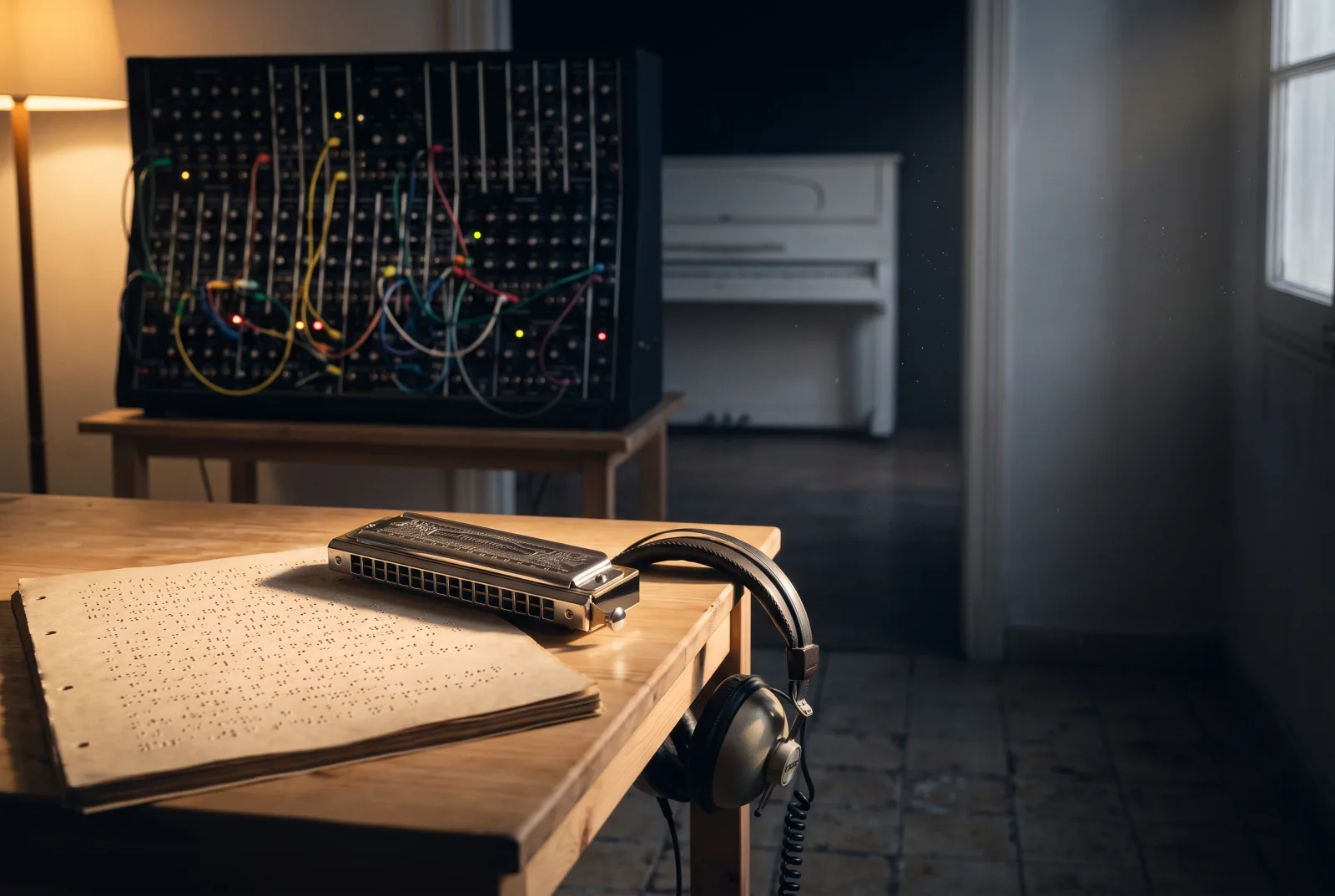
Ilustración: Rebobinados
Stevie Wonder was born six weeks premature, in 1950. In the incubator, the oxygen that kept him alive damaged his eyes for ever, and he was blind within days of being born.
That should not be called a gift: blindness is a hard condition, not a blessing. But something extraordinary came out of it. A boy who at nine was already playing piano, harmonica and drums, and who listened to the world with a depth those of us who can see seldom reach.
He did not "overcome" his blindness as in some feel-good film. He did something subtler: with an ear that became superhuman, he built one of the greatest and most joyful bodies of work in the music of the century.
Little Stevie
He started out as a phenomenon. He signed to Motown at eleven, under the name "Little Stevie Wonder": the wonder was that a child so small could play like that.
At thirteen, "Fingertips", recorded live, went to number one and made him the youngest artist to top the American charts. As a teenager he strung together "Uptight", "I Was Made to Love Her", "My Cherie Amour", and he was already one of the label's best-loved stars.
Twenty-one
What sets him apart from any child prodigy happened at twenty-one.
Most child stars fade away, or the label wrings them dry to the last drop. When his Motown contract expired, on the day he turned twenty-one, Stevie used that moment to demand something almost nobody at the label had ever obtained: total creative control over his music.
And instead of celebrating, he launched what many consider the finest creative run in popular music. Between 1972 and 1976 he released, one after another, "Talking Book", "Innervisions", "Fulfillingness' First Finale" and "Songs in the Key of Life". "Superstition", "Higher Ground", "Sir Duke", "As", "I Wish".
He was a pioneer of the synthesiser. He made records that were pure joy and social conscience at once: he sang about racism, poverty, city life, faith. He won the Grammy for album of the year three times in four years, and the year he did not win, Paul Simon went up to collect it and thanked Stevie Wonder for not putting out a record. He did not merely have the talent: he seized the freedom to use every bit of it.
Three days later
In the middle of that peak, death brushed past him.
On 6 August 1973, three days after "Innervisions" came out, the car he was asleep in crashed into a lorry loaded with logs on a North Carolina road. One of the logs struck him on the head. He was in a coma for four days.
He recovered, lost his sense of smell for a time, was left with a scar on his forehead, and went back on stage. Life missed him by a whisker and he kept on singing.
A song to shame a Congress
There is something that makes him more than an enormous musician, and it has to do with what he did with his fame.
In the early eighties he led the campaign to make Martin Luther King's birthday a national holiday in the United States. He organised marches, lobbied Congress and wrote "Happy Birthday" to show up the politicians who were dragging their feet. In 1983 the law was signed, and that holiday exists, in large part, because a blind musician would not give up.
Think about it for a second: a man who could never see the colour of anyone's skin used his music to make a country honour the man who dreamed of a world beyond colour.
His music, what is more, was banned from the radio in apartheid South Africa after he dedicated an Oscar to Nelson Mandela. And in 1988 he was on the bill at the Wembley concert for Mandela's seventieth birthday, the night a technical failure of his changed another artist's life. His joy was never naive: it had backbone.
The counter-example
Stevie Wonder is alive, past seventy, and still playing.
In a collection full of geniuses devoured by their own myth — Elvis, Lennon, so many others — he is the luminous counter-example. The one who took the wheel of his art and his life instead of letting others drive. The one who turned a loss into a prodigious ear, dodged death, bent a country towards justice, and did it all radiating joy.
If you put on "Sir Duke", or "As", or "Superstition", you are listening to a man who had every reason to be bitter and chose to make the most joyful and generous music of his century. He is neither saint nor martyr. He is something rarer: a genius who stayed whole and used that wholeness to leave the world a little better and a good deal happier.
Turn it up loud.
Sources
Stevie Wonder (born Stevland Hardaway Judkins, later Morris; Saginaw, Michigan, 13 May 1950), American singer, songwriter, producer and multi-instrumentalist. He was born premature; excess oxygen in the incubator caused retinopathy of prematurity and he went blind shortly after birth. He signed to Motown's Tamla label at 11 as "Little Stevie Wonder"; "Fingertips (Pt. 2)", recorded live, reached number one on the Billboard Hot 100 in 1963 and made him the youngest artist to top that chart. When he turned 21 (1971) his contract expired and he negotiated a new one with total creative control, which ushered in his "classic period": "Music of My Mind" (1972), "Talking Book" (1972), "Innervisions" (1973), "Fulfillingness' First Finale" (1974) and "Songs in the Key of Life" (1976). He won the Grammy for album of the year for "Innervisions" (1974), "Fulfillingness' First Finale" (1975) and "Songs in the Key of Life" (1977); at the 1976 ceremony, Paul Simon jokingly thanked Stevie Wonder for not releasing an album that year. "Innervisions" came out on 3 August 1973; on 6 August he was badly injured in an accident in North Carolina, when the car he was travelling in collided with a lorry loaded with logs, and he spent four days in a coma. From 1980 he led the campaign for the Martin Luther King Jr. Day holiday, with the song "Happy Birthday" (1980); the law was signed in 1983 and the holiday was first observed in 1986. In 1985 the South African state broadcaster banned his music after he dedicated his Oscar for best song, for "I Just Called to Say I Love You", to Nelson Mandela. He took part in the concert for Mandela's 70th birthday at Wembley (1988). Externally authored text, edited and verified for Rebobinados. Interpretations of the meaning of his work are offered as the author's reading. No song lyrics are reproduced, for copyright reasons. Information drawn from Britannica, AllMusic, Wikipedia, Ultimate Classic Rock, Parade and other press coverage.
Keep rewinding
00s
soul
Duffy
She told it first
Rockferry (2008) was the best-selling album of the year in the United Kingdom, with 1,685,000 copies, three BRITs in 2009 and the Grammy for Best Pop Vocal Album. In 2020 Duffy told it herself, before anybody else, that she was drugged, held captive and raped. And it is not an epilogue: a new song in 2024, a Disney+ documentary announced in 2025 and a signing with TaP Management in 2026.
80s
soul
Hall & Oates
The craft they called a guilty pleasure
Daryl Hall and John Oates put six songs at number one in the United States, and Billboard named them the most successful duo in Hot 100 history — a measure of chart performance, not of records sold. They met in Philadelphia in 1967 and ended up in a Nashville court in 2023, over the sale of the company that held their name and royalties.
90s
soul
Seal
The song that embarrassed him, and the scars he never hid
The song that won the Grammy for record of the year sat in a drawer for years because its author thought it was bad and was embarrassed to show it: it took a producer who believed in it more than he did. With the scars on his face he did the opposite: he never covered them.
Rewind with us
Comments · 0
No one has commented yet. Open the conversation.