
Tracy Chapman
The second time out
By Rebobinados · Published on September 9, 2026
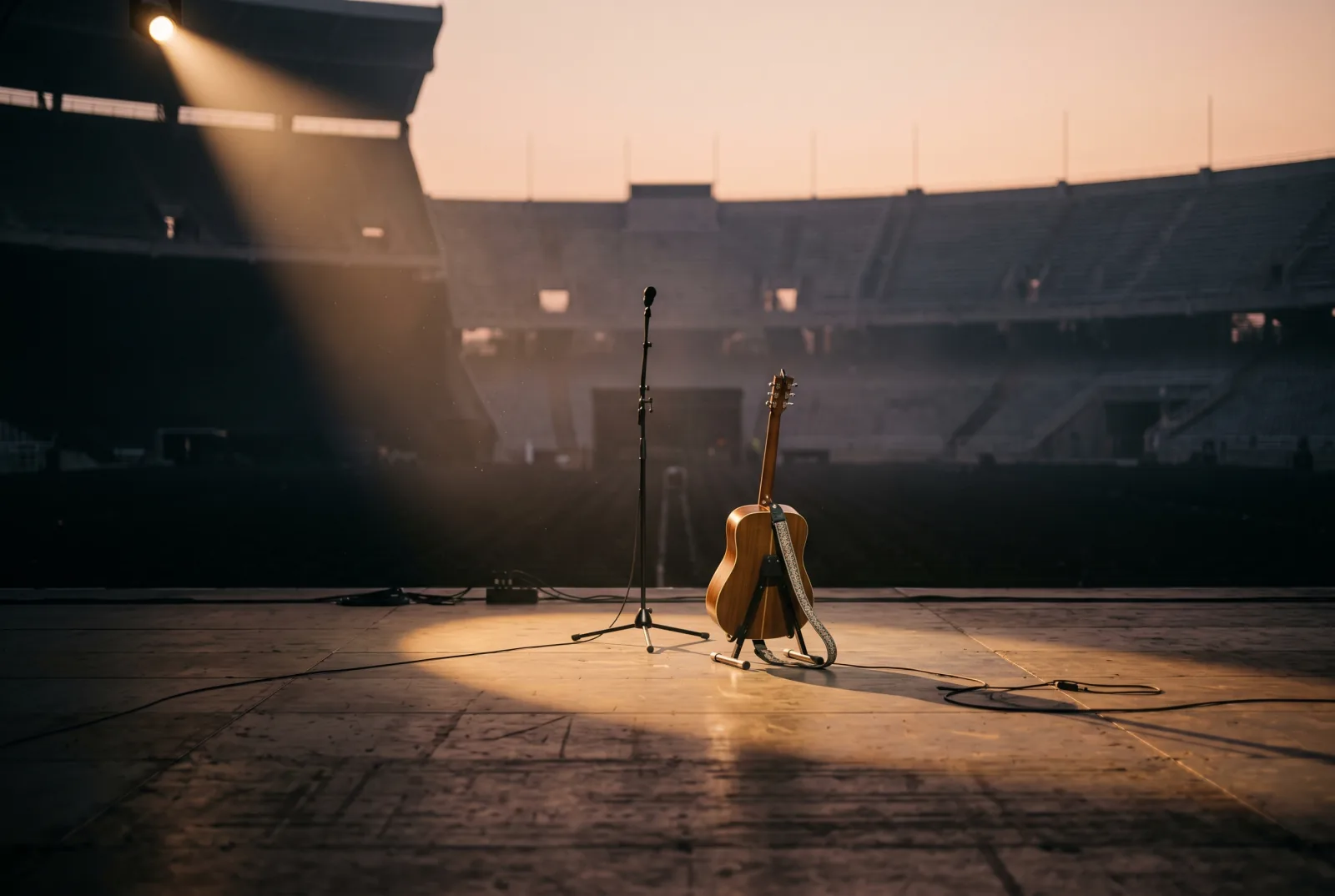
Ilustración: Rebobinados
In June 1988, at Wembley Stadium, a concert was held for Nelson Mandela's seventieth birthday. He had been in prison for twenty-five years and the whole world was demanding his release. It was broadcast to dozens of countries.
Among the performers was an almost unknown singer with a short afternoon set. She played, she left, and that should have been the end of her day.
But Stevie Wonder had technical problems and could not perform. There was a hole to fill and no plan B, so they sent her back out: one woman, an acoustic guitar and nothing else, in front of a full stadium and an enormous television audience.
That second appearance, unplanned, changed her life. The world heard "Fast Car" and "Talkin' Bout a Revolution" and did not let go.
Her name was Tracy Chapman.
The oldest and hardest thing
She was born in Cleveland in 1964, a Black girl from a working-class family who started playing guitar and writing songs very young. She studied anthropology at Tufts University and came to music almost by accident, until a label signed her and released her self-titled first album in 1988.
That record went to number one in the United States and the United Kingdom. It is worth registering how improbable that was: in the middle of an era of teased hair, synthesisers and glossy videos, the best-selling album was by one woman with a guitar.
Because her songs were something else. They brought the oldest and hardest thing: true stories, sung in a low, bare voice, with no tricks.
"Fast Car" is the account of somebody poor who dreams of escaping their life in a fast car, and it is so honest that it became the anthem of anyone who ever wanted to run towards a better life. Workers took it, the marginalised took it, and in particular a great many gay and lesbian listeners who recognised themselves in that promise of flight. "Talkin' Bout a Revolution", "Give Me One Reason": songs about poverty, about anger, about justice, in plain language anyone could follow.
In 1989 she took home three Grammys, one of them for best new artist. She had stopped the world with a guitar and the truth.
And then she stepped away
And there she did the opposite of what everyone does when the world surrenders to them.
Tracy Chapman is famous for her reserve. She barely gives interviews. She stays away from the spotlight. She guards her private life with absolute firmness: she has never spoken publicly about her sexuality, and when the writer Alice Walker said they had been in a relationship in the nineties, Chapman neither confirmed nor denied it. It is simply nobody's business.
She stopped touring, stopped appearing, withdrew to make her music away from the noise. In an industry that each year demands more exhibition, she chose, quite simply, not to be there.
And that refusal to sell herself is half the reason she is so loved. She is one of the very few who put her privacy above fame, rather than the other way round. Others of her generation paid dearly for speaking; she chose the other road, silence, and held it for forty years.
The last chapter
The story could have ended there, as a discreet legend. But it had an epilogue, and it is poetic justice.
In 2023 a country singer, Luke Combs, recorded a version of "Fast Car" — the same song he had heard as a boy in his father's car — and turned it into a phenomenon with a generation that had not been born when Chapman wrote it.
And that thirty-five-year-old song brought her honours she had not been given at the time. When the cover reached number one on the country charts, in July 2023, Chapman became the first Black woman to top them with a composition entirely her own. That year she won the Country Music Association's Song of the Year award, in a genre that has almost never rewarded anyone like her.
And at the 2024 Grammys she broke her silence and appeared, by surprise, to sing "Fast Car" as a duet with Combs. It was her first television performance in years. The whole room stood up, in an ovation that had taken decades to arrive.
The woman who had stepped away came back, for one night, to receive the recognition her song had earned long before.
A guitar and the truth
Tracy Chapman is alive and still choosing the silence and privacy she always chose.
Her story says something beautiful and against the grain: that a true song can survive anything — fashion, noise, oblivion, the shyness of the person who wrote it — and come back, thirty-five years later, to bring a whole room to its feet.
If you have never heard her first album, or if you only know "Fast Car" from the new version, go to the original. One woman, one guitar, one true story.
You will understand why the world stopped to listen to her that afternoon at Wembley, when they sent her back on stage to cover a gap. And why she, who could have had everything, preferred the songs to the fame.
Sources
Tracy Chapman (Cleveland, Ohio, 30 March 1964), American singer-songwriter. She began playing guitar and writing in childhood and studied anthropology at Tufts University. Her self-titled debut album (1988) reached number one in the United States and the United Kingdom. Her breakthrough came at the tribute concert for Nelson Mandela's 70th birthday, at Wembley Stadium in June 1988, an anti-apartheid event broadcast to dozens of countries: scheduled for a brief set, she returned to the stage as a last-minute stand-in for Stevie Wonder, who had technical difficulties, and that appearance is credited with decisively accelerating sales of "Fast Car" and the album. She won three Grammy Awards in 1989, including Best New Artist, Best Female Pop Vocal Performance for "Fast Car" and Best Contemporary Folk Album. Another of her well-known songs is "Give Me One Reason". She is a notably private figure, rarely gives interviews and has never spoken publicly about her sexual orientation; the writer Alice Walker stated that the two were in a relationship in the mid-nineties, something Chapman has not confirmed. In July 2023 Luke Combs's country version of "Fast Car" reached number one on that genre's charts, making Chapman the first Black woman to top them with a composition entirely her own; that year she won the Country Music Association award for Song of the Year. At the 2024 Grammys she performed "Fast Car" as a duet with Combs, in a widely celebrated appearance that received a standing ovation. Externally authored text, edited and verified for Rebobinados. Interpretations of the meaning of her work are offered as the author's reading. No song lyrics are reproduced, for copyright reasons. Information drawn from Wikipedia, Rolling Stone, CNN, Biography.com and other press coverage.
Keep rewinding

70s
folk
Florcita Motuda
Forty-nine years without a reissue
With "Brevemente… geeente" he won the best Chilean performer prize at Viña 1977, and he won it in the international competition because the folk one was not held that year. The album that contains it, released in 1977 on APRI —Antonio Prieto's label—, spent 49 years without a reissue: never on CD or streaming until it came back on vinyl in April 2026 and on digital on 11 July, the day he returned to the stage. The record for the longest title at the OTI is his, but it is from 1978 and not 1998.
00s
folk
Natalia Lafourcade
Where it said pumpkin she put flowers
The story says she rescued the son jarocho with reverence on *Un Canto por México*, but "La Bruja" is not on that record: she recorded it on *Cancionera*, on 24 April 2025, and rewrote the lyric. Where the son turns the man into a pumpkin, she sings that she filled him with flowers: "a cancionera is a kind of sorceress". Twenty Latin Grammys, a house rebuilt in Jáltipan and a harpsichordist father who left Chile two days after the coup.

70s
folk
Piero
The old man wasn't his
Piero sang "Mi viejo" in 1969, but the words are José Tcherkaski's and the father it portrays was his own: Mario Tcherkaski, a Russian street hawker who died at 52, eight years before the song. CBS released it with Father's Day in mind after several labels turned it down, and the first pressing passed 600,000 copies. Piero died on 7 October 2026, aged 81.
Rewind with us
Comments · 0
No one has commented yet. Open the conversation.