
Ben E. King
From psalm to plea
By Rebobinados · Published on September 7, 2026
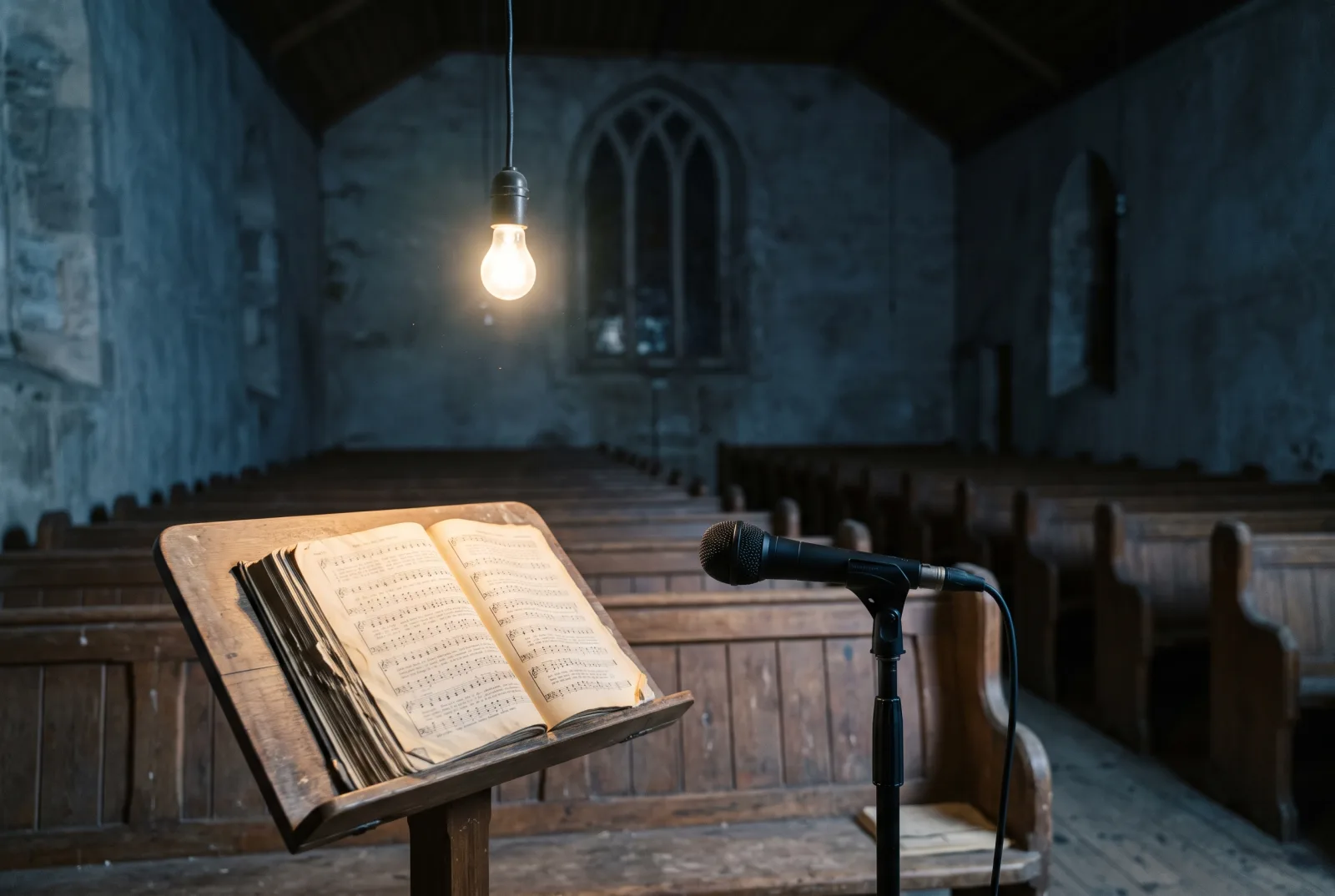
Ilustración: Rebobinados
Some songs stop belonging to whoever made them.
"Stand by Me" is the clearest case there is. In 1999, the organisation BMI named it the fourth most performed song of the twentieth century: some seven million broadcasts on radio and television.
Seven million times. A song Ben E. King recorded in 1961, when he was twenty-two.
Where it comes from
Its genealogy is the most interesting part, and it is usually told as a chain, which is not accurate.
There are three things, not one.
First, a church hymn: "Stand by Me", by Charles Albert Tindley, from 1905.
Second, Psalm 46 of the Bible, the source of the most striking images in the lyric: that we will not fear though the earth shake and the mountains fall into the sea.
And third, the title, which according to King himself came to him from "Stand by Me Father", a spiritual by Sam Cooke and J. W. Alexander recorded by the Soul Stirrers.
What King did, together with the songwriters Jerry Leiber and Mike Stoller, was take all that religious fervour and turn it into something earthly. It is no longer asking God to stay with you: it is asking another person, the one you love, in the dark, when the world is frightening.
That mixture — the solemnity of a psalm with the tenderness of a human plea — is what made it universal.
On the original single the writers were listed as "King and Elmo Glick", which was Leiber and Stoller's pseudonym.
The year he left
Before that he had been the lead voice of the Drifters, and the length is worth getting right: around a year, between 1959 and 1960.
He sang "There Goes My Baby", which changed the group's sound.
And then he asked for a raise and a share of the royalties. He was refused, and he left.
"Save the Last Dance for Me", the group's only number one on the pop chart, came out a few months after he walked away. The group had six more number ones on the rhythm and blues chart, nearly all of them with other singers.
It is one of those stories that keep repeating in the music of that era: the man who supplied the voice leaves over money, and the success arrives right afterwards.
Two lives
"Stand by Me" had two careers.
The first, in 1961: number four on the general chart and number one on the rhythm and blues chart.
The second, twenty-five years later. In 1986, Rob Reiner used it to give a name and music to his film about four boys who set out to find a body. The song went back onto the charts: number nine in the United States that year and number one in the United Kingdom in 1987.
In between and afterwards, everyone recorded it. John Lennon in 1975. Otis Redding. Florence and the Machine in 2016. Even the boxer Cassius Clay recorded it, before he was called Muhammad Ali.
And Tracy Chapman sang it in 2015, on David Letterman's show, with a single guitar, and the video went viral.
What to remember
Ben E. King is the proof that sometimes you write a song and end up writing a language.
Put on "Stand by Me" or "Spanish Harlem" and you will hear a warm, restrained voice that never pushes too hard.
But what you really have to understand is why that song does not wear out. What it asks for is the most basic thing a human being can ask: do not leave me alone when I am afraid.
There is no generation that does not need to say that. Which is why each one discovers it again and makes it its own.
He died on 30 April 2015, at seventy-six.
Remember him like this: not as the owner of "Stand by Me", because it has not been his for decades, but as the man who took a psalm and turned it into something you can say to another person.
Sources
Ben E. King, real name Benjamin Earl Nelson, born in Henderson, North Carolina, on 28 September 1938, and died in Hackensack, New Jersey, on 30 April 2015. He was lead singer of the Drifters for roughly a year, between 1959 and 1960, a period in which he recorded "There Goes My Baby"; he left the group after being refused a raise and a share of the royalties. "Save the Last Dance for Me", the group's only number one on the pop chart (October 1960), was released months after his departure; the Drifters also obtained six number ones on the rhythm and blues chart, mostly with other vocalists. "Stand by Me" (1961) was co-written by King with Jerry Leiber and Mike Stoller, credited on the original single under the pseudonym "Elmo Glick". Its genealogy combines three distinct sources: the hymn "Stand by Me" by Charles Albert Tindley (1905), the verses of Psalm 46 — which supply the images of the earth shaking and the mountains falling into the sea — and the title, which according to King himself comes from the spiritual "Stand by Me Father" by Sam Cooke and J. W. Alexander, recorded by the Soul Stirrers. This is worth stating precisely because it is usually presented as a chain derivation from a single source. The song reached number four on the Billboard Hot 100 and number one on the rhythm and blues chart in 1961, and returned to number nine in 1986 after its use in Rob Reiner's film "Stand by Me", as well as topping the British chart in 1987. In 1999, BMI designated it the fourth most performed song of the twentieth century, with some seven million broadcasts on radio and television; the frequently cited figure of "more than four hundred versions" comes from the Songwriters Hall of Fame and is not backed by an independent authority. Among those who have recorded it are John Lennon (1975), Otis Redding, Florence and the Machine (2016) and Cassius Clay, before he took the name Muhammad Ali. Tracy Chapman performed it on David Letterman's show in 2015. "Spanish Harlem" was written by Jerry Leiber and Phil Spector. Tracy Chapman has her own profile in this series. Externally authored text, edited and verified for Rebobinados. Interpretations of the meaning of his work are offered as the author's reading. No song lyrics are reproduced, for copyright reasons. Information drawn from Wikipedia, BMI, the Songwriters Hall of Fame, Billboard and other press coverage.
Keep rewinding
00s
soul
Duffy
She told it first
Rockferry (2008) was the best-selling album of the year in the United Kingdom, with 1,685,000 copies, three BRITs in 2009 and the Grammy for Best Pop Vocal Album. In 2020 Duffy told it herself, before anybody else, that she was drugged, held captive and raped. And it is not an epilogue: a new song in 2024, a Disney+ documentary announced in 2025 and a signing with TaP Management in 2026.
80s
soul
Hall & Oates
The craft they called a guilty pleasure
Daryl Hall and John Oates put six songs at number one in the United States, and Billboard named them the most successful duo in Hot 100 history — a measure of chart performance, not of records sold. They met in Philadelphia in 1967 and ended up in a Nashville court in 2023, over the sale of the company that held their name and royalties.
90s
soul
Seal
The song that embarrassed him, and the scars he never hid
The song that won the Grammy for record of the year sat in a drawer for years because its author thought it was bad and was embarrassed to show it: it took a producer who believed in it more than he did. With the scars on his face he did the opposite: he never covered them.
Rewind with us
Comments · 0
No one has commented yet. Open the conversation.