
Deep Purple
The smoke was real
By Rebobinados · Published on September 26, 2026
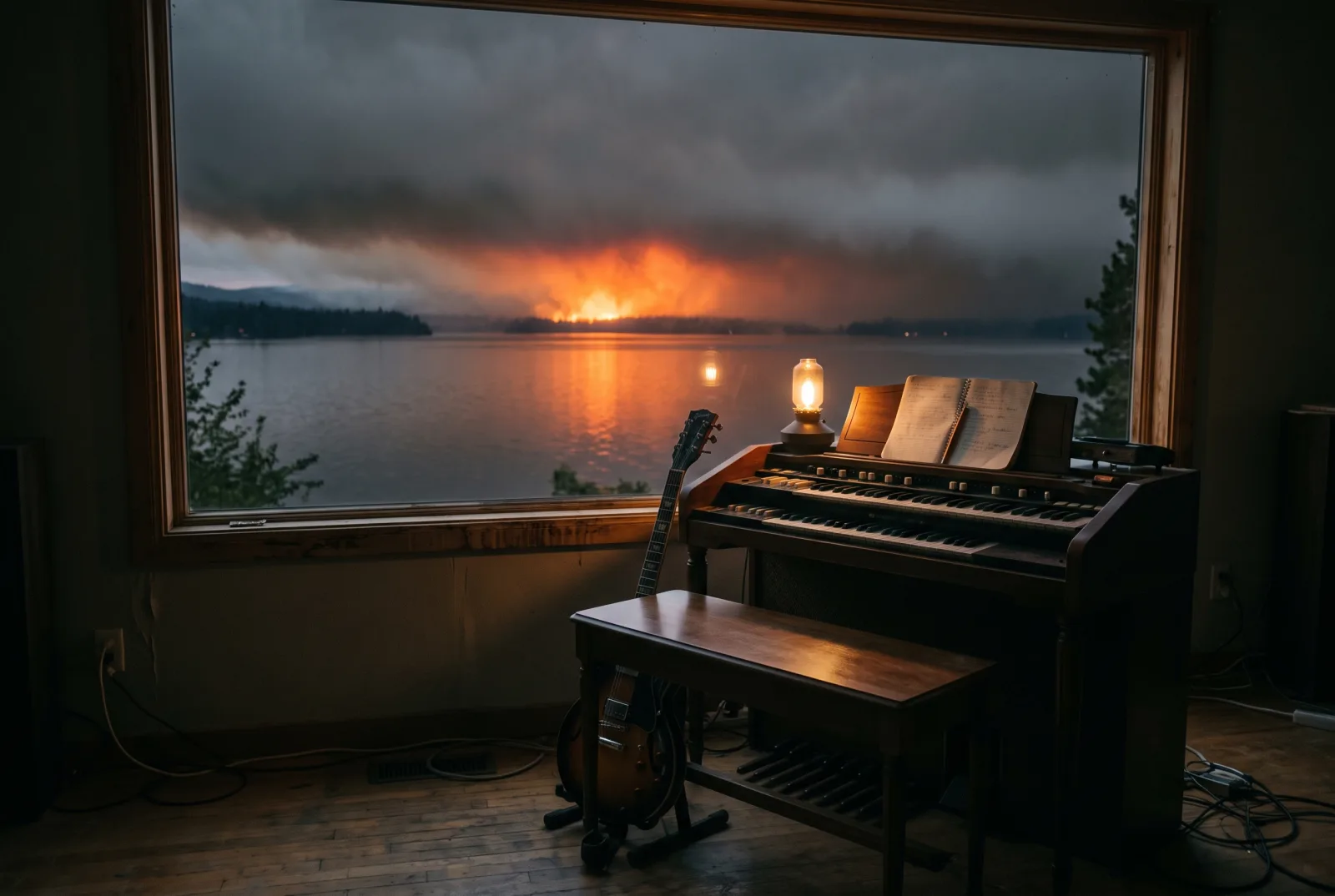
Ilustración: Rebobinados
Deep Purple is one of those foundational bands without which the music that came afterwards makes no sense.
Alongside Led Zeppelin and the Black Sabbath of Ozzy Osbourne they formed the trinity that, at the end of the sixties and the beginning of the seventies, invented hard rock and laid the foundations of heavy metal.
And they wrote, along the way, the riff that half the world learns.
The smoke was real
There is a riff that almost anyone who has ever picked up a guitar has tried to play: the one that opens "Smoke on the Water".
It is built on barely four notes, harmonised in fourths and played with the fingers instead of a pick. It is simple, it sounds enormous, and it is recognisable in an instant.
What almost nobody knows is that the song tells, literally, something that happened to them.
On 4 December 1971, Deep Purple were in Montreux, Switzerland, to record an album. They were going to use the theatre in the casino complex, beside the lake, with the Rolling Stones' mobile studio, as soon as Frank Zappa vacated the room.
That afternoon, during the concert by Zappa and the Mothers of Invention, in the middle of the synthesiser solo of "King Kong", a member of the audience fired a flare gun at the rattan ceiling.
The entire casino burned to the ground in front of them. Nobody died.
And if nobody did, part of the reason is the only person the lyric names. The "Funky Claude" of the song is Claude Nobs, the director of the Montreux Jazz Festival, who went into the burning building to pull people out.
And while they watched, the smoke spread over Lake Geneva in a low, thick layer.
Days later, Roger Glover woke from a dream saying the phrase out loud: smoke on the water. He feared it would sound like a drug song. Ian Gillan wrote the lyric.
That eternal riff was born out of watching a casino burn. And they finished the album wherever they could: first at the Pavilion, until the police threw them out for noise, and afterwards at the Grand Hôtel de Montreux, closed and empty for the winter, between 6 and 21 December.
The loudest band in the world
What made Deep Purple great, beyond that anthem, was the level of its musicians.
Ritchie Blackmore played with a dazzling technique and speed. Jon Lord put the organ —an instrument of the church and the concert hall— right in the middle of hard rock, fighting on equal terms with the distorted guitar. And through the band passed one of the most powerful voices in rock, that of Ian Gillan.
They were also among the first to put a rock band and a symphony orchestra on the same stage: the Concerto for Group and Orchestra premiered at the Royal Albert Hall on 24 September 1969, with the Royal Philharmonic conducted by Malcolm Arnold.
And there is one fact that tends to get told short. They were not "one of the loudest bands": they were the loudest band in the world, with an official record.
The 1975 Guinness listed them as such for a concert at the Rainbow Theatre in London in 1972: one hundred and seventeen decibels, with a ten-thousand-watt amplification system, which left three members of the audience unconscious.
The Who took the mark off them in 1976, and in the mid-nineties Guinness eliminated the category so as not to encourage hearing damage.
The changes and the permanence
Like many long-lived bands, Deep Purple went through fights, departures and returns. Rock historians talk about its different line-ups by numbering them, as if they were versions of a product.
Blackmore left in 1975, came back in 1984 and left again in 1993.
For thirty-three years that was the whole story. Until, on 12 August 2026, at the Northwell at Jones Beach Theater in Wantagh, New York, Blackmore walked on stage unannounced and played "Smoke on the Water" with Deep Purple for the first time since then. He told it without any grandeur: he had not gone to play the right notes, he had gone to see old friends, and they thought it might be the last time they saw each other.
But the band, with one set of members or another, never quite stopped existing, and went on playing and recording for more than half a century. That stubborn permanence is part of its story.
Jon Lord died in 2012. They entered the Rock and Roll Hall of Fame in 2016.
What to remember
Deep Purple is proof that you can be, at the same time, heavy and sophisticated, brutal and virtuosic.
Put on "Smoke on the Water", "Highway Star", "Child in Time" or "Perfect Strangers", and you are going to hear the birth of hard rock: the high volume, the organ fighting the guitar, a voice that reaches the sky, and that riff the whole world knows.
The next time you hear someone trying to play those four notes, remember that they are playing the echo of a real fire, turned by Deep Purple into the doorway into rock for whole generations.
Sources
Deep Purple, British band formed in 1968, regarded —alongside Led Zeppelin and Black Sabbath— as a pioneer of hard rock and a key influence on heavy metal. Its classic line-up, the one known as Mark II, was made up of Ian Gillan (vocals), Ritchie Blackmore (guitar), Jon Lord (keyboards and organ), Roger Glover (bass) and Ian Paice (drums). "Smoke on the Water", from the album "Machine Head" (30 March 1972), contains one of the most recognisable riffs in history, built on four notes harmonised in fourths and played with the fingers. Its lyric narrates a real event: on 4 December 1971, during a concert by Frank Zappa and the Mothers of Invention at the Montreux Casino, a member of the audience fired a flare gun at the rattan ceiling and the venue burned down completely, with no fatalities; the band, which was there to record with the Rolling Stones Mobile Studio, watched the smoke spread over Lake Geneva. Roger Glover coined the phrase "smoke on the water" on waking from a dream days later, and Ian Gillan wrote the lyric. After the fire they recorded at the Pavilion, from which the police evicted them for noise, and finished the album at the Grand Hôtel de Montreux, closed for the winter, between 6 and 21 December 1971. The single reached number four on the Billboard Hot 100 in 1973. Their "Concerto for Group and Orchestra" premiered at the Royal Albert Hall on 24 September 1969, with the Royal Philharmonic Orchestra conducted by Malcolm Arnold. The 1975 "Guinness Book of World Records" listed them as the loudest band in the world for a concert at the Rainbow Theatre in London in 1972, with 117 decibels and a 10,000-watt amplification system that left three members of the audience unconscious; The Who beat the mark in 1976 and Guinness withdrew the category in the mid-nineties. Ritchie Blackmore left the band in 1975 —his last concert was on 7 April at the Palais des Sports in Paris and the departure was announced on 21 June—, returned in April 1984 and left again in November 1993; on 12 August 2026 he walked on stage with them unannounced at the Northwell at Jones Beach Theater in Wantagh, New York, to play "Smoke on the Water" for the first time since 1993. Jon Lord died on 16 July 2012. Deep Purple entered the Rock and Roll Hall of Fame in 2016. Externally authored text, edited and verified for Rebobinados. Interpretations of the meaning of their work are offered as the author's reading. No song lyrics are reproduced, for copyright reasons. Information drawn from Wikipedia, Britannica, Louder Sound, UPI, Rolling Stone, Guitar Player and other coverage.
Keep rewinding
90s
hard rock
Lenny Kravitz
He doesn't play that guitar
The riff of "Are You Gonna Go My Way" (9 March 1993) is not played by him: the guitar is Craig Ross's, the song is co-written with him and the Academy nominated them both for Best Rock Song in 1994. "Always on the Run" was written by Slash for Guns N' Roses. And one of his four straight male rock Grammys, the one of 23 February 2000, he won with "American Woman", by The Guess Who, from which he removed the guitar solo.
60s
hard rock
Steppenwolf
The motorcycle was a Ford Falcon
The century's biker anthem was not written by the band that sings it, and it was not about a motorcycle: Mars Bonfire wrote "Born to Be Wild" as a folk ballad about his battered Ford Falcon, and he had left the group in June 1967, before the name Steppenwolf existed. "The Pusher" is Hoyt Axton's, Easy Rider dropped it in as a temporary track, and the single stalled at no. 2 on the Hot 100 in 1968.
00s
hard rock
Thirty Seconds to Mars
The seven-year law
In August 2008, EMI sued them for thirty million dollars for breaching a 1999 contract they had signed before releasing a single record. They defended themselves with a Californian employment law that voids contracts of more than seven years, closed a settlement on 28 April 2009 and signed with the same label again. The Guinness record they ended up with is not a box-office one: it is three hundred and nine concerts on a single tour.
Rewind with us
Comments · 0
No one has commented yet. Open the conversation.