
Dolores O'Riordan
The voice of a country
By Rebobinados · Published on September 16, 2026
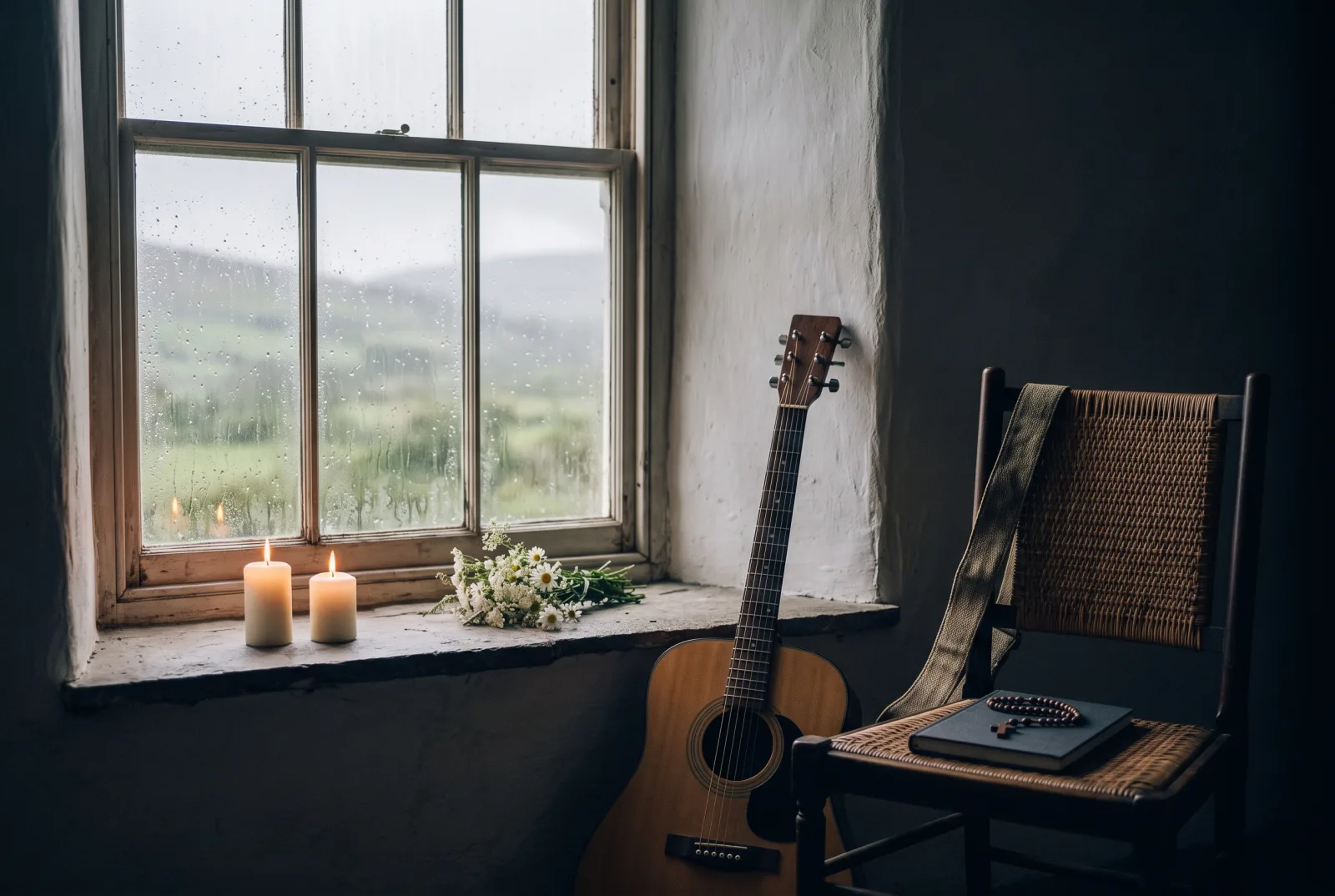
Ilustración: Rebobinados
There are voices you recognise in a second, and Dolores O'Riordan's was one of them: high and low at the same time, ancient and electric, with those Celtic breaks that rose and fell as though the landscape of Ireland itself were singing.
She did not hide her accent. On the contrary: she made it sound like an instrument.
When she sang she did not seem like a woman in her twenties. She seemed like the land remembering something.
Limerick
She was born in 1971 in County Limerick, the youngest of a huge family. Her childhood was hard, marked by abuse; her mother, a devout Catholic, named her Dolores after the seven sorrows of the Virgin, a name life took far too seriously.
At eighteen, a local band looking for a singer passed her a cassette with a few backing tracks. She came back a week later with the words and the melody of what would be "Linger".
That band was called The Cranberries, and with Dolores's voice out front it became the biggest Irish band after U2, with more than forty million records sold.
Zombie
Their first album, in 1993, brought "Linger" and "Dreams": melancholy, luminous songs that sounded like nothing else.
But it was "Zombie", in 1994, that made her immortal, and its origin says everything about her.
In March 1993, an IRA bombing in the English town of Warrington killed two children. Dolores was on tour when she heard, and grief and rage went through her. She went home and wrote a furious, heavy song, unlike anything gentle she had made before: a cry against inhumanity, against wars and the children who die in them.
"Zombie" became a global anthem against violence and still plays in every corner of the world where somebody has had enough of war. A girl from Limerick took the deaths of two children she had never met and turned them into one of the greatest protest songs of her era.
What she wanted was an ordinary life
Behind that voice there was a turbulent life, and it has to be told with respect.
Dolores lived with depression and with a bipolar disorder she made public herself, and with problems with alcohol. Fame, which arrived far too fast, never suited her; in more than one interview she said she only wanted to be able to go home and do what anybody does, to be human and not a star.
She stepped away from the band for years looking for exactly that. She came back, went on recording, went on singing with that voice that lost nothing with time.
She was not the only Irishwoman of her generation who paid dearly for saying what she thought out loud: Sinéad O'Connor had done the same, a year before "Zombie", tearing up a photograph on television.
London, January 2018
She died on 15 January 2018, in a London hotel where she had gone to record. She was found in the bath; a coroner determined that it was an accidental drowning, with alcohol as a factor. She left no note.
She was forty-six, and her last public messages were cheerful: she said she was feeling well, that she was singing again, that she was off to Ireland.
Death caught her by surprise, and the world with her, precisely because her voice had always sounded indestructible.
The land remembering
She has to be remembered for the voice, and for what she did with it.
Dolores O'Riordan carried real pain — the pain of her name, of her childhood, of her illness — and instead of keeping it to herself she turned it into beauty and gave it away.
If you put on "Linger", "Dreams", "Ode to My Family" or "Zombie", you will hear something that cannot be imitated: a voice that sounded like a whole country, like a landscape, like an old wound made song.
She went far too soon, like so many who sang from an open wound. But she left behind a voice that still sounds as though the land remembered her name.
This piece mentions depression, bipolar disorder and alcohol use. If you or someone you know is going through something like this, help is available, and asking for it is an act of strength. In Chile you can call *4141 free of charge, the Ministry of Health's suicide-prevention line, available 24 hours a day.
Sources
Dolores Mary Eileen O'Riordan (Ballybricken, County Limerick, Ireland, 6 September 1971 – London, 15 January 2018), singer and songwriter, the voice of The Cranberries. She joined the band in 1990, at 18; for the audition she wrote the words and melody of "Linger". With The Cranberries, one of the most successful Irish bands in history, with more than 40 million records sold, she released "Everybody Else Is Doing It, So Why Can't We?" (1993, with "Linger" and "Dreams") and "No Need to Argue" (1994, with "Zombie" and "Ode to My Family"), among other albums. "Zombie" was written in response to the IRA bombing in Warrington, England, in March 1993, in which two children died, and is a protest against violence. She spoke publicly about having suffered abuse in childhood and about her diagnosis of bipolar disorder; she also faced problems with alcohol. She was married to Don Burton, with whom she had three children. She died aged 46; the inquest at Westminster Coroner's Court ruled accidental drowning with alcohol intoxication as a factor, with no indication of self-harm and no note. Externally authored text, edited and verified for Rebobinados. Interpretations of the meaning of her work are offered as the author's reading. No song lyrics are reproduced, for copyright reasons. Information drawn from CNN, NPR, BBC, Wikipedia and other press coverage.
Keep rewinding
90s
indie
Portishead
A short film got them the record deal
Before the record they shot *To Kill a Dead Man*, eleven minutes of film noir written by the three of them: Geoff Barrow plays a sniper and Beth Gibbons a widow. That soundtrack got them the record deal, and the cover of *Dummy* is a still from the short. The rest is told wrong too: *Dummy* sold 3,600,000 copies and won the 1995 Mercury ahead of Oasis, Tricky and PJ Harvey. Three records in fourteen years, and eighteen without a fourth.
00s
indie
Peter Bjorn and John
The whistle was provisional
Björn Yttling whistled the melody of "Young Folks" as a placeholder, only so as not to forget it, and they decided to keep it. The single came out on 7 August 2006, with Victoria Bergsman as guest, and it was not no. 1 anywhere: no. 13 in the United Kingdom, no. 9 in Finland. Live it is whistled by Peter Morén, and the trio never broke up: nine albums.
00s
indie
Florence + the Machine
The catharsis had a name
The band formed in London in 2007 and "the Machine" comes from the keyboard player Isabella Summers. Florence Welch has said that she stopped eating at seventeen and that she stopped drinking around 2014: the catharsis in her music has a concrete content. She has five British number ones, the last with Everybody Scream (31 October 2025), nominated for the 2026 Mercury.
Rewind with us
Comments · 0
No one has commented yet. Open the conversation.