
Decade 90s · Rhythm disco dance
Faithless
The dance floor as a church
By Rebobinados · Published on September 16, 2026
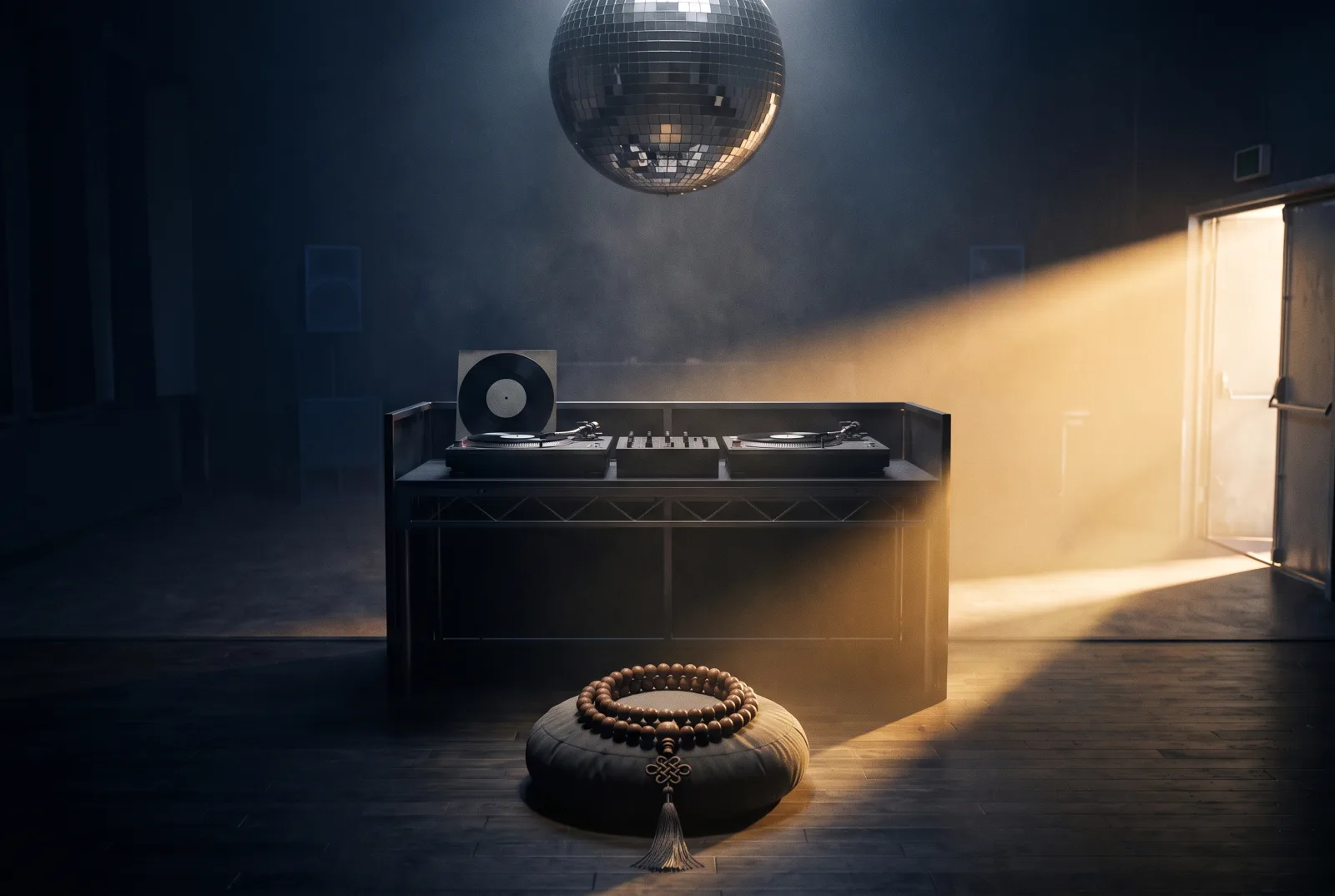
Ilustración: Rebobinados
In the nineties, dance music was, above all, hedonism: bodies, lights, ecstasy, the night for the night's own sake.
And then Faithless appeared, and their singer, Maxi Jazz, did something nobody in that world was doing: he gave it a soul.
Over techno and trance tracks, in a deep, calm voice, this man did not shout or work the party. He recited, like a poet, like a preacher, and spoke to the sweating crowd about deep things: about healing, about belonging, about finding meaning in the middle of the noise.
Three in London
Faithless formed in London in 1995 around three people: Maxi Jazz — Maxwell Fraser — the voice and the pen; Sister Bliss, keyboard player and DJ; and Rollo, the producer.
Their first record, in 1996, carried "Insomnia", with that synthesiser riff you recognise even if you do not know where from, and with Maxi's spoken, poetic, unmistakable delivery.
Then came "God Is a DJ", eight minutes of epic house, and "We Come 1": anthems that played in every club in the world and that stand among the most influential dance records to come out of the United Kingdom.
Live they were a force of nature. Their sunset set on the main stage at Glastonbury, in 2002, stayed in the memory of everyone who was there.
A Buddhist in the nightclub
But what makes Maxi Jazz great is not the hits, it is what lay underneath them.
He was not a dance vocalist like the others. He was a practising Buddhist who chanted his mantras every day, a man with a wisdom his bandmates described as profound and approachable at once. And he poured that way of seeing the world straight into the music.
In "God Is a DJ" he did something almost theological: he compared the club to a church, said that was the place where he healed his wounds, and turned the escape of the night into something close to a rite of belonging.
With Faithless, dancing stopped being only a way of running away. It became a way of healing and of being together.
Joy taken seriously
That idea — that a dance floor can be a serious place, and not only a happy one — is among the hardest to defend in popular music. Miranda! hold to it from the other side of the world and in other colours: that having a good time, together, is also a grave matter.
Faithless held to it from a stage full of strobe lights, with a Buddhist poet at the microphone.
How they said goodbye to him
When Maxi Jazz died, his own bandmates said goodbye to him with words that paint him whole: they said he was a brilliant lyricist, a DJ, a Buddhist, a magnificent stage presence, a beautiful human being, a moral compass and a genius, and that he gave their music real meaning and message.
He was, they said, a lovely human being, with time for everyone. Not everybody is remembered that way by the people they worked with for half a lifetime.
He left Faithless in 2016, went on playing with his own band — he was a car fanatic and the group was called Maxi Jazz & The E-Type Boys — and died in his sleep, at his home in south London, two days before Christmas 2022, at sixty-five.
Sister Bliss still plays the Faithless songs in her sets and says it is astonishing how Maxi lives on in the music. Even the football team he supported ran out onto the pitch to one of his songs to say farewell.
The soul of the machine
Faithless should be remembered not as one more dance act, but as the ones who gave the machine a soul.
A Buddhist poet stood on a stage full of lights and told a roaring crowd that the club could be a temple, and that dancing together was a way of healing.
If you put on "Insomnia", "God Is a DJ" or "We Come 1", you are not only going to hear great dance-floor tracks: you are going to hear the calm voice of Maxi Jazz reminding a generation that, even in the small hours and in the loudest room, there was feeling, belonging and a measure of grace.
He gave the dance floor its conscience. And then he went in peace, in his sleep, which for a man who spent his life singing for peace is a grace of its own.
Sources
Faithless, a British electronic music band formed in London in 1995, whose core members were Maxi Jazz (Maxwell Fraser; London, 14 June 1957 – 23 December 2022), vocalist and lyricist; Sister Bliss (Ayalah Bentovim), keyboards and DJ; and Rollo (Rollo Armstrong), producer; Jamie Catto took part in the early stage. Their debut album, "Reverence" (1996), included "Insomnia"; other major hits were "God Is a DJ" (1998) and "We Come 1" (2001), regarded as among the most influential dance records in the United Kingdom. They were acclaimed for their live performances, among them their set on the Pyramid Stage at Glastonbury in 2002. Maxi Jazz, a practising Buddhist, brought to dance music a spiritual and reflective quality that was rare in the genre; in "God Is a DJ" he compared the club to a church. He left Faithless in 2016 and fronted Maxi Jazz & The E-Type Boys; he also featured on "My Culture", by 1 Giant Leap. He died in his sleep at his home in south London, aged 65. His bandmates described him as "a brilliant lyricist, a DJ, a Buddhist, a magnificent stage presence, a beautiful human being, a moral compass and a genius". Externally authored text, edited and verified for Rebobinados. Interpretations of the meaning of their work are offered as the author's reading. No song lyrics are reproduced, for copyright reasons. Information drawn from DJ Mag, The Irish Times, BBC, Wikipedia and other press coverage.
Keep rewinding
90s
disco dance
Era
The fake Latin was written by an expert witness
The pseudo-Latin lyric of "Ameno" is co-credited to Guy Protheroe, director of the English Chamber Choir, who also sings it and is a forensic musicologist: the expert witness The New York Times profiled on 11 October 2016 as the man they call when two tunes sound alike. And Era was not born in a studio: the choral piece from "Les Visiteurs" (27 January 1993) reappeared on the first album, recorded with what the film paid for.
90s
disco dance
Enigma
The same mistake twice
The Munich choir's suit over the Gregorian chants on "Sadeness" was closed with a settlement in August 1991, a public apology from Virgin included. "Return to Innocence" came out in December 1993 with the chant of an Amis couple from Taitung recorded solely for cultural preservation: Difang and Igay Duana found out because some friends heard their voices on the radio, sued in California with the International Olympic Committee among the defendants and settled in July 1999.
80s
disco dance
Modern Talking
Half the duo went on at Viña del Mar
In February 1988 the Quinta Vergara announced Modern Talking, but only Thomas Anders walked onto the stage: the contract predated the 1987 break-up. And the duo was never two. The falsetto of the chorus was sung by Rolf Köhler, Michael Scholz, Detlef Wiedeke and Birger Corleis, without appearing in any credits, while Dieter Bohlen mouthed along. They sued in Berlin and collected one hundred thousand marks in 2001, but the case was about samples: no court ever ruled on who sang what.
Rewind with us
Comments · 0
No one has commented yet. Open the conversation.