
La Cabra Mecánica
The shopping list
By Rebobinados · Published on September 17, 2026
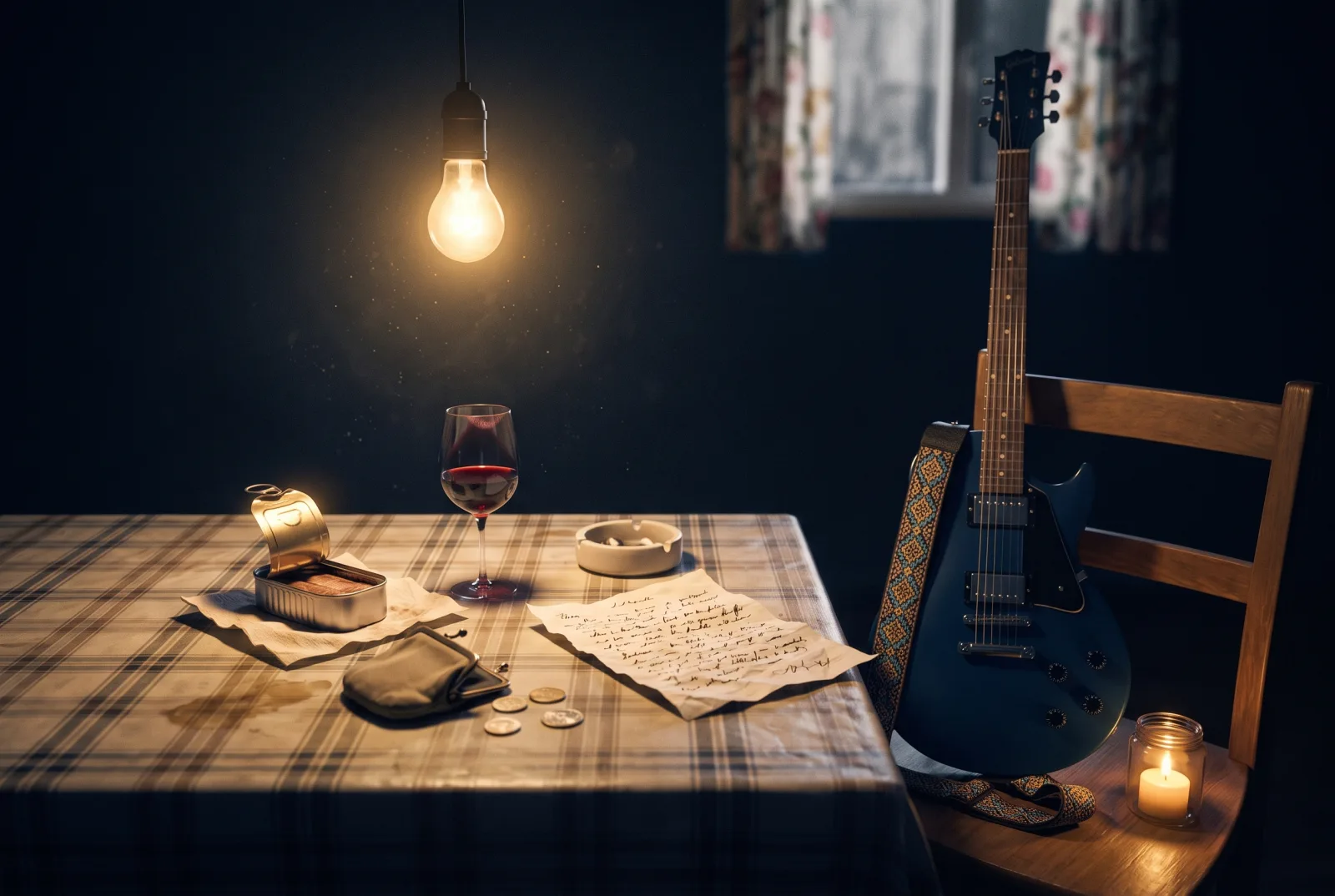
Ilustración: Rebobinados
La Cabra Mecánica were, more than a band, the voice of one man: Lichis, a singer and lyricist with a very rare gift.
The gift of looking at the lives of the losers, the poor, the odd and the lonely, and singing to them with a mixture of humour, rawness and an enormous tenderness.
Their music is rumba, flamenco, rock, blues, all jumbled together—what we now call mestizaje, and which they were doing before the word became fashionable. And over that party of rhythms, Lichis told stories of ordinary people with a neighbourhood poetry that made you laugh and stuck in your chest at the same time.
Lavapiés, the neighbourhood of the whole world
To understand this music you have to understand where it came from.
Miguel Ángel Hernando, Lichis, was born in Barcelona in 1970 and arrived in Madrid as a child. As a young man he played in the metro, in the stations near his school, to earn a few coins. And as an adult he lived for years in Lavapiés, the most mestizo neighbourhood in Madrid, where he had his rehearsal room.
Lavapiés is that place where you change continent just by crossing the pavement: an Arab tea house, a punk tavern, a flamenco tablao, a Latin bar, an African restaurant, all on the same street.
And that mixture got into his music. La Cabra Mecánica did not choose one style, they used them all—Catalan rumba, flamenco, rock, tango, blues, pasodoble—changing costume according to what the song needed to tell.
Lichis put it simply: he did not do mestizaje, he did music. He took what he liked from each place and mixed it his own way, without prejudices.
A love song between the tuna and the grease stains
The road was not easy. Their second album, "Cabrón", sold barely two thousand seven hundred copies according to the group's own biography, and Lichis came close to giving up music.
But in 2001, with Alejo Stivel producing, their big moment arrived: "La lista de la compra", recorded as a duet with the enormous flamenco singer María Jiménez.
It was a phenomenon, it played all summer long, and it catapulted them to stardom. Along the way it took María Jiménez back into the charts and introduced her to a generation that had not lived through her hits of the seventies and eighties.
And it is a small masterpiece, because it does something extremely difficult: it is a love song, but told from a poor man's kitchen.
On the same sheet of paper there is room for the shopping list and for a song. Loneliness rhymes with the tinned tuna in vegetable oil. And in the middle of that everyday poverty the purest love appears: he tells her she deserves a prince, a dentist, and yet there he still is, at her side.
Nobody had sung the love of those who have nothing with that dignity and that grace.
That is the heart of La Cabra Mecánica: finding beauty and tenderness exactly where nobody looks for them.
Singing to the people nobody looks at
And that is the underlying point of their whole body of work.
Lichis always had his eye on the margins: the drunks, the failed dreamers, the immigrants, the lonely, the people society would rather not see.
But he never looked at them from above or with pity. He looked at them as equals, with affection, with humour, with respect, finding in them dignity and even poetry.
Songs like "Felicidad" or "No me llames iluso" follow that line: rumba to dance to with lyrics that, if you listen properly, talk about holding on, about dreaming against all the evidence, about finding reasons to keep going.
Lichis was a neighbourhood poet, heir to that Spanish tradition of copla and rumba that always sang to ordinary people, but with a modern sensibility and an honesty that never posed.
And at a time when in the music world almost everyone pretends their art was born out of nothing, he acknowledged his debts without any trouble: he is a declared fan of Charly García, whom he would later record a cover of.
What to remember
The band announced their break-up in 2009 and closed the farewell in 2010. But in 2022 Lichis came back with a tour for the twenty-five years of the first album, and the thing did not go out: they carried on playing.
La Cabra Mecánica are the proof that you can get people dancing and, at the same time, speak to the soul of those nobody listens to.
If you put on "La lista de la compra", "Felicidad" or "No me llames iluso", you are going to hear a mestizo party of rumba, flamenco and rock, yes, but if you pay attention to the lyrics you are going to find a street poet singing with an uncommon tenderness to the poor, to the odd, to those who love without having anything.
Lichis understood something beautiful: that the lives of ordinary people, of the tuna on special offer and the bills that do not add up, also deserve songs, and deserve those songs to be beautiful.
He put music and dignity into the everyday and the humble.
And that is why, when "La lista de la compra" plays at any party, half of Spain—and a good part of Latin America—sings the whole thing, moved, without quite knowing why there is a lump in their throat in the middle of the rumba.
Sources
La Cabra Mecánica, Spanish pop rock, rumba and mestizo rock group led by Miguel Ángel Hernando Trillo, "Lichis" (Barcelona, Gràcia neighbourhood, 29 April 1970; moved to Madrid as a child), the only permanent member and the author of the songs, with a changing line-up of musicians. As a young man he played in the Madrid metro, in the stations near the San Mateo school; as an adult he lived for a long time in the Lavapiés neighbourhood, where he had his rehearsal room. The band formed in the mid-nineties on the Madrid bar circuit and was a pioneer of musical mestizaje, with urban, ironic lyrics carrying a social charge. Their debut was "Cuando me suenan las tripas" (1997); after the limited success of their second album, "Cabrón" (1999), which according to the group's official biography sold some 2,700 copies—a figure that does not come from Promusicae—they found fame with "Vestidos de domingo" (2001), produced by Alejo Stivel and driven by "La lista de la compra", a duet with the singer María Jiménez, a huge hit of that year that took the artist back into the charts and brought her to a new audience, although her full comeback is usually attributed to the following album, "Donde más duele" (2002). Other well-known tracks: "Felicidad" and "No me llames iluso". Lichis is a declared admirer of Charly García, whose "No soy un extraño" he covered on his album "Mariposas" (2017); the mentions of Fito Páez and other Argentine rock artists as influences come from biographical press texts and not from traceable statements of his own. The group announced its break-up in September 2009 and closed its farewell tour in 2010; in May 2022 it returned with the tour for the 25th anniversary of its first album, which ran into 2023, and has continued in activity since then. Externally authored text, edited and verified for Rebobinados. Readings of the meaning of their work are offered as the author's interpretation. No song lyrics are reproduced, for copyright reasons; the references to the content of "La lista de la compra" are descriptive. Information drawn from Wikipedia, Cancioneros.com, the group's official website, Efe Eme, Mondo Sonoro and other press coverage.
Keep rewinding

70s
folk
Florcita Motuda
Forty-nine years without a reissue
With "Brevemente… geeente" he won the best Chilean performer prize at Viña 1977, and he won it in the international competition because the folk one was not held that year. The album that contains it, released in 1977 on APRI —Antonio Prieto's label—, spent 49 years without a reissue: never on CD or streaming until it came back on vinyl in April 2026 and on digital on 11 July, the day he returned to the stage. The record for the longest title at the OTI is his, but it is from 1978 and not 1998.
00s
folk
Natalia Lafourcade
Where it said pumpkin she put flowers
The story says she rescued the son jarocho with reverence on *Un Canto por México*, but "La Bruja" is not on that record: she recorded it on *Cancionera*, on 24 April 2025, and rewrote the lyric. Where the son turns the man into a pumpkin, she sings that she filled him with flowers: "a cancionera is a kind of sorceress". Twenty Latin Grammys, a house rebuilt in Jáltipan and a harpsichordist father who left Chile two days after the coup.

70s
folk
Piero
The old man wasn't his
Piero sang "Mi viejo" in 1969, but the words are José Tcherkaski's and the father it portrays was his own: Mario Tcherkaski, a Russian street hawker who died at 52, eight years before the song. CBS released it with Father's Day in mind after several labels turned it down, and the first pressing passed 600,000 copies. Piero died on 7 October 2026, aged 81.
Rewind with us
Comments · 0
No one has commented yet. Open the conversation.