
Ray Charles
The church and the bar
By Rebobinados · Published on September 22, 2026
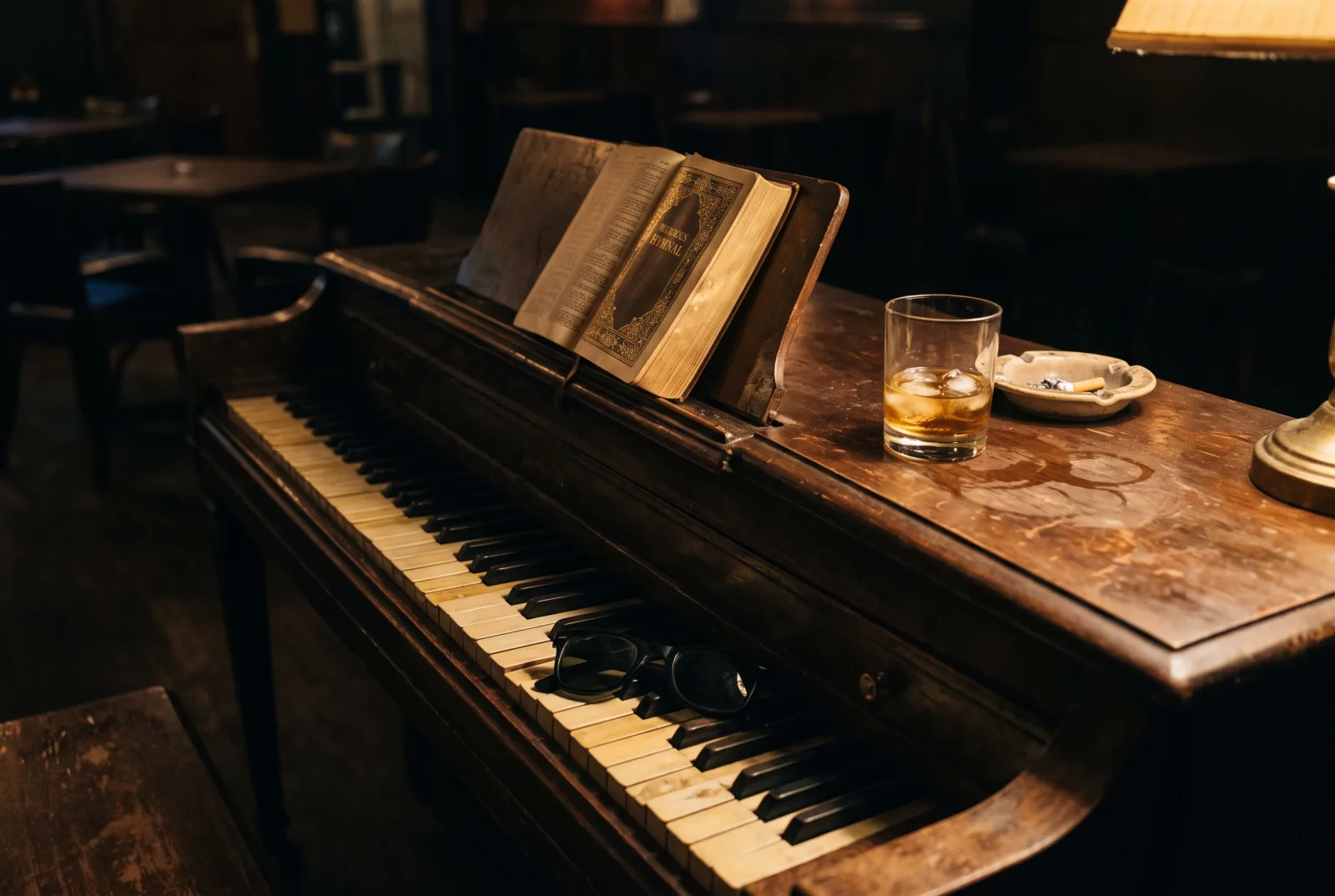
Ilustración: Rebobinados
They called Ray Charles, without any exaggeration, "the Genius".
He was a pianist, singer, arranger and bandleader, and he had one of the warmest and most ravaged voices in music: a voice made rough by living, able to go from a roar to tenderness within the same line.
But his real feat was not singing beautifully. It was inventing a genre.
Ray Charles took two worlds that in his day were separated by a wall and fused them: the music of the church and the music of the bar. Out of that mixture came soul.
You're blind, not stupid
Ray Charles Robinson was born in 1930 in Georgia and grew up in absolute poverty in Florida, in the middle of the Depression.
Tragedy marked him from childhood. At five he watched his younger brother George, who was four, drown in the washtub in the yard. He tried to pull him out and could not: the weight of the wet clothes beat him. He ran to fetch his mother and it was already too late.
Soon afterwards he began to lose his sight, almost certainly from untreated glaucoma, and by seven he was completely blind. By fourteen he had lost his mother too.
But before she died, she did two decisive things.
The first was a sentence he repeated all his life: you're blind, not stupid.
The second was to find him a school for blind children that would take a Black pupil. She found one in St. Augustine, and there Ray studied music seriously for eight years: he learned to read, write and arrange scores in braille, and to play piano, organ, clarinet, trumpet and saxophone.
Above all, he learned to understand music not as separate styles but as a single river.
The mixture they called blasphemy
In the nineteen-fifties the American music industry worked with invisible walls: gospel stayed in the church, blues in the clubs, and mixing them was almost a sin.
Ray Charles broke that wall. He took the melodies of religious hymns everybody knew and changed the words: where it said "my Lord", he put "my woman".
"I Got a Woman", from December 1954, is considered the birth certificate of soul, and it was exactly that: gospel fervour with profane words. He co-wrote it with his trumpeter, Renald Richard, over a gospel tune by the Southern Tones.
There is a famous line about that crossing, and it is worth attributing it properly, because it is almost always quoted the wrong way round. It was said by Jerry Wexler, the Atlantic Records producer — the same man who years later would sign Aretha Franklin — in an interview in 1994: that Ray had had that blasphemous idea of taking gospel songs and putting the devil's words to them.
Wexler was not accusing him. He was celebrating him.
And what Ray had discovered was enormous: that the same emotion with which people sang to God could be sung to earthly love. That crossing opened the door to Aretha, to James Brown, to Stevie Wonder, to everything that came afterwards.
He wasn't good because he was blind
There is one idea of Ray Charles's worth keeping in mind, because it disarms all the easy pity.
People tended to admire him for playing so well "despite being blind". He rejected that: he wasn't good because he was blind, he said; he was good because he was good at what he did, and that was that.
Blindness was not his merit or his decorative tragedy. It was a condition he lived with, while talent was something else, earned through sheer work.
He also lived without allowing himself limits. He owned his own master recordings from 1959, something practically unheard of for a Black artist of his time. He had his own labels and his own studio. He paid his band in cash, counting the notes by touch through the fold. And he travelled in a plane flown by an Air Force veteran, who explained the workings of the aircraft to him and let him take the controls in flight.
Years later he was asked whether he could land one. He said that at a pinch he could, and added something that captures him whole: that he did not recommend it, because he did not want other blind people saying "if Ray Charles did it, I can", and getting themselves killed.
Augusta, and the full circle
And here comes the story that closes everything.
On 15 March 1961, Ray Charles was booked to play a concert at the Bell Auditorium in Augusta, Georgia, his home state. Some students from Paine College sent him a telegram warning him that the audience would be segregated: Black people upstairs, white people downstairs.
He tried to negotiate. The management refused. He cancelled the concert.
And it cost him dearly, though not in the way the story is usually told: it was not a state fine for defying segregation. The promoter sued him for breach of contract, and in June 1962 a court in Atlanta ordered him to pay seven hundred and fifty-seven dollars.
He played that same auditorium again in October 1963, this time with no segregated audience.
And seventeen years after that telegram came the full circle. On 7 March 1979, Ray Charles sang "Georgia on My Mind" at the piano before the General Assembly of Georgia, in a session in which the state formally apologised to him. A month and a half later, the governor signed the law that declared the song the official state song.
The order matters, because it makes the story better: first the apology, then the law. The invitation to sing was the apology.
The blind Black man whose audience had been segregated ended up giving his voice to the official song of the state that humiliated him.
What to remember
Ray Charles also fought, for years, against a heroin addiction, and he managed to get out. He died in 2004, at seventy-three, of liver failure, a few months before a film about his life returned him to a new generation.
Put on "Georgia on My Mind", "What'd I Say" or "I Can't Stop Loving You", and you are going to hear a man who saw nothing and understood everything: that music has no borders, that gospel and the bar are cousins, that pain and celebration fit inside the same voice.
They called him the Genius, and it was not a generous nickname.
It was exact.
Sources
Ray Charles Robinson (Albany, Georgia, 23 September 1930 – Beverly Hills, 10 June 2004), singer, pianist, composer and arranger, regarded as one of the creators of soul for fusing gospel with rhythm and blues. He was raised in Greenville, Florida. At five he witnessed the drowning of his younger brother George, aged four, in the washtub in the yard. He began to lose his sight at around four or five and was completely blind by seven, in all probability from untreated glaucoma. His mother, Aretha Robinson, died in the spring of 1945, when he was fourteen; she had secured him a place at the Florida School for the Deaf and the Blind in St. Augustine, where he studied for eight years from 1937 and learned musical notation in braille and several instruments. "I Got a Woman" (December 1954), co-written with the trumpeter Renald Richard over the gospel tune "It Must Be Jesus" by the Southern Tones, is considered by many the first soul recording; it was his first R&B number one and entered the Grammy Hall of Fame in 1990. The line about "the blasphemous idea of taking church songs and putting the devil's words to them" is by the Atlantic Records producer and executive Jerry Wexler, in a 1994 interview with the San Jose Mercury News, and he framed it as admiration for Charles's daring, not as a reproach. The Augusta concert was scheduled for 15 March 1961 at the Bell Auditorium; Charles cancelled it after receiving a telegram from Paine College students warning him about the segregation of the audience. It was not a state sanction: the promoter sued him for breach of contract and on 14 June 1962 a Fulton County court in Atlanta ordered him to pay 757 dollars. The idea, spread by the film "Ray" (2004), that the state banned him for life has no documentary support. He performed at the Bell Auditorium again, without segregation, on 23 October 1963. On 7 March 1979 he performed "Georgia on My Mind" before the General Assembly of Georgia, in a session in which the state formally apologised, and on 24 April 1979 Governor George Busbee signed the law that declared it the official state song. He owned his master recordings from his deal with ABC-Paramount in 1959, and founded the labels Tangerine Records (1962) and Crossover Records (1973). He was not a pilot and had no licence: he travelled in a Cessna 310 flown by Tom McGarrity, a Black Air Force veteran, who let him take the controls in flight. He overcame a heroin addiction of some seventeen years after his arrest at Logan Airport in Boston on 31 October 1964. He died of acute liver failure. The idea that he was not good "because he was blind" but because of his talent sums up a position he expressed in several interviews, and is not given here as a literal quotation. Externally authored text, edited and verified for Rebobinados. Interpretations of the meaning of their work are offered as the author's reading. No song lyrics are reproduced, for copyright reasons. Information drawn from Wikipedia, Britannica, NPR, PBS, Smithsonian Music, the Atlanta Journal-Constitution and other press coverage.
Keep rewinding
00s
soul
Duffy
She told it first
Rockferry (2008) was the best-selling album of the year in the United Kingdom, with 1,685,000 copies, three BRITs in 2009 and the Grammy for Best Pop Vocal Album. In 2020 Duffy told it herself, before anybody else, that she was drugged, held captive and raped. And it is not an epilogue: a new song in 2024, a Disney+ documentary announced in 2025 and a signing with TaP Management in 2026.
80s
soul
Hall & Oates
The craft they called a guilty pleasure
Daryl Hall and John Oates put six songs at number one in the United States, and Billboard named them the most successful duo in Hot 100 history — a measure of chart performance, not of records sold. They met in Philadelphia in 1967 and ended up in a Nashville court in 2023, over the sale of the company that held their name and royalties.
90s
soul
Seal
The song that embarrassed him, and the scars he never hid
The song that won the Grammy for record of the year sat in a drawer for years because its author thought it was bad and was embarrassed to show it: it took a producer who believed in it more than he did. With the scars on his face he did the opposite: he never covered them.
Rewind with us
Comments · 0
No one has commented yet. Open the conversation.