
R.E.M.
The graceful exit
By Rebobinados · Published on September 7, 2026
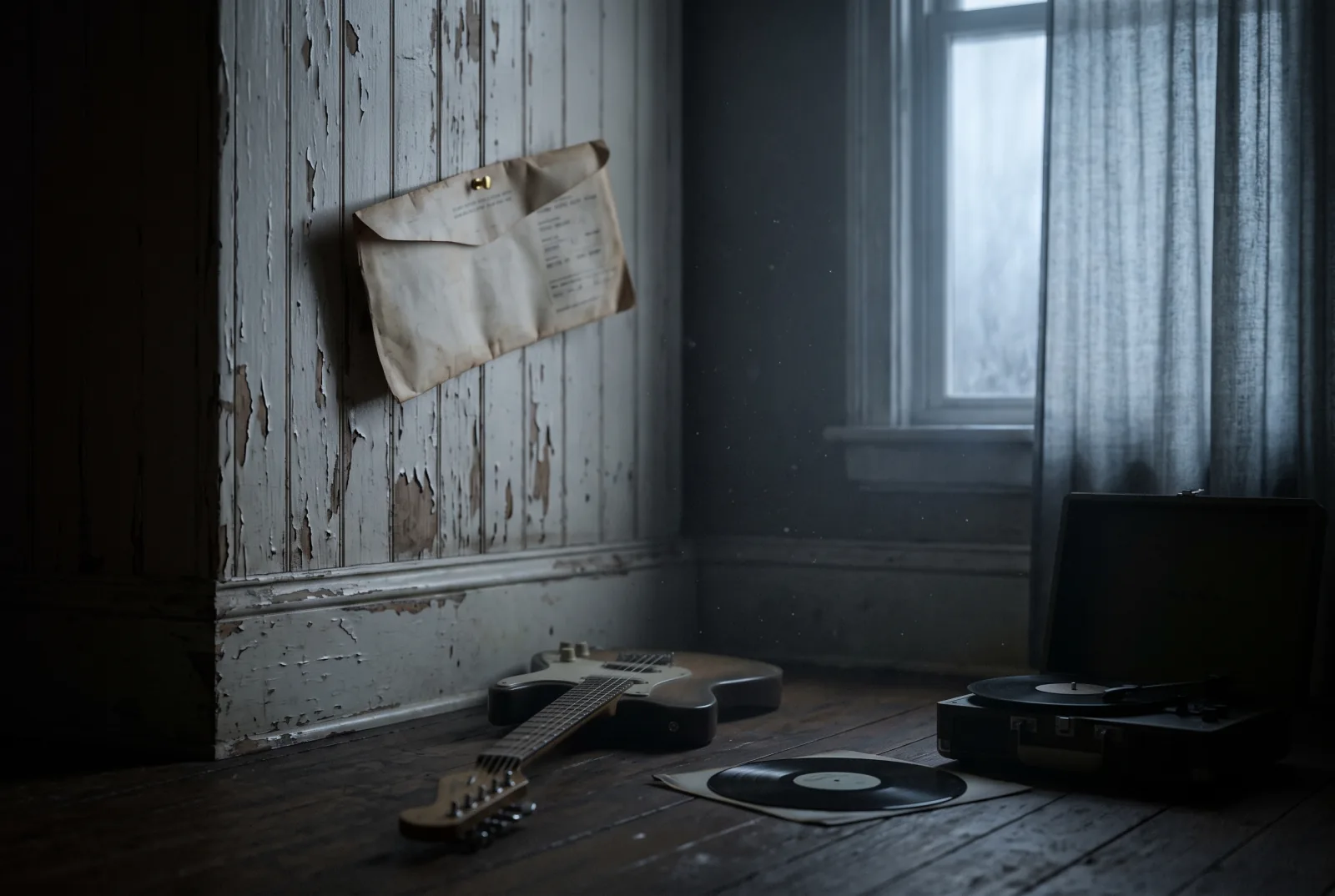
Ilustración: Rebobinados
In early 1994, in Seattle, a car is waiting outside a house. The driver waits an hour. Then five. Then ten. Inside is Kurt Cobain, who does not come out and does not answer the phone. On the wall there is a plane ticket he is not going to use.
Michael Stipe had sent it. It was not a contract or a business move: it was an excuse. Stipe wanted to get him out of that house and off the drugs, and to do it he invented a project. The legendary collaboration between the two most important bands of their generation — the one people still talk about — was never entirely an album. It was a man manufacturing a reason for his friend to pack a bag and get on a plane.
The friend stayed inside.
Real friends, not festival friends
It is worth spelling out, because in rock "friends" sometimes means they nodded at each other backstage. Not here. Stipe is the godfather of Frances Bean, Kurt and Courtney Love's daughter. R.E.M. were recording in Seattle and Peter Buck lived practically next door to them.
Cobain died on 5 April 1994, in the middle of the Monster sessions. R.E.M. put "Let Me In" on that album, written and recorded as a farewell. And there is a detail in it that says more than any obituary: Mike Mills played it on Cobain's own Fender Jag-Stang. Since Kurt was left-handed and Mills is right-handed, he had to play it backwards. A man seeing off a friend with the friend's guitar, held the wrong way round.
Monster came out that September.
The name does not mean what everyone thinks
Everyone repeats that R.E.M. stands for Rapid Eye Movement, the phase of sleep in which we dream. It is a lovely reading and probably false.
Stipe picked it at random from a dictionary, without looking for a meaning. And when William Dement, the scientist who discovered REM sleep, got in touch with the band, they told him the name did not come from there. There is another hypothesis: the photographer Ralph Eugene Meatyard, who signed his prints "r.e.m.". Among the names they rejected are "Cans of Piss" and "Negro Eyes". Sometimes history is generous.
It is also repeated that at their first concert they were called Twisted Kites. Not so: that name was on the reject list, not on the poster. Keep the word kite anyway, because it comes back at the end.
The first show was on 5 April 1980, at St. Mary's Episcopal Church in Athens, Georgia, converted into a home, at Kathleen O'Brien's birthday party. Four University of Georgia students playing sixties and seventies covers and a few songs of their own.
Yes: fourteen years later, on exactly the same calendar date, Cobain died.
The band that was in no hurry
For almost a decade R.E.M. were the kings of a small kingdom: college rock, university radio, records passed from hand to hand. Stipe sang almost unintelligibly on purpose, as if the words were a secret you had to earn.
The breakthrough came only in 1991 with "Losing My Religion", an extremely odd single to be a global hit: no traditional chorus, a mandolin in the lead, about unrequited love and doubt. There was no reason for it to work.
And even with success on top of them they kept something very rare in rock: composure. When Bill Berry collapsed on stage in Lausanne, on 1 March 1995, from a brain aneurysm, he made a full recovery within a month. But in October 1997 he left anyway, saying simply that he no longer had the enthusiasm he once had. They carried on as three. It was not the same, and they knew it.
Leaving in time
On 21 September 2011, after thirty-one years, they announced the end on their own website. No public fights, no lawsuits, nobody trashing anybody. "All things must end, and we wanted to do it right, to do it our way", Stipe wrote.
That is the thesis of their entire career. A legacy can be left intact, and the chance to do so comes only once.
It is impossible not to read that decision alongside the other one. Cobain also left the party, but through the wrong door and far too early — like so many others who could not or would not stay, in a scene that had already been taking its toll. Two artists who loved each other, two opposite ways of finishing. One knew how to leave; the other was taken by the exit.
The comet
The story could close there, tidy and sad. But in 2024 it added a final gesture that looks scripted.
That year, in an interview with CBS Mornings, they were asked what it would take for R.E.M. to play together again. Mike Mills answered half joking, to close the subject: a comet.
On 13 June, at the Songwriters Hall of Fame gala in New York, all four — Stipe, Buck, Mills and Berry — appeared by surprise and played "Losing My Religion" acoustically. It was their first public performance together since 2007. Billboard put it neatly: they said it would take a comet, and apparently they saw one.
And the story rhymes by itself, because the name they rejected minutes before their first concert in 1980 was Twisted Kites. The band they never became already had a kite inside it.
A few months earlier, in February, they had walked unannounced onto the stage of the 40 Watt Club in Athens — their town, where it all started — to join a tribute set and play "Pretty Persuasion".
But there will be no tour, and it is not bitterness: it is consistency. The whole point of having left well is not to ruin it now.
There is the elegance of R.E.M., the same in every chapter: in how they sang, how they grew, how they said goodbye and even in how they choose not to come back. They knew when to leave the party. If only Kurt had got on that plane.
If you are going through a difficult time, you are not alone. You can find a helpline for your country at findahelpline.com.
Sources
R.E.M. formed in Athens, Georgia, in 1980, made up of Bill Berry, Peter Buck, Mike Mills and Michael Stipe, students at the University of Georgia. Their first concert was on 5 April 1980 at St. Mary's Episcopal Church, converted into a home, during Kathleen O'Brien's birthday party. Stipe chose the name at random from a dictionary; although it is popularly associated with rapid eye movement sleep, when the researcher William C. Dement contacted the band they stated the name did not come from there, and there is an alternative hypothesis regarding the photographer Ralph Eugene Meatyard, who signed his prints "r.e.m.". Rejected names include "Cans of Piss", "Negro Eyes" and "Twisted Kites"; the band did not perform under the latter at their first concert. Michael Stipe is the godfather of Frances Bean Cobain. In 1994 Stipe planned a collaboration with Kurt Cobain and sent him a plane ticket, partly to get him away from his house and his addiction; the episode comes from Stipe's own statements reported in the press and not from a reference source. Cobain died on 5 April 1994, during the "Monster" sessions; the album was released on 26 and 27 September 1994 in the UK and the United States. "Let Me In" was written and recorded as a tribute to Cobain; Mike Mills played it on Cobain's Fender Jag-Stang, which, being left-handed, he had to play backwards, and Peter Buck used a Farfisa organ. "Losing My Religion" (1991) marked the band's mainstream breakthrough. Bill Berry suffered a brain aneurysm on stage in Lausanne, Switzerland, on 1 March 1995, recovered fully within a month and left the group in October 1997; the band continued as a trio. On 21 September 2011 they announced their dissolution; Stipe stated that "all things must end, and we wanted to do it right, to do it our way". On 13 June 2024, after Mills had joked on CBS Mornings that it would take "a comet", the four original members reunited by surprise at the Songwriters Hall of Fame gala in New York and performed "Losing My Religion" acoustically: their first public performance together since 2007. In February 2024 they joined a tribute set at the 40 Watt Club in Athens to play "Pretty Persuasion". Externally authored text, edited and verified for Rebobinados. Interpretations of the meaning of their work are offered as the author's reading. No song lyrics are reproduced, for copyright reasons. Information drawn from Wikipedia, Billboard and press coverage.
Keep rewinding
90s
indie
Portishead
A short film got them the record deal
Before the record they shot *To Kill a Dead Man*, eleven minutes of film noir written by the three of them: Geoff Barrow plays a sniper and Beth Gibbons a widow. That soundtrack got them the record deal, and the cover of *Dummy* is a still from the short. The rest is told wrong too: *Dummy* sold 3,600,000 copies and won the 1995 Mercury ahead of Oasis, Tricky and PJ Harvey. Three records in fourteen years, and eighteen without a fourth.
00s
indie
Peter Bjorn and John
The whistle was provisional
Björn Yttling whistled the melody of "Young Folks" as a placeholder, only so as not to forget it, and they decided to keep it. The single came out on 7 August 2006, with Victoria Bergsman as guest, and it was not no. 1 anywhere: no. 13 in the United Kingdom, no. 9 in Finland. Live it is whistled by Peter Morén, and the trio never broke up: nine albums.
00s
indie
Florence + the Machine
The catharsis had a name
The band formed in London in 2007 and "the Machine" comes from the keyboard player Isabella Summers. Florence Welch has said that she stopped eating at seventeen and that she stopped drinking around 2014: the catharsis in her music has a concrete content. She has five British number ones, the last with Everybody Scream (31 October 2025), nominated for the 2026 Mercury.
Rewind with us
Comments · 0
No one has commented yet. Open the conversation.