
Kurt Cobain
He never wanted to be that
By Rebobinados · Published on September 26, 2026
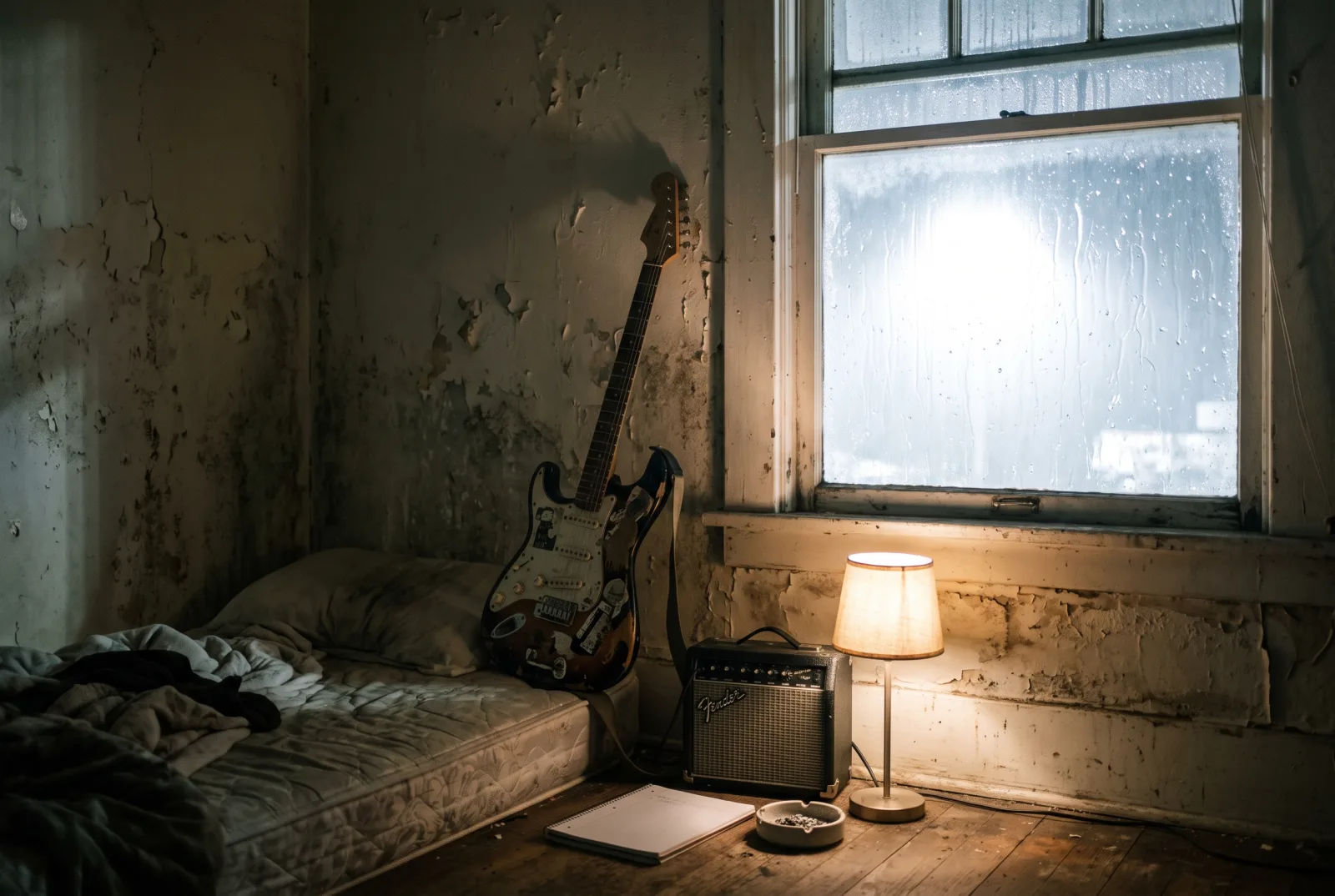
Ilustración: Rebobinados
Kurt Cobain was the singer, guitarist and songwriter of Nirvana, the band that in 1991 changed the course of popular music in a single blow.
With "Smells Like Teen Spirit" he swept the hairspray-and-stadium rock of the eighties off the radio and put something raw and honest in its place: grunge, born in the rain of Seattle, the same scene that produced Chris Cornell.
His voice went from a whisper to a scream in a second. His songs mixed rage and tenderness. And his contempt for everything fake turned him into the idol of millions.
That was where his tragedy lay: he never wanted to be what he became. At the end of this piece there is a painful part, handled with respect, and a note about where to find help.
An anthem born of a misunderstanding
The origin of the title of the song that changed everything is perfect in its absurdity, but it is worth telling properly, because it is almost always told by halves.
One night, Kathleen Hanna, of the band Bikini Kill, wrote in marker pen on the wall of Cobain's bedroom, in Olympia: "Kurt smells like Teen Spirit". They were drunk.
The popular version says she was telling him he was walking around with the smell of his girlfriend's deodorant on him. Hanna herself denies it: she says that reading is completely false.
What she tells is sillier and better. She had seen that brand of deodorant at the supermarket that day with Tobi Vail, the name had amused them, and they had been joking that things "smelled like Teen Spirit".
Cobain did not know the brand and understood none of it. He said so himself, years later: he did not know that deodorant existed until months after the single came out, and he had read it as a revolutionary slogan, because they had been talking about anarchism and punk rock.
With that misunderstanding he wrote the greatest anthem of his generation. The battle cry of a whole era was born because somebody did not catch that he was being told about a deodorant.
And he wrote the anti-commercial anthem while trying to have a hit: he said he was attempting to write the ultimate pop song and that he was basically ripping off the Pixies. He thought the riff was a cliché, so close to the one in Boston's "More Than a Feeling" that at Reading, in 1992, Nirvana opened the song by playing the Boston riff, as a joke.
The spokesman who did not want to be one
What defines Cobain, more than his success, is his tormented relationship with success.
Nirvana came out of independent punk, out of the ethic of the small and the authentic, out of the rejection of the commercial. And from one day to the next "Nevermind" exploded so completely that it knocked Michael Jackson off number one on the Billboard 200, on the chart dated 11 January 1992.
Cobain found himself turned into the biggest rock star on the planet and into "the voice of Generation X", a title he hated.
He was horrified at being idolised by the very people his music mocked; he felt they were buying the noise without understanding the message.
He was a shy, sensitive guy, from a broken home, who had become a punk precisely in order not to be part of the machinery. And the machinery swallowed him and put him at the top.
The bigger he got, the more trapped he felt. Few artists have been so unhappy while being so successful.
The pain behind it
Behind the fury of his music there were real pains, and they have to be named carefully.
Cobain suffered from a chronic stomach pain that no doctor managed to diagnose. He himself played it down at one point —he went so far as to say it was psychosomatic, that it all came from the rage— but he described it as a daily torture.
He also carried a deep depression. And he said that heroin was the only thing that calmed that pain: three days in a row using it and his stomach at peace, he said, and it was an enormous relief. From there he fell into a severe addiction.
In March 1994 he suffered a serious overdose in Rome, at the Hotel Excelsior, and was in a coma. At the time it was declared accidental: the doctor who treated him said it did not look to him like a suicide attempt, and Courtney Love maintained afterwards that it had been one. There was never a verdict.
A month later he took his own life at the family property in Seattle, in the room above the garage. The coroner estimated the date as 5 April 1994; his body was found three days later.
He was twenty-seven years old, the same age at which Hendrix, Joplin and Morrison died. He left a small daughter, Frances Bean.
What to remember
Kurt Cobain is proof that fame cures nothing, and that sometimes the one who shines brightest is the one having the worst time of it.
Put on "Smells Like Teen Spirit", "Come as You Are", "Heart-Shaped Box" or the harrowing "Where Did You Sleep Last Night" from his acoustic concert —an American traditional song that they took from Lead Belly's version— and you are going to hear a musician who put a sound to the anguish and the rage of a whole generation, with an honesty that hurt.
He did not want to be the leader of anything. He only wanted to make true songs and not to be confused with what he despised.
Remember him for that: for the ferocious honesty of his music, for having changed rock almost without meaning to, and for the fragile humanity that was there behind the noise.
This piece discusses suicide, depression and addiction. If you are going through a difficult time or having thoughts of harming yourself, you are not alone and help is available. In Chile you can call *4141 free of charge, the Ministry of Health's suicide-prevention line, available 24 hours a day. If you or someone you know is struggling with alcohol or drug use, SENDA's Drugs and Alcohol helpline answers free of charge 24 hours a day on 1412.
Sources
Kurt Donald Cobain (Aberdeen, Washington, 20 February 1967 – Seattle, c. 5 April 1994), singer, guitarist and main songwriter of Nirvana, the band he formed with Krist Novoselic in 1987; Dave Grohl joined in September 1990. With "Nevermind" (1991) and the single "Smells Like Teen Spirit" they took grunge and alternative rock to a mass audience; Cobain was acclaimed, to his own dismay, as "the voice of Generation X". "Nevermind" displaced Michael Jackson's "Dangerous" from number one on the Billboard 200 on the chart dated 11 January 1992, although it only held that position for two non-consecutive weeks; the single reached number six on the Hot 100 and number one on Modern Rock Tracks. The title comes from a phrase that Kathleen Hanna, of Bikini Kill, wrote in marker pen on the wall of Cobain's bedroom in Olympia. The usual version needs correcting: Hanna has expressly denied that she was alluding to the deodorant used by Tobi Vail, with whom Cobain had had a brief relationship that was already over; according to her account, she and Vail had seen the brand at the supermarket that day and were joking that things "smelled like Teen Spirit". Cobain, who did not know the brand, told Michael Azerrad that he did not know of its existence until months after the single was released and that he had interpreted it as a revolutionary slogan. Cobain suffered from chronic, undiagnosed stomach pains —which he himself went so far as to describe as psychosomatic— and from depression, and developed a heroin addiction that he explicitly linked to the relief of that pain. He was married to Courtney Love, with whom he had his daughter Frances Bean (18 August 1992). On 4 March 1994 he suffered an overdose at the Hotel Excelsior in Rome that left him in a coma; at the time it was classified as accidental, and Love maintained afterwards that there had been suicidal intent, with no public medical determination on the matter. He died by suicide in the room above the garage of his property on Lake Washington Boulevard East; the King County coroner estimated the date as 5 April 1994 and the body was found on 8 April. He was 27 years old. "Where Did You Sleep Last Night" is an American traditional song traceable to the 1870s, also known as "In the Pines", which Nirvana performed following Lead Belly's 1944 version. Nirvana entered the Rock and Roll Hall of Fame in 2014. Externally authored text, edited and verified for Rebobinados. Interpretations of the meaning of his work are offered as the author's reading. No song lyrics are reproduced, for copyright reasons. Information drawn from Britannica, Billboard, Wikipedia, ABC Australia and other coverage.
Keep rewinding

90s
grunge
Eddie Vedder
His dead father sings on his record
He grew up in San Diego called Edward Mueller and learned at 17 that his father was the lounge musician he had been introduced to as a friend of the family, dead of multiple sclerosis in January 1981. Out of that came "Alive", "Once" and "Footsteps", written in a single day on 13 September 1990. Thirty-one years later, the credits of *Earthling* include one line: "Edward Severson Jr. – vocals (13)".

90s
grunge
Pearl Jam
They testified and they lost
On 6 May 1994 Pearl Jam filed a memorandum with the Antitrust Division of the Department of Justice and on 30 June Stone Gossard and Jeff Ament testified in the House of Representatives. On 5 July 1995 the DOJ closed the investigation without acting: the boycott lasted until 1998, cost them some nine million dollars and three years almost without playing in their own country. And *Ten* never reached number one: Billy Ray Cyrus blocked it.

90s
grunge
Blind Melon
It was about not being able to get out of bed
Everybody believes "No Rain" is about not fitting in. It was written by the bassist Brad Smith before the band existed, about a girlfriend with depression who slept through sunny days: it is about not being able to get out of bed. The belonging was invented by Samuel Bayer's video. And there are two bee girls: Heather DeLoach, 10, in the video, and Georgia Graham, the drummer's sister, on the cover. Real peak on the Hot 100: no. 20.
Rewind with us
Comments · 0
No one has commented yet. Open the conversation.