
Pearl Jam
They testified and they lost
By Rebobinados · Published on October 11, 2026
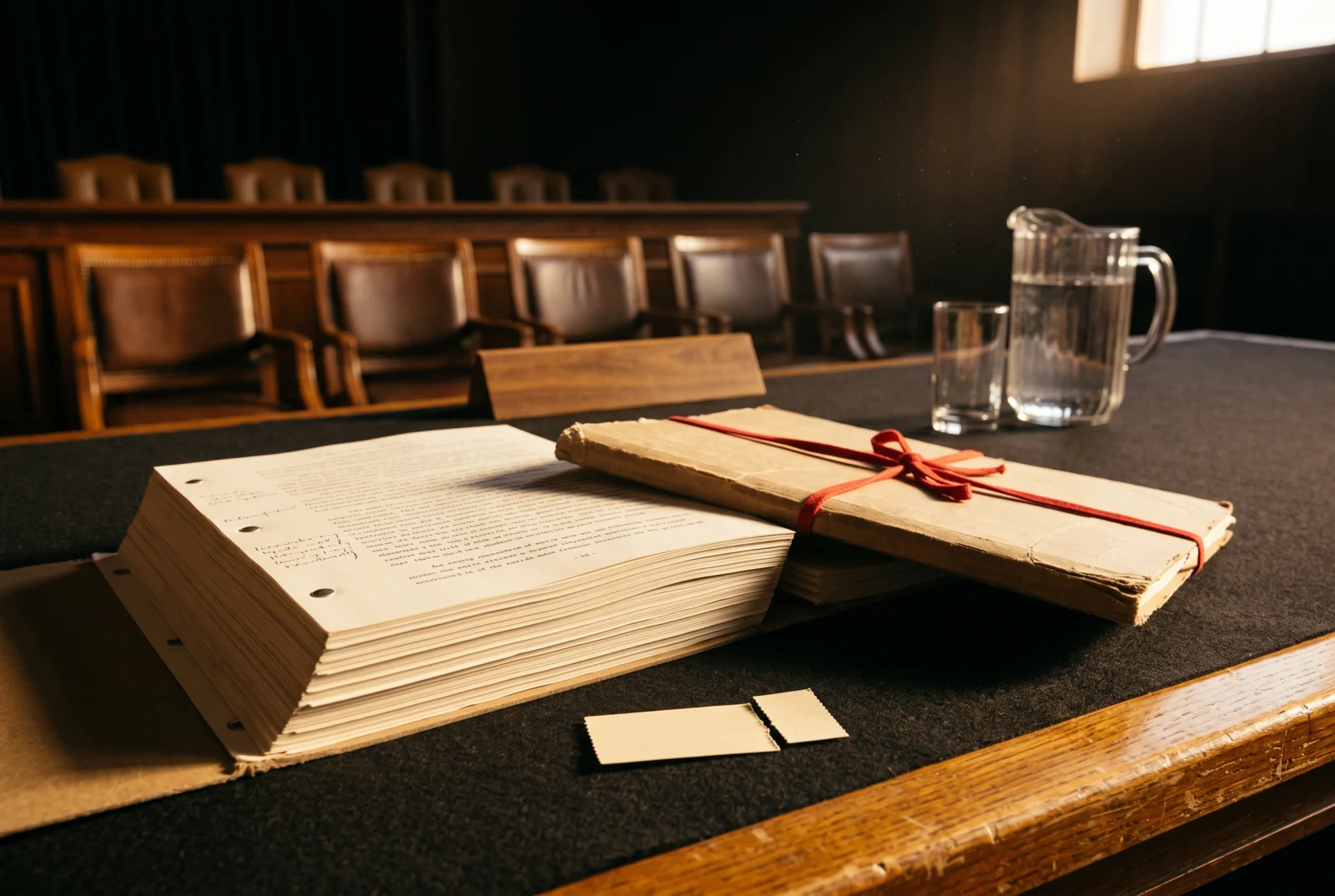
Ilustración: Rebobinados
Of Pearl Jam's fight with Ticketmaster it is almost always the first half that gets told. The band refused to let their audience be charged surcharges that at some venues came to more than seven dollars a ticket, took the matter to Washington and two of its members sat down to testify before a subcommittee of the House of Representatives. The second half almost never gets told: the Department of Justice closed the investigation without acting against anybody, practically no other band joined the boycott, and the stand cost them four years, an entire tour and the possibility of playing in their own country. Jeff Ament summed it up talking about the 1995 tour: that "pretty much killed us". They testified and they lost, and told that way the story is bigger than the heroic version, not smaller.
Mookie Blaylock, and Jack Irons carried the tape
The ashes Pearl Jam came out of have a name and a date. Stone Carpenter Gossard, rhythm guitar, and Jeffrey Allen Ament, bass, came from Green River, which broke up in 1988, and from Mother Love Bone, which ended on the nineteenth of March 1990 with the death of its singer, Andrew Wood, at twenty-four, from a heroin overdose and two days on life support. Apple, that band's only album, came out four months after they buried him. What came next was not an orderly reconstruction: Gossard reconnected with Michael David McCready, lead guitar and a childhood friend, on seeing him play, and it was McCready who pushed him to call Ament again.
The trio recorded a tape with five instrumentals looking for a singer and a drummer. That tape did not travel to San Diego on its own: it was carried by Jack Irons, former drummer of Red Hot Chili Peppers, whom Ament and Gossard had earlier offered the drum seat and who had said no. He passed it to a friend of his who sang in a local band called Bad Radio, Edward Louis Severson III, known as Eddie Vedder, who was no unknown surfer but a working musician. Vedder wrote lyrics for three of those instrumentals — the ones that would end up being "Alive", "Once" and "Footsteps" — and sent the tape back. With Dave Krusen on drums, the five of them played their first concert on the twenty-second of October 1990 at the Off Ramp Café in Seattle. And the first record on which Vedder's voice is heard is not a Pearl Jam record: it is Temple of the Dog, the tribute to Wood put together by Chris Cornell, the dead man's flatmate, recorded in fifteen days in late 1990 at the London Bridge Studio with Rick Parashar and released on the sixteenth of April 1991, four months before the debut. There Vedder sings the second lead vocal of "Hunger Strike" and the drums are played by Matt Cameron, eight years before he joined Pearl Jam.
The name at that first concert was Mookie Blaylock, Ament's favourite NBA point guard, and they had to drop it in 1991 on signing to Epic because it belonged to a real person. What was left of the player was his shirt number on the cover of the debut: Ten. What came in to replace it drags along a legend its own author disowned: Vedder said in an early interview that "pearl" came from his great-grandmother Pearl, married to an indigenous man, who had a recipe for jam with peyote in it, and on a Rolling Stone cover in 2006 he said that story was "total bullshit". The real origin, according to Ament and McCready, is less picturesque: the word "pearl" was Ament's contribution and the "jam" was added after going to a Neil Young concert at which the songs stretched out into improvisations of fifteen to twenty minutes.
Nine months to the top ten
Ten was released on the twenty-seventh of August 1991, recorded in March and April of that year at the London Bridge Studio in Seattle with Parashar producing and Krusen on drums, and it was not an explosion. It took nine months to get into the top ten of the Billboard 200: it did so on the thirtieth of May 1992, at number eight. It never reached number one. It peaked at two, for four weeks, blocked by Some Gave All by Billy Ray Cyrus, and it stayed two hundred and sixty-four weeks on the chart before ending up certified thirteen times platinum. The line that gets repeated — that with the debut the world came crashing in on them — is exactly the opposite of what happened: Ten was a slow burn, and that is the best fact about the record.
Nor is the anthem as home-grown as it looks. The riff of "Alive" was not born in Pearl Jam: Gossard composed it in 1990, when he was still in Mother Love Bone, as an instrumental titled "Dollar Short"; the music is his and the lyric is Vedder's. It came out as a single on the seventh of July 1991, fifty-one days before the album, and it never entered the Hot 100, because in the United States it was not sold commercially until June 1995. "Black", the other song everybody takes for a single, was never released as one, and not by the label's decision but because the band refused: Vedder personally called radio programmers to make sure Epic had not put it out behind their backs. Even so it reached number three on Mainstream Rock.
And "Jeremy" is not what most people think. The music is Jeff Ament's, not Vedder's, who is credited with the lyric. The case is a specific one: Jeremy Wade Delle, fifteen years old, a sophomore at Richardson High School in Richardson, Texas, took his own life in front of his second-period English class on the eighth of January 1991, and Vedder read about it in the press. It was not a school shooting, it was a suicide, and the misunderstanding has a traceable origin: MTV cut the shots of the weapon out of its broadcast version, under its rules on violence, and with that edit the boy was no longer shooting himself, so a lot of people understood that he was killing his classmates. With the censored video, directed by Mark Pellington, they won four MTV awards on the second of September 1993, among them Video of the Year. After the Columbine massacre, in 1999, MTV and VH1 practically stopped airing it.
The memorandum of the sixth of May 1994
It is worth measuring where they launched from. Vs. came out on the nineteenth of October 1993, debuted at number one and sold nine hundred and fifty thousand copies in its first week, pulverising the previous record of seven hundred and seventy thousand set by Use Your Illusion II by Guns N' Roses, and they managed it without shooting a single video clip for any of the album's four singles. That was the band that seven months later turned up in Washington. The grievances that took them there are three and they are all dated. In September 1992, at the free "Drop in the Park" concert at Magnuson Park in Seattle, paid for in full by the band as a voter registration drive, Ticketmaster demanded a dollar fifty a ticket — some forty-five thousand dollars — for distributing tickets that cost nothing. In December 1993, at a benefit in the same city, it threatened to pull out unless the surcharge went up by a dollar and then broke its promise to donate it in full. In March 1994, in Chicago, it refused to print its three dollars seventy-five surcharge separately until the band threatened to move the show to another venue. And what they denounced was not "prices" in the abstract: it was the per-ticket surcharge and the monopoly over distribution. Their plan was to sell at eighteen dollars with the surcharge capped at ten per cent, a dollar eighty; according to their testimony, at Los Angeles venues the company was charging between three dollars fifty and seven twenty-five, and in one case cited as much as fifteen.
The channel matters, because the press distorts it to this day. There was no lawsuit. On the sixth of May 1994, Pearl Jam filed a memorandum with the Antitrust Division of the Department of Justice, drafted by the New York firm Sullivan & Cromwell, arguing that Ticketmaster had a "virtually absolute" monopoly over ticket distribution and that it had pressured promoters to boycott their low-price tour. It was an administrative complaint that opened an investigation, never a suit nor a judgement. On Thursday the thirtieth of June, Gossard and Ament testified before the Subcommittee on Information, Justice, Transportation and Agriculture of the House of Representatives' Government Operations Committee: they said they could not keep tickets under twenty dollars because of the surcharges and pointed out that a good part of their audience were teenagers who could not pay fifty. Congressman John Dingell proposed, as a result of all that, a law that would require full disclosure of surcharges. On the other side, at the same witness table, was Fred Rosen, Ticketmaster's chief executive, who maintained that the average surcharge over the previous five years was around three dollars and that the company's margin was about ten cents a ticket; his testimony went unchallenged in the room. The corporate line that is remembered from the case was not said there: it had been written a month earlier by a vice-president of the company, Ned S. Goldstein, in a letter to the Los Angeles Times —"TicketMaster operates fully and squarely within the parameters of all applicable laws"— published on the twenty-eighth of May 1994. Among the shareholders, Paul G. Allen, co-founder of Microsoft: it was Seattle against Seattle as well.
On the fifth of July 1995, the Department of Justice closed the investigation without acting: the lawyers doubted they could win the case, and the Washington Post headlined it the next day "Ticketmaster Cleared". The band lost, and even so it kept up the boycott. It had already cancelled the summer 1994 tour on failing to find enough venues with no contract with the company — their manager put at some nine million dollars what they would have earned from it — and the Vitalogy tour of 1995, set up with other ticketing companies, was a logistical disaster in which almost nobody went with them: on the twenty-fourth of June, at Golden Gate Park in San Francisco, Vedder came out of a hospital with food poisoning, sang seven of twenty-one songs and Neil Young took the vocals for the rest of the concert. The practical effect was that the band was left all but unable to play in the United States for about three years; the return to large-scale touring, and to Ticketmaster, came in the summer of 1998 with the Yield tour. There was one more casualty, and it is the one that best measures the price: David James Abbruzzese, who recorded Vs. and Vitalogy, was fired in August 1994 — the band presented it at first as an amicable parting and he contradicted that, saying he had not taken part in the decision and had not been given a reason — and among the reasons that have been given are political differences. Abbruzzese confirmed it himself: he did not agree with the Ticketmaster business, although he said he bore nobody any grudge.
Nine dead and five drummers
On Friday the thirtieth of June 2000, on the Orange Stage of the Roskilde Festival in Denmark, with some fifty thousand people in front of them and the ground wet from days of rain, nine people in the audience died, males from seventeen to twenty-six years old, and twenty-six were injured; eight died on the spot, of asphyxia, and the ninth, an Australian, on the fifth of July. According to the band's documentary archive, the first falls happened during "Even Flow", the sixth song, and some twenty minutes and six more songs went by before anybody told the group the gravity of what was happening. Vedder stopped the concert as soon as he knew, asked the audience again and again to move back and, when the bodies were found, stayed crouched on the stage. The Danish authorities did not publish the names, by law, to protect the families. The band played again on the third of August 2000 in Virginia Beach and in 2002 put the song "Love Boat Captain", which names the nine, on Riot Act.
What the investigations ruled is worth stating exactly as it stands. A first police report of December 2000 concluded that the cause had been "a chain of unfortunate circumstances" and pointed to the bad sound at the back as the main factor, which pushed the crowd to move forward towards the stage. A second investigation, published in the summer of 2002, determined that there was no reason to presume that anything punishable had been done: nobody was charged or convicted. Apart from that there was an episode that gets quoted without its denial. On the nineteenth of July 2000, NME published that a police report handed to the Danish Parliament two days earlier held Pearl Jam "morally responsible" for the tragedy, with a quote from Roskilde's Deputy Chief Constable, Bent Rungstrom, about witnesses saying the band almost appealed for violent behaviour; manager Kelly Curtis called it "appalling and ludicrous". On the twenty-fifth of July the Roskilde Chief Constable, Uffe Kornerup, publicly denied that reading: the band could not be held legally responsible under Danish law and, as for the rest, "we never blamed the band for anything and are completely puzzled by the reports claiming we did". The "moral responsibility", then, is in neither of the two rulings.
The other thing the story of their longevity tends to skip is the drummer count: there have been five official ones and none of them is still in the seat. Krusen plays all of Ten and left on the twenty-fifth of May 1991 to go into rehab for alcoholism. Matt Chamberlain lasted a summer and took the job in the house band of Saturday Night Live: his only filmed trace is that he is the one playing drums in the video clip of "Alive", shot on the third of August 1991, his last day in the group. Abbruzzese was there from 1991 to 1994. Jack Irons, the one with the tape, finally joined in October 1994, recorded No Code and Yield and left on the twentieth of March 1998 because he could not stand the length of the tours; he has spoken publicly about his bipolar disorder. Matt Cameron joined in June 1998 and stayed twenty-seven years. When the band entered the Rock and Roll Hall of Fame on the seventh of April 2017, at the Barclays Center in Brooklyn and in its first year of eligibility, they were inducted by David Letterman — Neil Young had been announced to do it and was absent through illness — and of the five drummers the Rock Hall included only two: Krusen, the first, who sat down to play "Alive" that night, and Cameron, the incumbent. Chamberlain, Abbruzzese and Irons were left out, and Abbruzzese fought it in public.
The present does not look like a settled line-up either. Cameron announced his departure on the seventh of July 2025; his last concert had been on the eighteenth of May that year at the PPG Paints Arena in Pittsburgh, the close of the forty-eight concerts of the Dark Matter tour. Then came sixteen months without playing a full concert, until the Ohana Festival in Dana Point, California, where Pearl Jam turned up by surprise on the twenty-fifth of September 2026 and headlined on Sunday the twenty-seventh, with Abe Laboriel Jr. — Paul McCartney's drummer — behind the drums. Vedder introduced him as somebody who was "sitting in on drums", and as of October 2026 neither he nor the band has confirmed him as a member. There is no announcement of a new album or of a tour.
What to remember
Pearl Jam is not the band that won the fight against the industry: it is the band that lost it and stayed standing for thirty-six years. The memorandum of May 1994 was not a lawsuit, the testimony in June got them nothing, and the closing of the investigation, in July 1995, left Ticketmaster intact and the band without stages in its own country. The cost was a tour, a drummer and three years. That they sell tickets today through the same system erases none of that: what remains is that in 1994 the guitarist and the bassist of the band that had just broken the one-week sales record sat down before a congressional subcommittee to explain what a surcharge costs.
The rest of the facts correct in the same direction. Ten was not an explosion but nine months of climbing to number eight and a number one that never came; "Alive" came from an earlier band; "Black" was not a single because they did not want it to be; and "Jeremy" tells the suicide of a fifteen-year-old boy that MTV made unrecognisable by cutting a few shots. At Roskilde nine people died and two Danish reports closed with nobody charged. When the riff of "Alive" sounds and a whole stadium sings it, there is what they really are: four musicians who did the arithmetic, decided it was worth it and paid the bill in full, with a drummer's stool behind them that has not stopped changing. If you or someone you know is going through a crisis or thinking about suicide, in Chile you can call *4141 free of charge, the Ministry of Health's line, available twenty-four hours a day.
Sources
Pearl Jam is an American rock band formed in Seattle, Washington, in 1990 under the name Mookie Blaylock — Jeff Ament's favourite NBA point guard — and renamed Pearl Jam in 1991 on signing to Epic Records; the title of the debut, "Ten", is Blaylock's shirt number. Founding line-up: Stone Carpenter Gossard (rhythm guitar, b. 20 July 1966, Seattle), Jeffrey Allen Ament (bass, b. 10 March 1963, Havre, Montana), Michael David McCready (lead guitar, b. 5 April 1966, Pensacola, Florida), Edward Louis Severson III, known as Eddie Vedder (vocals, b. 23 December 1964, Evanston, Illinois) and Dave Krusen (drums). First concert: 22 October 1990, Off Ramp Café, Seattle. Gossard and Ament came from Green River (1984-1988) and from Mother Love Bone (1988-1990), a band ended by the death of Andrew Patrick Wood (b. 8 January 1966) on 19 March 1990, aged 24, from a heroin overdose after two days on life support; "Apple", Mother Love Bone's only album, was released on 19 July 1990 on Stardog/Mercury. "Temple of the Dog", put together by Chris Cornell in tribute to Wood, was recorded in 15 days in November and December 1990 at London Bridge Studio (Seattle) with Rick Parashar and released on 16 April 1991 on A&M Records, with Matt Cameron on drums and Eddie Vedder on backing vocals and as co-lead vocal of "Hunger Strike"; it reached no. 5 on the Billboard 200 and platinum certification after the 1992 reissue. "Ten" was released on 27 August 1991 (Epic), recorded in March and April 1991 at London Bridge Studio with production by Rick Parashar and the band, mixing by Tim Palmer and Dave Krusen on drums: it entered the top 10 of the Billboard 200 on 30 May 1992 at no. 8, nine months after its release; it peaked at no. 2 for 4 weeks, blocked by "Some Gave All" by Billy Ray Cyrus; no. 18 in the United Kingdom; 264 weeks on the chart and 13 times platinum by the RIAA (13 million copies in the US as of February 2013). "Alive" (music by Stone Gossard, written in 1990 in Mother Love Bone as the instrumental "Dollar Short"; lyric by Eddie Vedder) was released as a single on 7 July 1991: no. 16 Mainstream Rock, no. 18 Alternative Airplay, no. 16 United Kingdom, no. 9 Australia; it did not enter the Hot 100 because it was not sold commercially in the US until 27 June 1995. "Even Flow" reached no. 3 on Mainstream Rock in 1992. "Black" (music by Gossard, lyric by Vedder) was never released as a commercial single, by the band's decision, and reached no. 3 on Mainstream Rock. "Jeremy" (music by Jeff Ament, lyric by Vedder) was released on 17 August 1992 in Australia and Europe and on 27 June 1995 in the US: no. 5 Mainstream Rock, no. 5 Modern Rock, no. 15 United Kingdom and no. 79 on the Hot 100 on the 1995 reissue. The lyric is based on the suicide of Jeremy Wade Delle, 15 years old, a sophomore at Richardson High School in Richardson, Texas, on 8 January 1991, in front of his second-period English class; Vedder has said that it mixes that case with the memory of a high-school classmate of his in San Diego. The video clip, directed by Mark Pellington, premiered on 1 August 1992; MTV cut the shots of the weapon out of its broadcast version under its rules on violence, an edit that gave rise to the misunderstanding that it was about a school shooting. On 2 September 1993 it won four MTV awards: Video of the Year, Best Group Video, Best Metal/Hard Rock Video and Best Direction. After the Columbine massacre, in 1999, MTV and VH1 practically stopped airing it. "Vs." was released on 19 October 1993 (Epic): it debuted at no. 1 with 950,378 copies in its first week according to SoundScan, beating the record of 770,000 set by "Use Your Illusion II" by Guns N' Roses; 5 weeks at no. 1, no. 2 in the United Kingdom, 7 times platinum; the record stood until "Double Live" by Garth Brooks, in November 1998. None of its four singles — "Go", "Daughter", "Animal" and "Dissident" — had a video clip; "Daughter" reached no. 1 on Modern Rock and Album Rock. On 20 September 1992, the band paid in full for the free concert "Drop in the Park" at Magnuson Park, Seattle, as a voter registration drive; the "Seattle Times" of 21 September put attendance at 29,000 people and Ticketmaster charged 1.50 dollars a ticket, some 45,000 dollars. In December 1993 Ticketmaster threatened to pull out of a benefit in Seattle unless the surcharge went up by a dollar and then did not donate that surcharge as it had promised; in March 1994, in Chicago, it refused to print its 3.75 dollar surcharge separately. On 6 May 1994 Pearl Jam filed a memorandum with the Antitrust Division of the Department of Justice, drafted by the firm Sullivan & Cromwell, alleging a "virtually absolute" monopoly over ticket distribution and pressure on promoters to boycott their low-price tour; it was not a lawsuit and there was no judgement. The band's plan was to sell tickets at 18 dollars with the surcharge capped at 10 %, 1.80 dollars; according to their testimony, Ticketmaster was charging between 3.50 and 7.25 dollars a ticket at Los Angeles venues, more than 2 dollars per telephone order and as much as 15 dollars in one case cited. On Thursday 30 June 1994, in Washington D.C., Stone Gossard and Jeff Ament testified before the Subcommittee on Information, Justice, Transportation and Agriculture of the House of Representatives' Government Operations Committee; Congressman John Dingell proposed legislation on full disclosure of surcharges. The witness list for that day, per Billboard (9 July 1994, pp. 1 and 99), was: Gossard and Ament first; then Tim Collins, Aerosmith's manager; Chuck Morris, the Nitty Gritty Dirt Band's manager; Joe Rascoff, managing director of RZO Inc.; Bertis Downs, R.E.M.'s attorney; Claire Rothman, general manager of the Los Angeles Forum; the critic Dave Marsh; and for Ticketmaster its chief executive Fred Rosen, who testified that the average surcharge over the previous five years was about $3 and the company's margin about 10 cents a ticket, with nobody challenging him in the room. Ned S. Goldstein, Ticketmaster vice-president, did not appear: his line "TicketMaster operates fully and squarely within the parameters of all applicable laws" comes from a company letter to the Los Angeles Times reported by Chuck Philips on 28 May 1994, a month before the hearing. Ben Liss, of the North American Concert Promoters Association, warned promoters of possible lawsuits in letters of 24 and 25 March 1994, not at the hearing. Paul G. Allen, co-founder of Microsoft, was a shareholder in the company. On 5 July 1995 the Department of Justice closed the antitrust investigation without acting against Ticketmaster; the "Washington Post" ran the headline "Ticketmaster Cleared" on 6 July. The band cancelled its summer 1994 tour — their manager put at some 9 million dollars what went unearned, a figure from a secondary source — and kept up the boycott: the "Vitalogy" tour of 1995 (36 concerts, with Jack Irons on drums) was set up with other ticketing companies, and on 24 June 1995, at Golden Gate Park in San Francisco and in front of 50,000 people, Vedder sang 7 of 21 songs after a bout of food poisoning and Neil Young took over the vocals for the rest of the concert. The return to large-scale touring and to Ticketmaster came in the summer of 1998 with the "Yield" tour. Jeff Ament summed up the 1995 tour by saying that it "pretty much killed us". David James Abbruzzese joined on 23 August 1991, recorded "Vs." (1993), "Vitalogy" (1994) and the "MTV Unplugged", played his last concert on 17 April 1994 in Atlanta and his dismissal was announced in August 1994; the band spoke first of a mutual and amicable parting and he contradicted that, stating that he had not taken part in the decision and that he was not given a reason. Among the reasons cited are political differences — Abbruzzese was against the Ticketmaster boycott, which he confirmed himself — and clashes of character. Official drummers: Dave Krusen (late 1990 to 25 May 1991, leaving to go into rehab for alcoholism), Matt Chamberlain (summer 1991 to 3 August 1991, appears playing in the video clip of "Alive"), Dave Abbruzzese (1991-1994), Jack Steven Irons (October 1994 to 20 March 1998; "No Code" and "Yield"; has spoken publicly about his bipolar disorder) and Matthew David Cameron (b. 28 November 1962, San Diego; from June 1998 to his departure announcement on 7 July 2025, 27 years, from "Binaural" to "Dark Matter"). On 30 June 2000, on the Orange Stage of the Roskilde Festival (Denmark), in front of some 50,000 people and with the ground wet from the rain, nine male members of the audience between 17 and 26 years old died and 26 were injured, three of them seriously; eight died on the spot of asphyxia and the ninth, an Australian, on 5 July 2000. The incident happened between 22:15 and 22:30, after twelve songs; the Danish authorities did not publish the names, by law. A first police report of December 2000 attributed the cause to "a chain of unfortunate circumstances" and pointed to the bad sound in the rear area as the main factor; a second investigation, published in the summer of 2002, determined that there was no reason to presume punishable conduct and nobody was charged. On 19 July 2000 NME published that a police report handed to the Danish Parliament on 17 July held Pearl Jam "morally responsible", quoting Roskilde's Deputy Chief Constable, Bent Rungstrom ("we have spoken to numerous witnesses who have told us that Pearl Jam are well known for almost appealing for violent behaviour"); manager Kelly Curtis replied on 20 July that the accusation was "appalling and ludicrous". On 25 July 2000 the Roskilde Chief Constable, Uffe Kornerup, publicly denied that reading —"we never blamed the band for anything and are completely puzzled by the reports claiming we did"— and pointed out that the band could not be held legally responsible under Danish law (Pollstar, 25 July 2000). Neither of the two official reports attributes responsibility to the band. The band played again on 3 August 2000 in Virginia Beach, Virginia, and on 12 November 2002 released "Riot Act", with "Love Boat Captain", a song that names the nine who died. Stone Gossard called the event "our worst nightmare" in the 20th-anniversary statement, in 2020. "Last Kiss", released on 8 June 1999, is a cover of the song Wayne Cochran recorded in 1961 and reached no. 2 on the Billboard Hot 100: the band's highest-charting single in the US; it appeared on the benefit album "No Boundaries: A Benefit for the Kosovar Refugees". Studio discography: "Ten" (27 August 1991, no. 2), "Vs." (19 October 1993, no. 1), "Vitalogy" (22 November 1994, no. 1), "No Code" (27 August 1996, no. 1), "Yield" (3 February 1998, no. 2), "Binaural" (16 May 2000, no. 2), "Riot Act" (12 November 2002, no. 5), "Pearl Jam" (2 May 2006, no. 2), "Backspacer" (20 September 2009, no. 1), "Lightning Bolt" (15 October 2013, no. 1), "Gigaton" (27 March 2020, no. 5) and "Dark Matter" (19 April 2024, no. 5, their 13th top 10, with "Dark Matter" and "Wreckage" at no. 1 on Mainstream Rock Airplay). Pearl Jam entered the Rock and Roll Hall of Fame on 7 April 2017 at the Barclays Center in Brooklyn, in its first year of eligibility; the induction was done by David Letterman in place of Neil Young, absent through illness. The Rock Hall included six members: Eddie Vedder, Stone Gossard, Mike McCready, Jeff Ament, Matt Cameron and Dave Krusen; Matt Chamberlain, Dave Abbruzzese and Jack Irons were left out. Krusen played "Alive" at the ceremony. Josh Klinghoffer is a touring musician, not a member, since 18 September 2021. The "Dark Matter" tour comprised 48 concerts on three continents, from 4 May 2024 to 18 May 2025 at the PPG Paints Arena in Pittsburgh. After 16 months without a full concert, the band turned up by surprise on 25 September 2026 at the Ohana Festival at Doheny State Beach, Dana Point, California, and headlined on Sunday 27, with Abe Laboriel Jr. on drums and Billy Strings as a guest; Vedder introduced him as somebody "sitting in on drums" and, as of October 2026, he has not been confirmed as a member of the band. There is no announcement of a new album or of a tour. The five founders are alive as of October 2026. Profile compiled for Rebobinados with fact-checking; interpretations of the meaning of the work are offered as the author's reading. No song lyrics are reproduced, for copyright reasons. Information drawn from Wikipedia, the "Seattle Times" (21 September 1992 and 28 May 1994), the "Washington Post" (6 July 1995), "Rolling Stone", "Billboard" (9 July 1994, pp. 1 and 99), "Variety", NME (19 and 20 July 2000), Pollstar (25 July 2000), ABC News, Consequence, Ultimate Classic Rock, the official Rock & Roll Hall of Fame entry, the Five Horizons archives — which include the transcript of the testimony of 30 June 1994 — and pearljamonline.it.
Keep rewinding
90s
grunge
Eddie Vedder
His dead father sings on his record
He grew up in San Diego called Edward Mueller and learned at 17 that his father was the lounge musician he had been introduced to as a friend of the family, dead of multiple sclerosis in January 1981. Out of that came "Alive", "Once" and "Footsteps", written in a single day on 13 September 1990. Thirty-one years later, the credits of *Earthling* include one line: "Edward Severson Jr. – vocals (13)".
90s
grunge
Blind Melon
It was about not being able to get out of bed
Everybody believes "No Rain" is about not fitting in. It was written by the bassist Brad Smith before the band existed, about a girlfriend with depression who slept through sunny days: it is about not being able to get out of bed. The belonging was invented by Samuel Bayer's video. And there are two bee girls: Heather DeLoach, 10, in the video, and Georgia Graham, the drummer's sister, on the cover. Real peak on the Hot 100: no. 20.
90s
grunge
Candlebox
The farewell that wasn't
In 2023 they released a farewell record and a final tour that ended up fraying out at Club Chocolate in Santiago. As of October 2026 they are still on the road: 32 dates, 8 new songs and an album for 2027. Kevin Martin explains it without embarrassment: "I was done. And the minute you say that, your value goes up tenfold". Before that came a 4× platinum debut, no. 7 on the Billboard 200 and a "C" from Robert Christgau.
Rewind with us
Comments · 0
No one has commented yet. Open the conversation.