
Cat Stevens
Letting it all go
By Rebobinados · Published on September 22, 2026
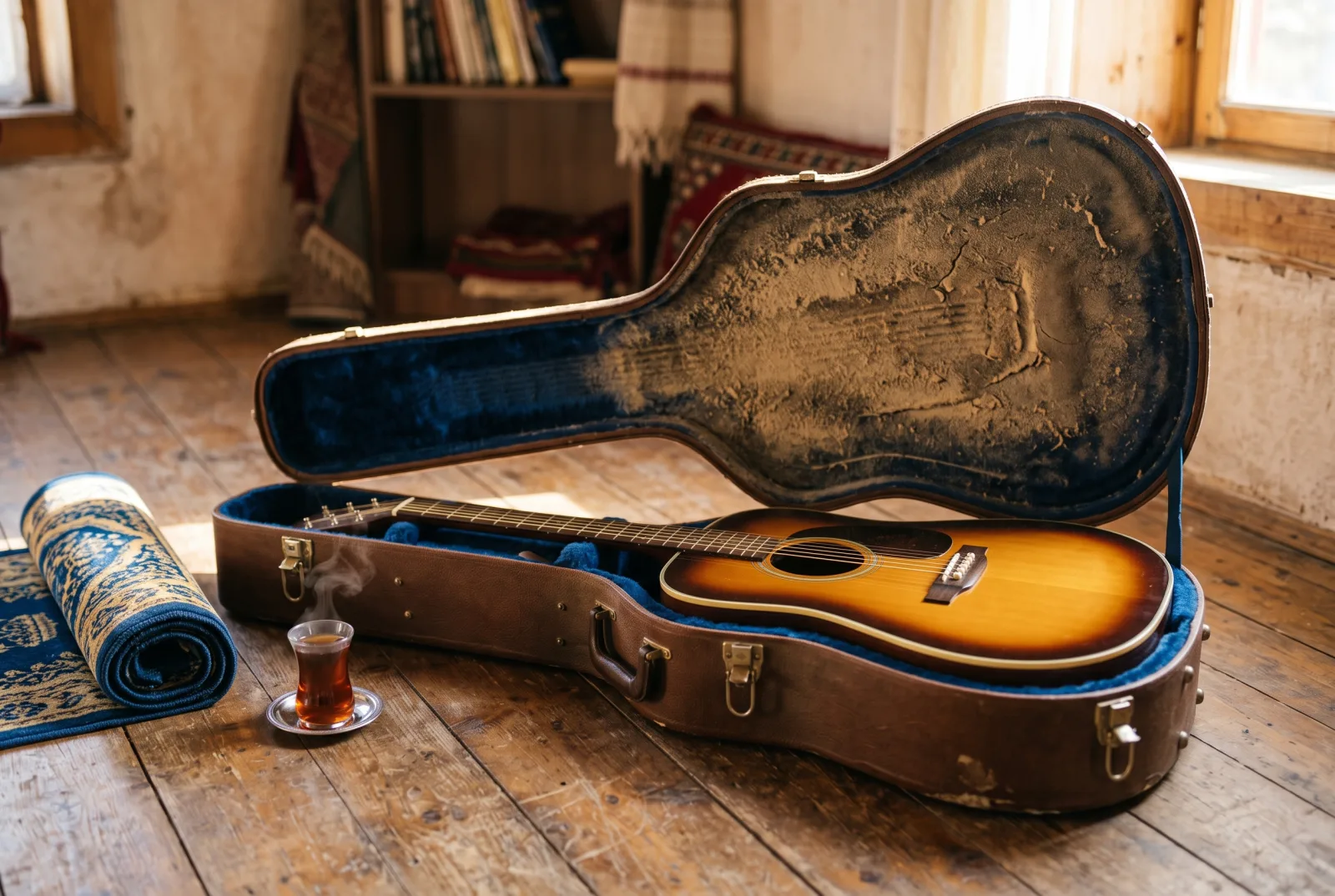
Ilustración: Rebobinados
Cat Stevens was one of the most beloved and delicate singer-songwriters of the seventies, the author of songs that feel like hugs: gentle, wise, full of peace and of deep questions about life.
"Father and Son", "Wild World", "Peace Train", "Moonshadow". Songs that several generations have sung in moments of love, of farewell, of searching.
But his story is much more than that of a successful musician.
It is the story of a man who came close to dying, who walked away from everything at the top for a spiritual search, and who almost three decades later sang again.
Songs that console
Steven Demetre Georgiou was born in London in 1948, the son of a Greek Cypriot father and a Swedish mother, owners of the Moulin Rouge, a restaurant on Shaftesbury Avenue above which the family lived.
As a young man he spent a year at art school and considered becoming an illustrator, but music won out.
The stage name has two versions, and he gives both. A girlfriend told him he had cat eyes. And the other one, more practical, he told himself: he could not imagine anyone walking into a record shop to ask for "that Steven Demetre Georgiou album", and in England —and he was sure it was the same in the United States— people adored animals.
He started a pop career in the mid-sixties, but his real thing came later, when he left easy pop behind and found his folk singer-songwriter voice: intimate, warm, acoustic.
"Tea for the Tillerman" (1970) and "Teaser and the Firecat" (1971) are full of classics and turned him into one of the voices that defined that decade of introspection.
His songs did not shout: they had a conversation. They talked about the relationship between parents and children, about the passing of time, about peace, about caring for the world, with a tenderness rare in someone so young.
A very widespread misunderstanding is worth clearing up, because it has followed him for half a century: "Morning Has Broken", which many people assume is his, is not. It is a Christian hymn from 1931, with words by Eleanor Farjeon set to a traditional Gaelic melody. Stevens arranged it and made it popular, and the piano everyone remembers was played by Rick Wakeman, who did not even appear in the original credits.
The illness, and the sea
And here is what explains the whole direction of his life.
The first turn came in February 1968, when he was nineteen: a severe case of tuberculosis that almost killed him. He spent three months in bed in a London clinic and then a long convalescence in a sanatorium, close to a year out of circulation.
That forced confinement, that facing of his own fragility so young, made him introspective and changed his music forever. Out of it came the deep, reflective Cat Stevens the world loved: in that bed he wrote a good part of what would become "Mona Bone Jakon", "Tea for the Tillerman" and "Teaser and the Firecat", and "Trouble" is, quite directly, the song about the illness.
The second turn was in 1976, on a beach in Malibu. Stevens was genuinely drowning, dragged out by the sea, unable to get back to shore. He says that, desperate, he prayed, promised that if he was saved he would devote his life to God, and at that moment a wave pushed him back to the beach.
It is worth saying that the search did not start there: he had spent years exploring Buddhism, Zen, the I Ching, numerology. The sea did not light the question. It intensified it.
And one link is almost never told. That same year, his brother David —a convert to Judaism— brought him a Quran in English from Jerusalem as a birthday present. He has said it plainly: he would never have picked up a Quran on his own, free spirit that he was.
Without that gift, the story jumps from the sea to the mosque with no stops in between.
Leaving it all
What came next is one of the most radical decisions a music star has ever made.
On 23 December 1977 he converted to Islam at the Regent's Park mosque, and the following year he took the name Yusuf Islam.
And then he did something that left the world stunned: he retired from secular music. It was not that he recorded less; he was gone.
His last concert was on 22 November 1979, at Wembley, in aid of UNICEF's International Year of the Child.
He then auctioned off his guitars and his four gold records, and gave the proceeds to charity. Years later he would get at least one of those guitars back, thanks to his son's efforts.
He devoted his life to his faith, to charity and to education: he founded a primary school in London and a humanitarian aid organisation, and chaired another one for almost a decade. He kept recording, but only religious material.
For his fans it was a crushing blow, and his path was not free of controversy over the years.
But it was, above all, an act of extreme consistency: a man who put his search for meaning above fame and money.
And he did not even close the door completely. In 1980 he said he had suspended his activities in music, but that he was not going to be dogmatic and claim he would never make music again.
The return
And the story has a last act, a beautiful one.
After twenty-eight years away from secular music, in the mid-two-thousands, Yusuf picked up the guitar again.
He started recording and playing live again, now as "Yusuf / Cat Stevens", finally reconciling his two identities: the young singer-songwriter he had been and the man of faith he had become.
In April 2014 he entered the Rock and Roll Hall of Fame, inducted by Art Garfunkel, and played "Father and Son", "Wild World" and "Peace Train".
The audience, which had missed him for decades, welcomed him with open arms.
What to remember
Cat Stevens is the proof that a life can be a search, and that sometimes the bravest gesture is letting go.
If you put on "Father and Son", "Wild World", "Peace Train" or "The Wind", you are going to hear some of the tenderest and wisest songs popular music ever produced, sung by a voice that consoles.
And behind them you are going to find a man who brushed against death and chose to change; who had the rare courage to leave fame for a search for meaning; and who, almost thirty years later, sang again without bitterness and without drama, at peace with himself.
You can share his faith or not —that is each person's own business—, but it is hard not to admire someone who lived with that consistency between what he believed and what he did.
His songs are still there, waiting, as gentle and as wise as on the first day, to keep company with whoever needs them.
Sources
Cat Stevens (born Steven Demetre Georgiou; London, 21 July 1948), British singer-songwriter, son of the Greek Cypriot Stavros Georgiou and the Swede Ingrid Wickman, owners of the Moulin Rouge restaurant on Shaftesbury Avenue, above which the family lived. He spent a year at the Hammersmith School of Art. He has given two explanations for his stage name: that a girlfriend told him he had cat eyes, and —in a 1999 interview with Salon— that he could not imagine anyone asking in a shop for "that Steven Demetre Georgiou album". His albums "Tea for the Tillerman" (23 November 1970) and "Teaser and the Firecat" (October 1971) established him. "Morning Has Broken" is not his composition: it is a Christian hymn from 1931 with words by Eleanor Farjeon set to the traditional Gaelic melody "Bunessan"; Stevens is credited as arranger, and the piano was played by Rick Wakeman, omitted from the original credits. He also wrote "The First Cut Is the Deepest", which he sold to P.P. Arnold in 1967 for 30 pounds. In February 1968, at the age of 19, he contracted a severe case of tuberculosis: he spent three months in bed at the Harley Street Clinic in London and then convalesced at the King Edward VII Sanatorium in Midhurst, close to a year out of action, a period in which he wrote a good part of the material for his following albums; "Trouble" alludes to that illness. In 1976 he came close to drowning in Malibu, an episode he has described as decisive on his path to faith; some sources, among them Britannica, date it to 1975. His spiritual search predated it and included Buddhism, Zen and the I Ching; that same year his brother David Gordon, a convert to Judaism, gave him for his birthday a Quran in English brought from Jerusalem. He converted to Islam on 23 December 1977 at the Regent's Park mosque and took the name Yusuf Islam in 1978. His last concert before the retirement was on 22 November 1979 at Wembley Stadium, in aid of UNICEF's International Year of the Child. He subsequently auctioned his guitars and four RIAA gold records —"Buddha and the Chocolate Box", "Mona Bone Jakon", "Catch Bull at Four" and "Greatest Hits"—, giving the proceeds to charity; sources disagree about the year of the auction. Years later he recovered his Gibson J-180 through the efforts of his son Yoriyos. He retired from secular music, not from all music: he went on releasing Islamic material, such as "The Life of the Last Prophet" (1995) and "A Is for Allah" (2000). He founded the Islamia Primary School (1983) and the NGO Small Kindness, and chaired Muslim Aid between 1985 and 1993. In 1980 he stated that he had suspended his musical activities but that he would not be dogmatic in claiming he would never return. He came back to secular music with "An Other Cup" (November 2006), twenty-eight years after "Back to Earth" (December 1978). He was inducted into the Rock and Roll Hall of Fame on 10 April 2014, presented by Art Garfunkel. Externally authored text, edited and verified for Rebobinados. Interpretations of the meaning of their work are offered as the author's reading. No song lyrics are reproduced, for copyright reasons. Information drawn from Wikipedia, Britannica, Songwriters Hall of Fame, Salon, BBC and other press coverage.
Keep rewinding

70s
folk
Florcita Motuda
Forty-nine years without a reissue
With "Brevemente… geeente" he won the best Chilean performer prize at Viña 1977, and he won it in the international competition because the folk one was not held that year. The album that contains it, released in 1977 on APRI —Antonio Prieto's label—, spent 49 years without a reissue: never on CD or streaming until it came back on vinyl in April 2026 and on digital on 11 July, the day he returned to the stage. The record for the longest title at the OTI is his, but it is from 1978 and not 1998.
00s
folk
Natalia Lafourcade
Where it said pumpkin she put flowers
The story says she rescued the son jarocho with reverence on *Un Canto por México*, but "La Bruja" is not on that record: she recorded it on *Cancionera*, on 24 April 2025, and rewrote the lyric. Where the son turns the man into a pumpkin, she sings that she filled him with flowers: "a cancionera is a kind of sorceress". Twenty Latin Grammys, a house rebuilt in Jáltipan and a harpsichordist father who left Chile two days after the coup.

70s
folk
Piero
The old man wasn't his
Piero sang "Mi viejo" in 1969, but the words are José Tcherkaski's and the father it portrays was his own: Mario Tcherkaski, a Russian street hawker who died at 52, eight years before the song. CBS released it with Father's Day in mind after several labels turned it down, and the first pressing passed 600,000 copies. Piero died on 7 October 2026, aged 81.
Rewind with us
Comments · 0
No one has commented yet. Open the conversation.