
Cyndi Lauper
The glove turned inside out
By Rebobinados · Published on September 8, 2026
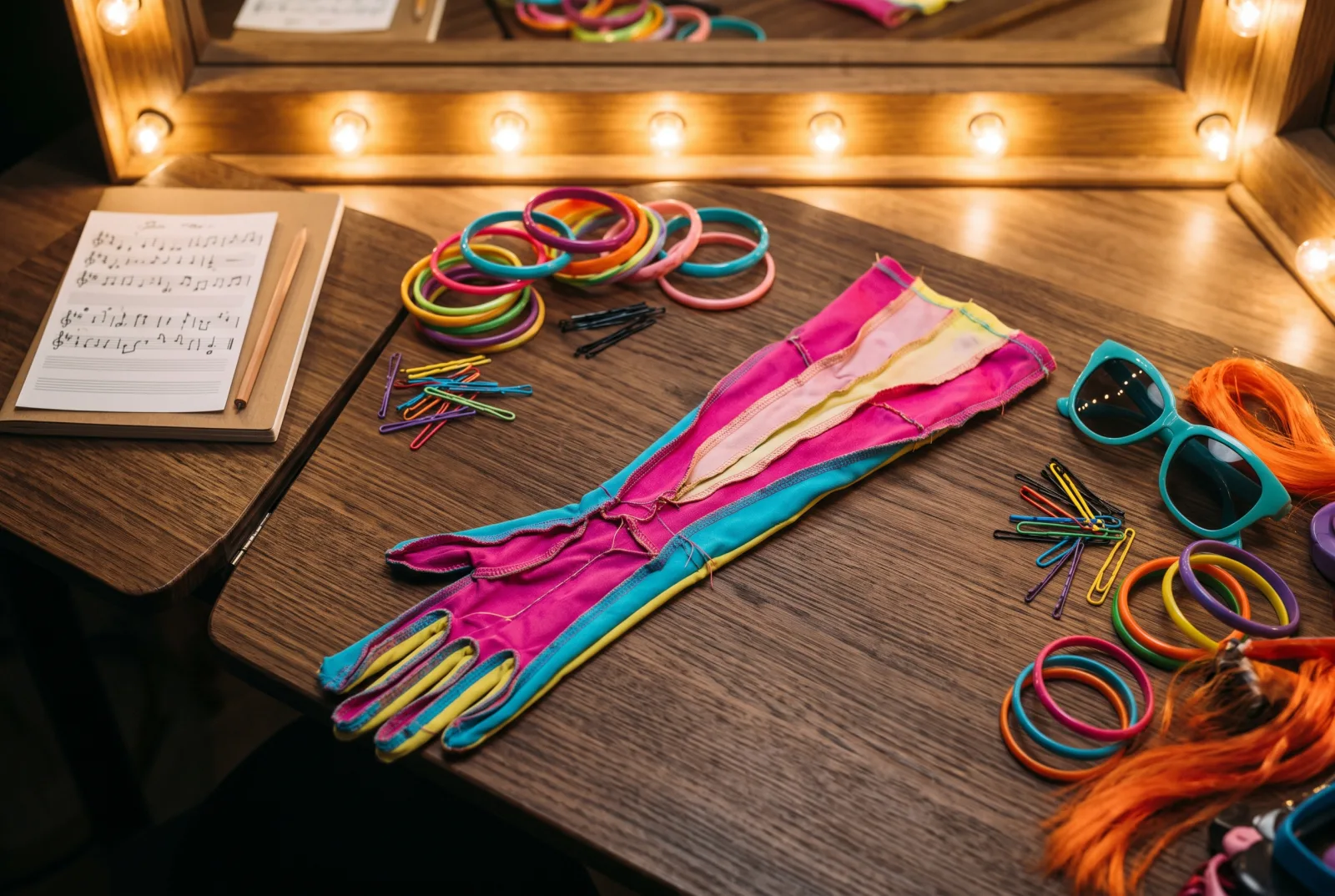
Ilustración: Rebobinados
In 1983, "Girls Just Want to Have Fun" sounded like a silly little party song.
Dyed hair, synthesisers, a catchy chorus about girls who want to have a good time. Nothing more.
Forty years later it is still a feminist anthem. And the story of how it became one is more interesting, and a good deal more uncomfortable, than the version usually told.
Who wrote what
The song was written by a man: Robert Hazard, in 1979, and he cut a demo singing it from the male point of view.
Lauper herself has described it: a guy who feels lucky to be surrounded by girls who want to "have fun" with him, double meaning included.
It is worth being precise about what she did, because the story gets told large and the reality is subtler. She reworked a few lines, at the suggestion of producer Rick Chertoff, to strip out the double meaning. She did not rewrite the song.
And there is a detail the usual account leaves out, one that changes the whole matter: Lauper never received a writing credit. When she said in interviews that she had co-written it, Hazard sent her a cease-and-desist letter.
So where is the twist?
In everything else. And it is enormous.
It is in how she sings it: with a defiant joy that asks nobody's permission. It is in the arrangement. And it is, above all, in the video, which is what turned the song into something else.
In that video, women of every kind, age and body dance in the street, and her real mother plays the mother. The song stopped being a guy looking at some girls and became the girls looking at each other.
What Lauper did was not change the words. It was change who says them, and from where. In a song, that is almost everything.
What was underneath the colours
The image — the orange hair, the thrift-store clothes, the plastic bracelets — led plenty of people to treat her as a passing eccentricity.
On the same album, "She's So Unusual", was "Time After Time".
That one she did co-write, with Rob Hyman. It was her first American number one, on 9 June 1984, and it has been covered without pause ever since. Miles Davis recorded it in 1985 and played it live regularly; Lauper said the way he played it was pure magic.
There is the full range: the catchiest party anthem of the decade and, on the next track, a ballad that breaks your heart.
The "We Are the World" session
In January 1985, the biggest stars in the United States gathered in a studio to record "We Are the World", orchestrated by Quincy Jones.
Lauper was among the chosen, and she sang part of the bridge alongside Michael Jackson, Huey Lewis and Kim Carnes.
From that night comes an anecdote that sums her up, and it has a Chilean protagonist. The sound engineer, Humberto Gatica, kept picking up a strange noise on her channel. He checked the microphone: perfect. The problem was her earrings and her bracelets, jingling as she sang. She took them off one by one and left them in a heap on the studio floor.
That April, Life magazine put seven figures of American music on its front and back covers. She was one of them: alongside Michael Jackson, Willie Nelson, Lionel Richie, Bob Dylan, Tina Turner and Bruce Springsteen.
The activism, with the dates in order
Her commitment to LGBT rights goes back to the eighties, when it was neither popular nor comfortable. Her sister is a lesbian, and that drew her in early. "True Colors", from 1986, became an anthem of acceptance that still plays at marches.
The organisation came considerably later: the True Colors Fund, today True Colors United, devoted to homeless LGBT young people, dates from 2008. The two are worth keeping apart, because they tend to get told as one thing.
In 2013 she won the Tony for best original score for "Kinky Boots", the first woman to win it on her own. She has an Emmy as well. In November 2025 she entered the Rock and Roll Hall of Fame.
What to remember
Cyndi Lauper is the proof that a song is not only its lyrics.
Put on "Girls Just Want to Have Fun" and then "Time After Time" and you will hear the same person doing two things almost nobody does well at once.
And remember what she really did with the first one. She did not rewrite it: she sang it differently, with another face and from another place, until the song stopped meaning what its author meant to say.
Remember her like this: not as the odd girl with the coloured hair, but as the one who proved that a performer can turn a whole song inside out without changing a single word.
Sources
Cynthia Ann Stephanie Lauper, born in Brooklyn, New York, on 22 June 1953 and raised in Ozone Park, Queens; she is alive and still working. "Girls Just Want to Have Fun" was written by Robert Hazard in 1979, who recorded a demo performing it from a male perspective. The extent of Lauper's involvement should be stated precisely: she altered some lines at the suggestion of producer Rick Chertoff in order to remove the double meaning, but she did not rewrite the song and received no writing credit; when she publicly stated that she had co-written it, Hazard sent her a cease-and-desist letter. The transformation of the song's meaning came through the performance, the arrangement and above all the video. The single was released on 17 October 1983 and reached number two on the Billboard Hot 100, going to number one in ten countries. "Time After Time", from the same album, "She's So Unusual" (1983), was co-written by Lauper with Rob Hyman and reached number one on the Hot 100 on 9 June 1984, for two weeks; Miles Davis recorded it on "You're Under Arrest" (1985). She took part in the recording of "We Are the World" on 28 January 1985, orchestrated by Quincy Jones, singing a section of the bridge alongside Michael Jackson, Huey Lewis and Kim Carnes; the Chilean sound engineer Humberto Gatica identified the artist's earrings and bracelets as the source of a noise on the recording. In April 1985 Life magazine devoted its front and back covers to seven figures of American music: Michael Jackson, Willie Nelson, Lionel Richie, Bob Dylan, Cyndi Lauper, Tina Turner and Bruce Springsteen. Her activism for LGBT rights began in the nineteen-eighties; "True Colors" dates from 1986. The True Colors Fund, today True Colors United, was founded in 2008. She won the Tony for best original score for "Kinky Boots" in 2013, the first woman to win it on her own, as well as an Emmy award; she received her star on the Hollywood Walk of Fame in 2015 and entered the Rock and Roll Hall of Fame on 8 November 2025. David Bowie, Lady Gaga, Quincy Jones and Michael Jackson have their own profiles in this series. Externally authored text, edited and verified for Rebobinados. Interpretations of the meaning of her work are offered as the author's reading. No song lyrics are reproduced, for copyright reasons. Information drawn from Wikipedia, Songfacts, Rolling Stone and other press coverage.
Keep rewinding
10s
pop
Bruno Mars
Eleven names in the credits
"Uptown Funk" came out on 10 November 2014 with six writers and today it has eleven. In February 2015 The Gap Band's publisher filed a claim over "Oops Up Side Your Head" in YouTube's copyright system —there was never a lawsuit— and on 28 April five names were added, with 17 % of the publishing. It happened weeks after the "Blurred Lines" verdict, and the song had been fourteen weeks at number one.
00s
pop
André Rieu
It was not from the jazz suite
The waltz with which André Rieu reached half the world is not from Shostakovich's Suite for Jazz Orchestra No. 2: it is from the Suite for Variety Orchestra, which the composer did not assemble, and it was born in 1956 as music for a Soviet film about settlers in Kazakhstan. The error comes from a misprint in volume 10 of the complete works (Muzyka, Moscow, 1984), corrected only in 2001. And the title "The Second Waltz" was invented by his wife, because the real one did not sell.
90s
pop
Daniela Mercury
She took the neighbourhood out of the song
"O Canto da Cidade" was written by Tote Gira, a composer from Nordeste de Amaralina who recorded the demo on a borrowed cassette, marking the beat on the door of a refrigerator; Mercury's team almost threw the tape away. She shares the credit because she deleted the references to the Pelourinho so that the song would serve all of Brazil. The album, from 20 September 1992, sold more than 2 million copies and nationalised axé. But she did not invent it: the name was a journalist's insult in 1987.
Rewind with us
Comments · 0
No one has commented yet. Open the conversation.