
Quincy Jones
Check your ego at the door
By Rebobinados · Published on September 3, 2026
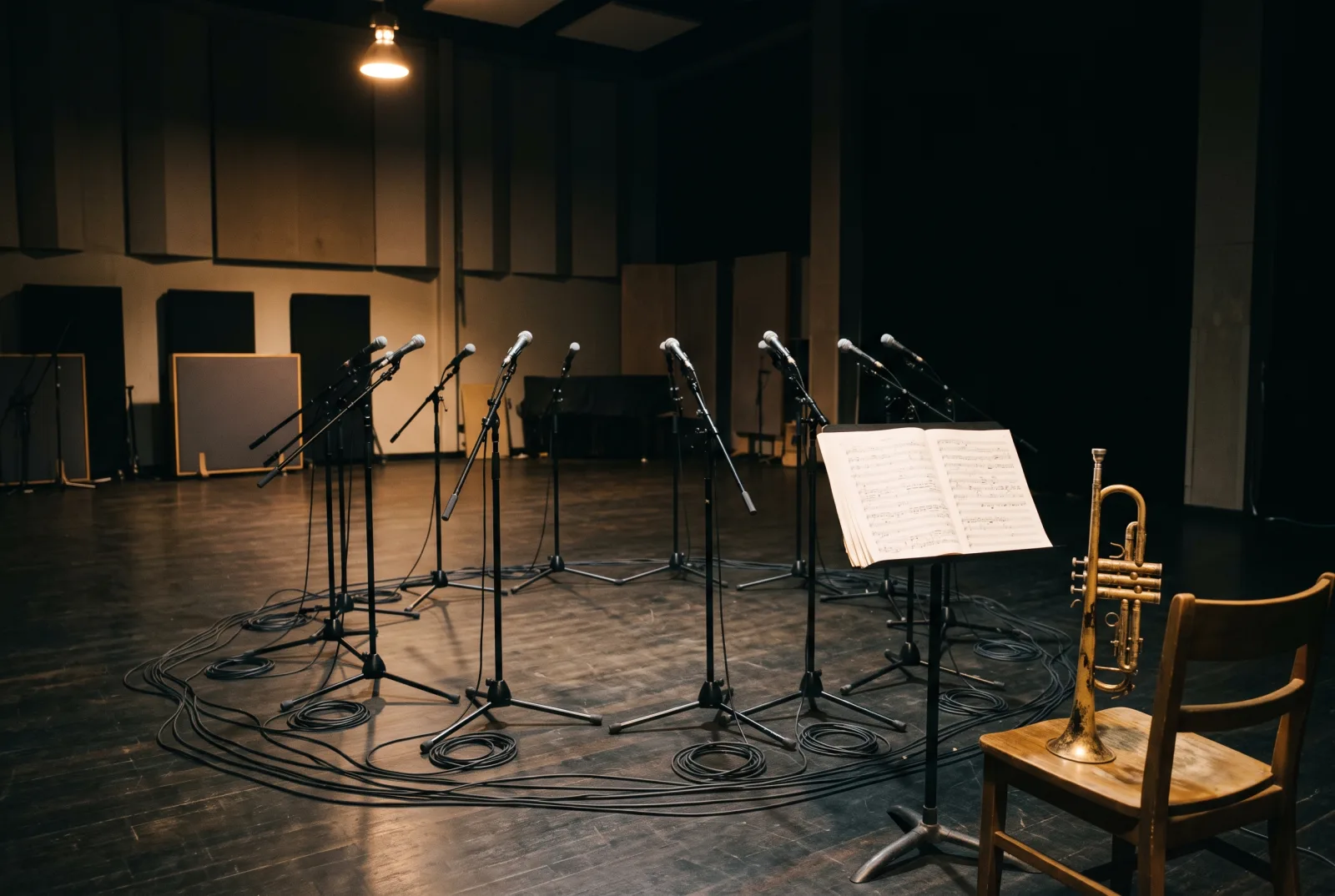
Ilustración: Rebobinados
Quincy Jones is, probably, the biggest figure in twentieth-century popular music that most people would not be able to recognise in a photograph.
He was not a star who sang out front. He was something rarer and more powerful: the man behind, the producer, the arranger, the one who made the magic happen.
His career spanned more than seventy years and practically every genre of American music. He won twenty-eight competitive Grammys out of eighty nominations.
He died on 3 November 2024, at ninety-one.
From Chicago to Seattle
The story begins in the hardest place.
He was born in 1933 on the south side of Chicago, in the middle of the Depression, in a poor and violent neighbourhood where as a boy he moved among gangs. His mother, Sarah Frances, suffered from schizophrenia and was institutionalised when he was small, a wound he would carry all his life.
He went so far as to say that there are two kinds of people, those who have and those who do not, and that he had no idea what the word mother meant. He maintained that you have to have someone looking after you before you turn nine, or you carry a hole for the rest of your life.
Music saved him, but not in Chicago. When he was ten the family moved to Bremerton, in Washington state, and afterwards to Seattle.
There he found a trumpet. And there, at fourteen, he met a blind sixteen-year-old pianist newly arrived from Florida: Ray Charles. The two of them, barely more than children, dreamed of getting out of poverty through music. They would be friends for the rest of their lives.
Quincy won a scholarship, played jazz with the orchestras of Lionel Hampton and Count Basie, backed Billie Holiday, arranged for Sinatra and Ella Fitzgerald. In 1964 he became vice-president of Mercury Records, one of the first black executives at that level in the industry.
The boy from the gangs ended up rubbing shoulders with presidents.
The architect of Thriller
The greatest achievement, among thousands, has a name.
In the early eighties he produced three Michael Jackson albums — "Off the Wall", "Thriller" and "Bad" — that turned Michael from a former child star into the King of Pop.
And "Thriller", from 1982, is still the best-selling album in the world according to Guinness.
But here is what almost nobody takes the measure of: that record was not Michael's work alone. It was a partnership.
Michael brought the supernatural talent, the voice, the dancing, the ambition. Quincy brought the master ear, the architecture, knowing exactly what sound, what arrangement, what musician and what mix were needed in every second.
He was the one who took Michael's songs and turned them into those perfect works — "Billie Jean", "Beat It" — fusing disco, funk, rock, pop and R&B into a sound that conquered every corner of the planet.
With one caveat that is exactly the mistake this article is complaining about: "Thriller", the song, is not Michael's. Rod Temperton wrote all of it, including the lines Vincent Price recites.
Temperton was an Englishman, the keyboard player in Heatwave, whom Quincy called when a song was needed. "Baby Be Mine" and "The Lady in My Life" are his too, and before that "Rock with You" and "Off the Wall".
He wrote the song that gives its title to the best-selling album in the world and died in 2016 with almost nobody knowing who he was. The man behind the man behind.
Lionel Richie, who worked with him, called him the master orchestrator, and said he had the respect of every musician on the planet.
Check your ego at the door
There is another moment that sums up his unique gift: the ability to bring together the greatest names and make them sound together.
On 28 January 1985, to raise funds against hunger in Africa, "We Are the World" was recorded with some forty-five of the biggest stars of American music in a single studio: Michael Jackson, Bruce Springsteen, Stevie Wonder, Ray Charles, Tina Turner, Lionel Richie and many more.
Getting that many gigantic egos in one room and making them sing like a choir was an impossible task. Quincy Jones was the man who did it.
He hung a sign at the entrance of the A&M studio with a phrase that says it all: "Check Your Ego at the Door".
And it was not a bright idea from that night: back in 1980 he was telling Billboard that they had an imaginary sign with those words. It was his method.
That night, the most respected producer in the world conducted the biggest stars on the planet the way one conducts an orchestra. Nobody else could have done it: it needed someone whom everyone, without exception, respected enough.
What to remember
Quincy Jones is proof that in music the greatest heroes are not always the ones out front singing, but sometimes the ones behind, building.
Put on "Thriller", "We Are the World", or any of the jazz records he arranged for Sinatra and Ella, and you will be hearing his hand even though you never hear his voice.
He was the invisible thread that connected seven decades of American music: he played jazz with the legends of the forties, arranged for the giants of the fifties and sixties, produced the King of Pop in the eighties, and went on being an influence until the end.
A poor boy from the south side of Chicago, the son of a sick mother, who held on to a trumpet and to the friendship of another poor, blind boy, and came to be the architect of half a century's soundtrack.
When he died, in 2024, it was not just another musician who left. The master orchestrator walked out of the room, but the music he helped to build is still playing everywhere.
Sources
Quincy Delight Jones Jr. (Chicago, 14 March 1933 – Bel Air, Los Angeles, 3 November 2024), American producer, arranger, composer, conductor and trumpeter, one of the most influential figures in twentieth-century popular music; he won 28 competitive Grammy awards out of 80 nominations, in a career of more than 70 years, and died at the age of 91 of pancreatic cancer. He was born on the tough south side of Chicago; his mother, Sarah Frances, suffered from schizophrenia and was institutionalised when he was a child. It is worth being precise about a point that tends to be told wrong: the family moved to Bremerton, in Washington state, when he was ten, and afterwards to Seattle, and it was there that he found the trumpet and there that he met, at fourteen, Ray Charles, then sixteen and newly arrived from Florida; they were friends for life. He played jazz with Lionel Hampton and Count Basie, backed Billie Holiday and arranged for Frank Sinatra, Ella Fitzgerald and many others; he composed soundtracks such as "In the Heat of the Night" and the series "Roots". In 1964 he was appointed vice-president of Mercury Records, becoming one of the first black executives at that level in the industry. He produced the Michael Jackson albums "Off the Wall" (1979), "Thriller" (1982) and "Bad" (1987); "Thriller" remains the best-selling album in the world according to Guinness World Records, with some 67 to 70 million copies, although in the United States the highest RIAA certification belongs to "Their Greatest Hits 1971-1975" by the Eagles. He orchestrated the charity recording "We Are the World" on 28 January 1985 at the A&M studios, bringing together some forty-five stars, and hung at the entrance the famous sign "Check Your Ego at the Door"; back in 1980 he had told Billboard that he worked with an imaginary sign bearing that phrase. Lionel Richie called him "the master orchestrator" in the documentary "The Greatest Night in Pop" (2024). He received, among others, the Grammy Legend Award, the Kennedy Center Honor and the National Medal of Arts. Michael Jackson, Ray Charles, Lionel Richie, Stevie Wonder and Aretha Franklin have their own profiles in this series. Externally authored text, edited and verified for Rebobinados. Interpretations of the meaning of his work are offered as the author's reading. No song lyrics are reproduced, for copyright reasons. Information drawn from AP, Britannica, NPR, Wikipedia, Guinness World Records and other coverage.
Keep rewinding
10s
pop
Bruno Mars
Eleven names in the credits
"Uptown Funk" came out on 10 November 2014 with six writers and today it has eleven. In February 2015 The Gap Band's publisher filed a claim over "Oops Up Side Your Head" in YouTube's copyright system —there was never a lawsuit— and on 28 April five names were added, with 17 % of the publishing. It happened weeks after the "Blurred Lines" verdict, and the song had been fourteen weeks at number one.
00s
pop
André Rieu
It was not from the jazz suite
The waltz with which André Rieu reached half the world is not from Shostakovich's Suite for Jazz Orchestra No. 2: it is from the Suite for Variety Orchestra, which the composer did not assemble, and it was born in 1956 as music for a Soviet film about settlers in Kazakhstan. The error comes from a misprint in volume 10 of the complete works (Muzyka, Moscow, 1984), corrected only in 2001. And the title "The Second Waltz" was invented by his wife, because the real one did not sell.
90s
pop
Daniela Mercury
She took the neighbourhood out of the song
"O Canto da Cidade" was written by Tote Gira, a composer from Nordeste de Amaralina who recorded the demo on a borrowed cassette, marking the beat on the door of a refrigerator; Mercury's team almost threw the tape away. She shares the credit because she deleted the references to the Pelourinho so that the song would serve all of Brazil. The album, from 20 September 1992, sold more than 2 million copies and nationalised axé. But she did not invent it: the name was a journalist's insult in 1987.
Rewind with us
Comments · 0
No one has commented yet. Open the conversation.