
Manu Chao
Belonging nowhere
By Rebobinados · Published on September 17, 2026
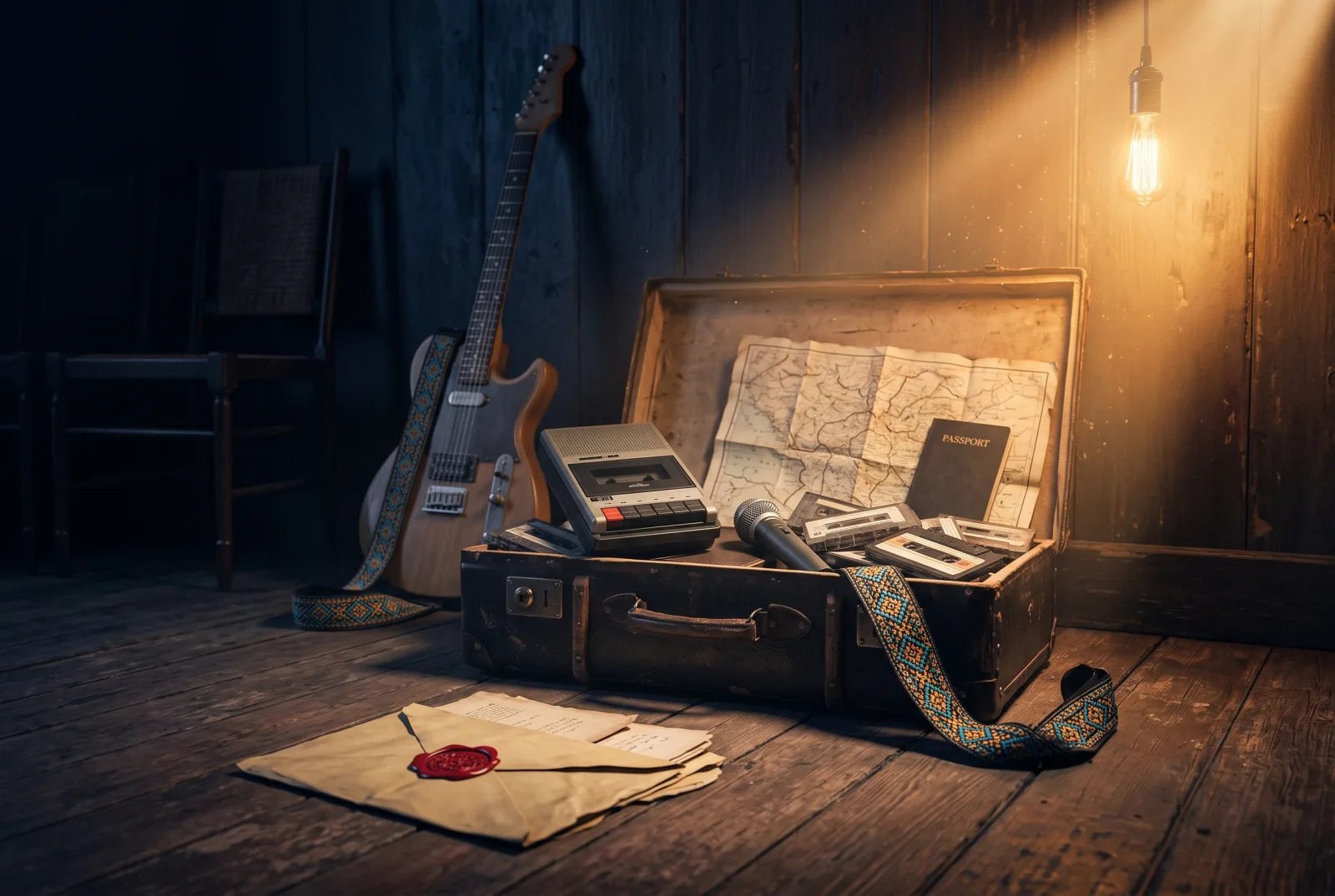
Ilustración: Rebobinados
Manu Chao is, probably, the rock star least like a rock star there is.
He sells millions of records and would rather sleep on a friend's floor than in a five-star hotel. He fills stadiums all over Latin America and records his albums on his own, travelling the world with a laptop.
He sings in half a dozen languages all mixed together and he put music, like few others, to the people nobody listens to: the immigrants, the undocumented, the disappeared, the poor of the planet.
Son of many worlds
To understand Manu Chao you have to start with his blood, because it explains everything.
He was born in Paris in 1961, into a Spanish family that had fled Franco's regime. His father, Ramón Chao, a Galician writer and journalist from Vilalba; his mother, Felisa, a Basque from Bilbao, from a family that had passed through the French refugee camps after the Civil War.
So Manu grew up being, from the start, a little bit from everywhere and from nowhere entirely: Spanish in France, a child of exile, surrounded by immigrants from half the world in the suburbs of Paris.
He became a street musician as a young man, playing in the streets and the bars, soaking up all the languages and all the rhythms that sounded around him: rock, French chanson, salsa, reggae, ska, the Algerian raï of the immigrants.
That mixture, that mestizaje, was not an artistic decision. It was, quite simply, the world he happened to grow up in.
Mano Negra, mestizo punk
In 1987, Manu formed with his brother Antoine and his cousin Santiago Casariego a band that would become legendary: Mano Negra.
They were punk, yes, but a punk contaminated with everything: Latin, African and Caribbean rhythms, lyrics in several languages, an incendiary energy. They gave that mixture a name of its own, "patchanka", which was also the title of their first album, from 1988, where "Mala Vida" is.
And then they made two journeys that sum up the suicidal, beautiful spirit of the band.
The first, in 1992: they crossed the Atlantic on a cargo ship, the Melquiades, and spent five months playing in Latin American ports from a stage set up in the ship's hold.
The second, in 1993, was worse and grander. They restored a freight train, filled it with blocks of ice and with a device that shot out flames, christened it "El Expreso del Hielo"—The Ice Express, a nod to García Márquez—and travelled the abandoned tracks of Colombia, between Bogotá and the coast, giving free concerts in towns nobody ever reached, in the middle of a war.
It was less a tour and more a deranged adventure: the train moved at twenty-five kilometres an hour, it broke down, there was no money. Most of the musicians walked away and went back to France within a few weeks. That, in fact, is where the original line-up died. They still managed to put out one more record, "Casa Babylon", and the band fell apart between 1994 and 1995.
Manu was left in pieces, depressed, with no direction.
"Clandestino"
And out of that shipwreck came his masterpiece.
For years he wandered around Latin America, playing in bars in Tijuana, in Rio, recording little bits of songs wherever he landed, with a portable set-up he called, ironically, his "Estudio Clandestino". It was, literally, a laptop.
Out of all that he put together "Clandestino", his first solo album, from 1998, and it was a worldwide phenomenon.
It is a warm, lo-fi record made of scraps: street voices, sounds captured anywhere at all, fragments of a Zapatista declaration read by Subcomandante Marcos, tucked into "Luna y Sol" and at the end of "Welcome to Tijuana".
And songs that became anthems of popular feeling: "Clandestino", about undocumented immigrants who cross borders in hiding; "Desaparecido"; "Bongo Bong". And "Malegría", which gives its name to the word he popularised to describe what he does: the mixture of sadness and joy, of rage and hope, that beats in everything he makes.
Then came "Próxima Estación: Esperanza", with "Me Gustas Tú", one of the most sung-along songs in Spanish of the last few decades. The title came from the announcement at a station on the Madrid metro, which he sampled on the record.
Music as a bridge
And here is what orders his whole body of work.
Manu Chao uses music as a bridge between peoples. That he sings in French, Spanish, Arabic, Galician, Portuguese and Italian, mixing them sometimes within a single song, is not a trick: it is his message turned into sound.
He is saying, all the time, that beyond languages and borders and flags, we are all the same, the same people.
He is a real activist—he goes about with the Zapatistas in Chiapas, with the prostitutes who organise in Madrid, with the homeless, with the movements against savage globalisation—and his music is the natural extension of that: simple, catchy songs, for anyone at all to sing, about the people the world would rather not look at.
You may or may not share his politics, openly left-wing; what you cannot do is doubt that he lives them. Manu Chao does not sing about the poor from a balcony: he goes off to live with them.
What to remember
Manu Chao is the proof that you can be enormous without ceasing to be true to yourself.
A man who sold millions and still travels in the economy class of life, recording with a laptop, sleeping wherever he lands, playing the same for a hundred thousand people in a stadium as for twenty in a village square.
He made mestizaje—mixing languages, rhythms, countries—into the most beautiful and most brotherly music his generation produced.
If you put on "Clandestino", "Me Gustas Tú", "Desaparecido" or "Bongo Bong", you are going to hear the sound of the whole world fitting into a single song: happy and sad at once, simple and deep, sung in every language for every kind of person.
He is the troubadour of the voiceless, the musician who turned not belonging anywhere into belonging everywhere.
And that, in a world that raises more walls every day, is one of the most valuable things an artist can do.
Sources
Manu Chao (José Manuel Tomás Arturo Chao Ortega; Paris, France, 21 June 1961), French-Spanish musician, singer, composer and producer, raised in the Paris suburbs of Boulogne-Billancourt and Sèvres. His father was the Galician writer and journalist Ramón Chao, from Vilalba (Lugo), who emigrated to Paris fleeing Franco's regime; his mother, Felisa Ortega, was a Basque from Bilbao, from a family that passed through the French refugee camps after the Civil War. He sings in French, Spanish, English, Italian, Arabic, Catalan, Galician and Portuguese, often mixing them. He trained as a street musician on the Paris alternative scene and in 1987 founded, with his brother Antoine and his cousin Santiago Casariego, the band Mano Negra, pioneers of "patchanka"—the name they gave to their fusion of punk and global rhythms and the title of their 1988 debut album, which includes "Mala Vida". In 1992 they took part in "Cargo 92", crossing the Atlantic on the cargo ship Melquiades together with Royal de Luxe, with five months of concerts in Latin American ports; in 1993 they embarked on "El Expreso del Hielo", a tour on a restored freight train along abandoned tracks in Colombia, between Bogotá and the coast, which turned out to be a logistical disaster from which most of the musicians deserted and which precipitated the end of the original line-up. The band still released "Casa Babylon" (1994) and broke up between 1994 and 1995. After years of travelling around Latin America, he released his solo debut "Clandestino" (1998), recorded by himself in different places with a laptop—the "Estudio Clandestino"—with touch-ups in Paris; it includes fragments of an EZLN declaration read by Subcomandante Marcos, in "Luna y Sol" and at the end of "Welcome to Tijuana", as well as "Clandestino", "Desaparecido", "Bongo Bong" and "Malegría", the word he popularised to name the mixture of sadness and joy in his music. It was followed by "Próxima Estación: Esperanza" (2001), with "Me Gustas Tú", whose title comes from the announcement of the Esperanza station on Line 4 of the Madrid Metro, sampled on the record. He is one of the best-selling artists in the world, although less well known in the Anglosphere, and a committed activist. He collaborated with Os Paralamas do Sucesso on "Soledad Cidadão (Me Llaman Calle)", from the album "Hoje" (2005). Externally authored text, edited and verified for Rebobinados. Readings of the meaning of his work are offered as the author's interpretation. No song lyrics are reproduced, for copyright reasons. Information drawn from Wikipedia, Vice, manuchao.net, Mondo Sonoro and other press coverage.
Keep rewinding

70s
folk
Florcita Motuda
Forty-nine years without a reissue
With "Brevemente… geeente" he won the best Chilean performer prize at Viña 1977, and he won it in the international competition because the folk one was not held that year. The album that contains it, released in 1977 on APRI —Antonio Prieto's label—, spent 49 years without a reissue: never on CD or streaming until it came back on vinyl in April 2026 and on digital on 11 July, the day he returned to the stage. The record for the longest title at the OTI is his, but it is from 1978 and not 1998.
00s
folk
Natalia Lafourcade
Where it said pumpkin she put flowers
The story says she rescued the son jarocho with reverence on *Un Canto por México*, but "La Bruja" is not on that record: she recorded it on *Cancionera*, on 24 April 2025, and rewrote the lyric. Where the son turns the man into a pumpkin, she sings that she filled him with flowers: "a cancionera is a kind of sorceress". Twenty Latin Grammys, a house rebuilt in Jáltipan and a harpsichordist father who left Chile two days after the coup.

70s
folk
Piero
The old man wasn't his
Piero sang "Mi viejo" in 1969, but the words are José Tcherkaski's and the father it portrays was his own: Mario Tcherkaski, a Russian street hawker who died at 52, eight years before the song. CBS released it with Father's Day in mind after several labels turned it down, and the first pressing passed 600,000 copies. Piero died on 7 October 2026, aged 81.
Rewind with us
Comments · 0
No one has commented yet. Open the conversation.