
Gipsy Kings
The upside-down guitar
By Rebobinados · Published on September 26, 2026
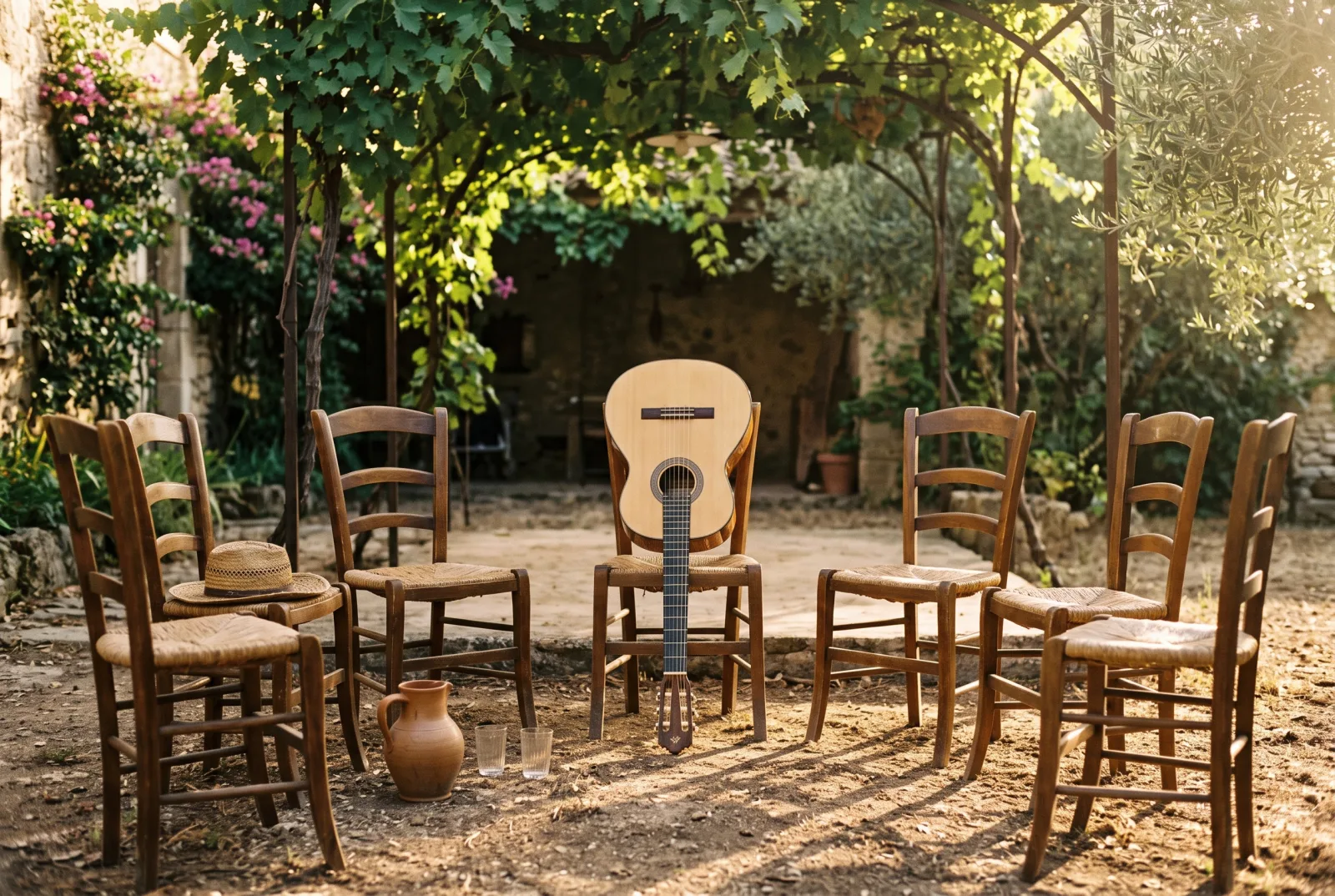
Ilustración: Rebobinados
Gipsy Kings pulled off something rare: taking a local music, with very specific roots, and turning it into a phenomenon that plays in every corner of the planet.
Their rumba flamenca —Spanish guitars strummed at full speed, handclaps, and that broken, impassioned voice— came out of the streets and the weddings of southern France and ended up on the radio, in films and at parties across half the world.
With "Bamboléo", "Djobi Djoba" or their version of "Volare", they gave millions of people who do not speak Spanish an irresistible urge to clap along.
Gypsies between two countries
The story is a story of roots and of exile.
They are gitanos —Romani people—, and their music comes from flamenco, the most Spanish thing there is. But they were born in France, in the south, because their families fled Catalonia during the Civil War of the thirties.
They are, then, doubly of the border: Roma in a world that pushes them to the margins, and Spaniards at heart born on French soil. Like Manu Chao, the son of Spanish exiles in Paris, they turned not quite belonging anywhere into their way of sounding.
The band is really two related families, the Reyes and the Baliardo, cousins of one another. The surname Reyes means exactly that, and from there comes the group's name, half translated into English.
José Reyes, the father, was no ordinary musician: he was a cousin of Manitas de Plata, the legendary Gypsy guitarist, and formed a lasting duo with him. They reached Carnegie Hall and moved in the circle of Picasso and Dalí.
When José died, in June 1979, his sons carried on, playing at weddings and festivals all over France.
Two families, and a third founder who was not of the clan: Jahloul "Chico" Bouchikhi, French-Moroccan, José Reyes' son-in-law. The rhythm guitar on the 1987 album is his. The group that sold the world its Gypsy purity was co-founded by an outsider.
In 1991 they threw him out on discovering that he had registered the group's name as a trademark under his own. They got it back through the courts, and he went off to found Chico & the Gypsies.
The guitar upside down
There is a detail that gets repeated everywhere when people talk about them.
That several of the Reyes —Nicolás, André, Patchaï— are left-handed and do not play left-handed guitars: they play right-handed guitars turned upside down, with the strings in reverse order. And that they learned this way because as children they were too poor to own a guitar and grabbed whatever was at hand, almost always a right-hander's.
It is a perfect story. It is on blogs, in reviews, on guitar forums, in radio scripts. And there is nothing behind it.
The two halves —the poverty and the reversed strings— come from the same sentence, which somebody wrote unsigned in the English-language Wikipedia article in January 2010. From May 2012 that sentence carried a "citation needed" tag stuck to it, and it ended up deleted from the very article that gave rise to it.
All that survives today is a stray line, also without a reference, in a list of musicians who play left-handed.
There is no interview, no specialist guitar press, no official site backing any of this up. Not the poverty and not the reversed strings.
The only thing that can be checked is what you see in any video: several of them play left-handed.
It is worth staying there a moment, because it is the whole mechanism of how an anecdote gets manufactured. One anonymous sentence, a warning nobody attended to for twelve years, and thousands of repetitions that no longer need the original in order to go on existing.
When the sentence was deleted, the story kept circulating all the same. Nothing was holding it up any more: it held itself up.
A party that crossed every border
What happened with their 1987 album was extraordinary.
"Bamboléo" and "Djobi Djoba" became party anthems all over the planet, and the album held on for some forty weeks on the United States charts, in a country that rarely opens the door to music in another language. It came out there in November 1988.
And it was sung in a mixture of Spanish and Gypsy caló.
With "Bamboléo" something happens that is not unlike the guitar: the song the whole planet takes for the Gypsy anthem par excellence is not entirely theirs.
It is credited to T. Baliardo, J. Bouchikhi and N. Reyes, yes, but also to Simón Díaz and André Filho. The verses come from "Caballo Viejo", written in 1980 by the Venezuelan Simón Díaz; the chorus, from "Bamboleô", by the Brazilian André Filho, recorded by Carmen Miranda in 1931.
And on that same 1987 album there is "A Mi Manera", which is "My Way".
The key to that success is that their music needs no translation: the joy of those guitars and those handclaps is understood in any language. They put a beat under weddings, commercials and films in countries where nobody knew what the words said, and it did not matter.
They did for rumba flamenca what few manage to do for a regional music: they made it everybody's heritage.
What to remember
Gipsy Kings is proof that a local music, if it is true enough and joyful enough, can become universal. And also that no local music is as pure as its own legend tells it.
Put on "Bamboléo", "Djobi Djoba", "Un Amor" or their rumba version of "Volare", and you are going to hear the sun of the south, guitars that run like the wind, handclaps, and a joy that asks nobody's permission.
Behind it there is a family marked by exile, a Moroccan who co-founded the group, an anthem with two South American authors in the credits and a "My Way" on the same record.
They do not sing in English and they never stopped sounding like what they are. But they took whatever was useful to them —a Venezuelan joropo, a Brazilian carnival march, a Sinatra song— and handed it back turned into rumba. That is a root too: the kind that feeds on what it finds.
Their music is a portable party, ready to go off in any language. Put it on loud, clap once, and you will understand why nobody needed to understand a word to love them.
Sources
Gipsy Kings, French rumba flamenca group formed in Arles in 1979, after the death of José Reyes, although it would not take that name until the early eighties; its predecessor, "José Reyes et Los Reyes", dates from 1975. It is made up of Romani gitanos from the Reyes (of Arles) and Baliardo (of Montpellier) families, cousins of one another, whose families emigrated from Catalonia to France during the Spanish Civil War of the thirties; the third founder was the French-Moroccan Jahloul "Chico" Bouchikhi, José Reyes' son-in-law and rhythm guitarist on the 1987 album, expelled in 1991 after registering the group's name as a trademark under his own —the group recovered it through the courts and he founded Chico & the Gypsies—. "Reyes" means "kings" in Spanish, which is where the group's name comes from. José Reyes, father of several of its members, was a cousin of the guitarist Manitas de Plata (Ricardo Baliardo) and formed a lasting duo with him; he died on 6 June 1979. The lead vocalist is Nicolas Reyes and the lead guitarist, Tonino Baliardo. They achieved worldwide fame with their self-titled album (1987; released in the United States in November 1988), which included "Djobi Djoba", "Bamboléo" and "Un Amor", and remained some forty weeks on the United States charts, something exceptional for a record sung in Spanish and caló. Their version of "Volare", an adaptation of Domenico Modugno's "Nel blu dipinto di blu", belongs to "Mosaïque" (1989). Several of their guitarists play left-handed. The usual claim that they do so on right-strung guitars, and that they learned this way for not having had a guitar of their own in childhood, is undocumented: both halves come from a single unsigned sentence added to the English-language Wikipedia article in January 2010, which carried a "citation needed" tag from May 2012 and was subsequently removed; all that survives today is an unreferenced entry in that same site's list of left-handed musicians, and there is no interview, specialist press or official source to sustain either claim. Since 2014 the project has carried trademark litigation: the rulings of 8 March 2018 and 19 January 2021 recognised Nicolas Reyes and Tonino Baliardo jointly as holders of the right to the name, and the two tour together and are billed that way —in 2024 both sued Patchaï Reyes, on the same side—. Line-ups led by André Reyes, Patchaï Reyes and Chico Bouchikhi (Chico & the Gypsies) tour separately. Externally authored text, edited and verified for Rebobinados. Interpretations of the meaning of their work are offered as the author's reading. No song lyrics are reproduced, for copyright reasons. Information drawn from the English and French Wikipedia, gipsykings.com and other coverage.
Keep rewinding
70s
folk
Florcita Motuda
Forty-nine years without a reissue
With "Brevemente… geeente" he won the best Chilean performer prize at Viña 1977, and he won it in the international competition because the folk one was not held that year. The album that contains it, released in 1977 on APRI —Antonio Prieto's label—, spent 49 years without a reissue: never on CD or streaming until it came back on vinyl in April 2026 and on digital on 11 July, the day he returned to the stage. The record for the longest title at the OTI is his, but it is from 1978 and not 1998.
00s
folk
Natalia Lafourcade
Where it said pumpkin she put flowers
The story says she rescued the son jarocho with reverence on *Un Canto por México*, but "La Bruja" is not on that record: she recorded it on *Cancionera*, on 24 April 2025, and rewrote the lyric. Where the son turns the man into a pumpkin, she sings that she filled him with flowers: "a cancionera is a kind of sorceress". Twenty Latin Grammys, a house rebuilt in Jáltipan and a harpsichordist father who left Chile two days after the coup.
70s
folk
Piero
The old man wasn't his
Piero sang "Mi viejo" in 1969, but the words are José Tcherkaski's and the father it portrays was his own: Mario Tcherkaski, a Russian street hawker who died at 52, eight years before the song. CBS released it with Father's Day in mind after several labels turned it down, and the first pressing passed 600,000 copies. Piero died on 7 October 2026, aged 81.
Rewind with us
Comments · 0
No one has commented yet. Open the conversation.