
Series
A History of Chilean Rock · Chapter 6: The 11th of September
By Rebobinados · Published on August 21, 2026
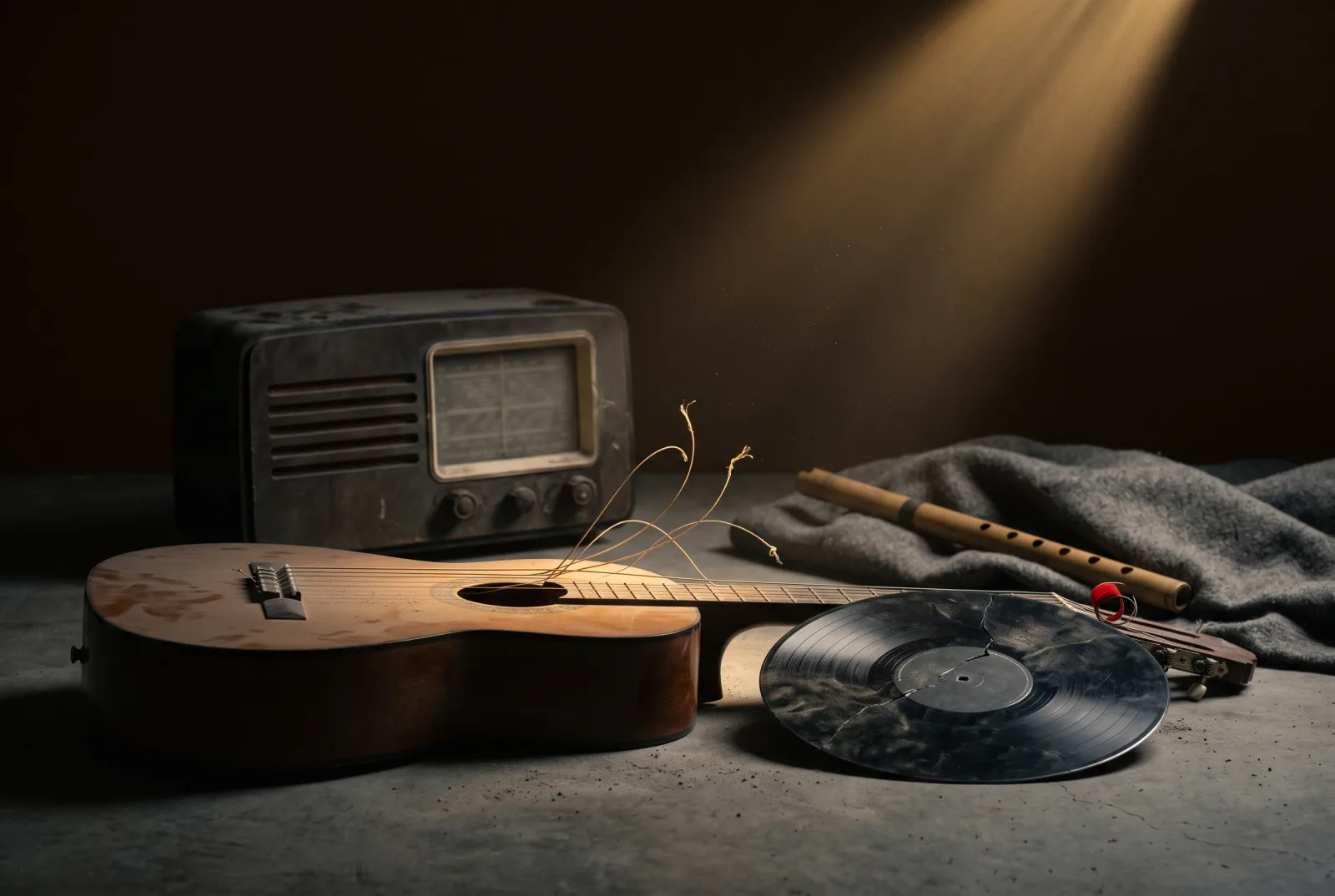
Ilustración: Rebobinados
That year, on the other side of the world, four English musicians released an album about madness, time, money and death, the things that push a person to the edge. It was called "The Dark Side of the Moon", and it became one of the most listened-to records in history. While the planet put on headphones to contemplate darkness turned into art, Chile lived it for real. Its dark side was not a metaphor. It arrived one September morning, and it did not leave for seventeen years.
On 11 September 1973, the armed forces staged a coup d'état. Planes bombed La Moneda, the government palace; Salvador Allende died there that day, after a final radio address in which he said goodbye to the country. The dream of the previous chapter —the Chilean road, socialism through the vote, a country singing its future— ended in a single day, among bombs and smoke. And something else began, which would last until 1990: a military dictatorship headed by Augusto Pinochet.
The stadium of the party became the stadium of terror
In the days and months that followed, thousands of people were detained. Detention and torture centres were set up all over the country. There were executions, and there were the disappeared: people who were taken away and never heard of again. The same National Stadium that in 1962 had filled with football and joy, the stadium of the World Cup, now filled with prisoners: thousands of people locked in the stands and changing rooms of a sports ground, interrogated, tortured, some of them killed. The place of the party became the place of terror. Keep that image of the stadium, because it will come back.
Víctor Jara's hands
And in another stadium, the Estadio Chile, what would become the symbol of everything took place. Víctor Jara —university teacher, the most loved voice of the Nueva Canción— was arrested the day after the coup at the university where he taught, and taken there. They tortured him, they broke his hands, the hands of a guitarist, and on 16 September they killed him with forty-four bullets. He was forty years old. Silencing his song was not enough: they wanted to destroy the hands that made it. Half a century later, the Chilean courts convicted those responsible; it is not a legend, it is a proven fact, with guilty men who have names. Today that stadium bears his name.
A whole country lowered its voice
What that meant for music, which is our subject, was a decapitation. The country that in the previous chapter was singing in the street, with a raised fist, woke up mute. The Nueva Canción, which had been the soundtrack of the dream, was wiped off the dial: its songs could not be played on the radio, its records were hidden or burnt, its musicians were dead, imprisoned or abroad. Inti-Illimani and Quilapayún, who were on tour in Europe when the coup came, could not return, and stayed in exile singing to Chile from far away for years. And something happened that says it all: owning a quena, a charango, certain records, became dangerous. An Andean instrument in your house could be proof that you were on the wrong side. Music, which until yesterday had filled the squares, was now kept the way you keep a secret that can cost you dearly. A whole country lowered its voice.
What also has to be said
It was not a foreign army falling on a united people. It was a country split in two, and one part of that country —the part that had lived the dream as a nightmare, the part that was afraid, the part that stood in the queues and saw chaos coming— received the coup with relief, and sometimes with joy. That too is memory, and it has to be said: many people thought, that day, that they were being saved. What none of those people voted for, or imagined, was what came afterwards: that "saving the country" would mean torturing, executing, disappearing people. You can understand the fear that led many to applaud that 11 September; you cannot justify what that day unleashed. Both things are true, and holding them together —the real fear of some and the real horror that came— is what separates memory from propaganda.
That is how the dream ended, and how the night began. The country that had made music its banner was left, from one day to the next, without a voice: the voice murdered, the voice exiled, the voice hidden under the bed alongside the records you could no longer own. On the other side of the world, people went on listening to their album about the dark side of the moon, not knowing that in the south there was a country living inside it. But there was one thing they didn't manage, and that is where the next chapter begins: they didn't manage to kill the songs. They killed Jara, and "Te recuerdo Amanda" stayed alive. They took the Nueva Canción off the radio, and it went on playing quietly, in people's houses, in those who left, in memory. The voice fell silent in the street, but it didn't go out. It went inwards and outwards, to wait. And one day it was going to come back.
Sources
The coup d'état of 11 September 1973 overthrew the government of Salvador Allende; the La Moneda palace was bombed by the Air Force and Allende died inside it that day, after a final radio address. A military dictatorship headed by Augusto Pinochet began and lasted until 1990. The Rettig and Valech reports established thousands of victims of execution, forced disappearance, political imprisonment and torture. The Estadio Nacional —host of the 1962 World Cup final— operated as a mass detention centre between September and November 1973. Víctor Jara, a university teacher and central figure of the Nueva Canción, was arrested on 12 September 1973 at the Universidad Técnica del Estado and taken to the Estadio Chile, where he was tortured and killed with multiple gunshots; he was 40. Chilean courts convicted former military officers for the crime, and the venue today bears the name Estadio Víctor Jara. The Nueva Canción was banned and its musicians were killed, imprisoned or exiled; possessing Andean instruments and certain records came to be grounds for suspicion. The country was deeply divided and part of the population received the coup with relief, a fact the historiography records alongside the violence that followed. On the world clock: Pink Floyd's "The Dark Side of the Moon" was released in March 1973. Information drawn from Memoria Chilena, the Rettig and Valech reports, the Museum of Memory and Human Rights, Wikipedia and press coverage.
Keep rewinding
Series
A History of Chilean Rock · Chapter 16: Music Loses Its Weight
Napster and the mp3 strip music of its weight, and with it goes the distance this series opened with: you cannot arrive late to something that arrives instantly. The door opens both ways, but the same freedom that released the musician destroyed the economy that sustained them.
Series
A History of Chilean Rock · Chapter 15: The Golden Age and the End of the Millennium
As the world crosses into the year 2000, Chilean rock reaches its peak and loses its last inhibition: it stops measuring itself against a distant "real thing". Los Tres say goodbye in Concepción just as the new century begins, and in that same city Los Bunkers had already existed for months.
Series
A History of Chilean Rock · Chapter 14: Joy and Rage
While the world surrenders to Britpop, the echo reverses: through MTV Latino, Chilean rock finally goes out to be heard. And Los Tres, from Concepción, conquer the screen not by copying the north but by taking Roberto Parra's cueca. Yet beneath the joy lay real losses and a rage that would not go away.
Rewind with us
Comments · 0
No one has commented yet. Open the conversation.