
Series
A History of Chilean Rock · Chapter 9: The Constitution and the Mould
By Rebobinados · Published on August 24, 2026
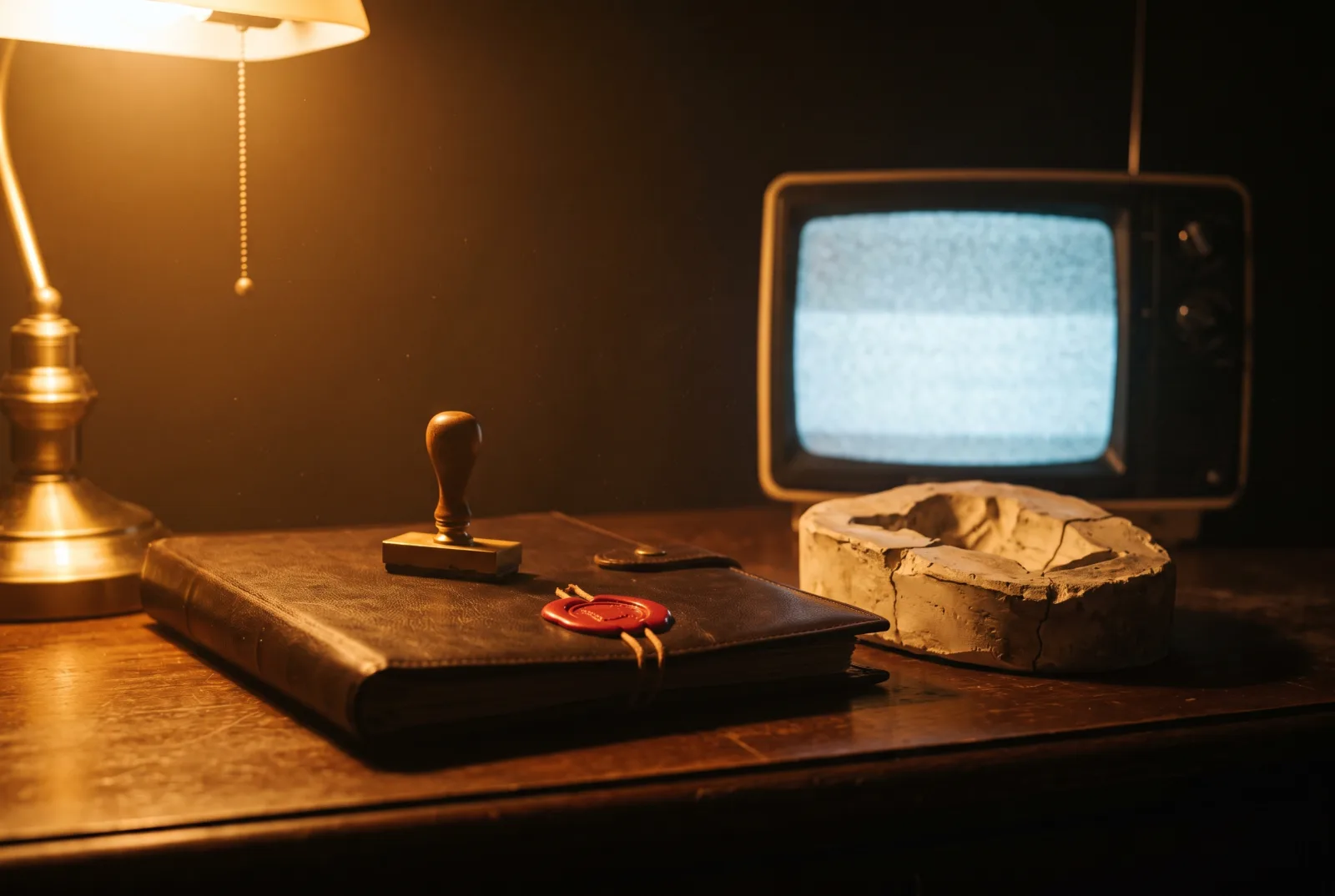
Ilustración: Rebobinados
The eighties began, in the north of the world, with music turning into something new. On 1 August 1981 MTV went on air, a television channel that played nothing but music videos, twenty-four hours a day. Overnight, music stopped being something you only listened to and became something you watched. Sounding good was no longer enough: you had to look good, have an image, a camera, an aesthetic. The song became a visual product, glossy, made for the screen. The north poured music into a new mould, the music video, and from then on almost everything would pass through it.
And a few months earlier, in December 1980, something had happened that closed an era with one blunt blow: on a New York street, John Lennon was shot dead. The former Beatle, the man who had sung "Imagine" —imagine a world with no borders, nothing to kill for— fell shot at his own front door. The most famous dreamer on the planet, killed by a bullet. The dream of the sixties, already fading, took its final shot there.
The mould you could not change the channel on
Down here, in Chile, the mould being cast was of another kind. In 1980, the dictatorship wrote a new Constitution —the charter that sets the rules for an entire country, how power is chosen, what is allowed and what is not— and put it to a plebiscite on 11 September of that year, on the seventh anniversary of the coup. That plebiscite was held with no electoral rolls, no freedom of the press, with the opposition unable to campaign, and controlled by the government itself. The "Yes" won with an official 67 per cent, but because of those conditions —no register, no guarantees, no counterweight— its legitimacy remains contested to this day. With that Constitution, the dictatorship was not only securing itself more years in power: it was fixing, in the country's highest law, a political and economic model designed to last for decades. The country was poured into a mould, and that mould was signed with the force of those who held all the weapons and faced no counterweight.
What is in dispute and what is not
This is ground where people still argue, and it should be said honestly: some defend what that mould contained, others reject it root and branch, and that fight is still alive. But one thing is not in dispute, because it is documented: the mould was imposed without the minimum conditions to call it a free decision. It was not chosen by everyone; it was set from above, and everyone else had to live inside it.
Two dreamers shot
There is a rhyme between the two clocks, and it hurts. In the north they shot a dreamer dead and buried the dream of a decade. In the south, seven years earlier, they had done the same to the dream of a country, and now they were laying a slab of legal concrete over it so it could not rise again. Two dreamers shot, one at each end of the continent, a decade apart. The mould, above and below, closing.
Imported sound, turned into ammunition
And here is what matters to this story. The generation that would make Chilean rock in the eighties grew up entirely inside that mould. They were young people who had known nothing but the dictatorship: they were born or raised under it, with no memory of the country that sang in the street. They were not brought up on the quena and the charango of the Nueva Canción, which was banned and which to them was a thing of another era; they were brought up on the rock and pop coming from the north, on the radio and, very soon, on that MTV that turned everything into image. And here comes the sharpest irony of these years: the imported sound, the north's commercial mould, was precisely what put the weapon in these kids' hands. The electric guitar, the synthesiser, the rhythm arriving from outside turned out to be the perfect tools for rebelling against the mould at home. What came from abroad, which looked like pure consumption, became ammunition.
From the other side of the mountains
And not all the sound came from the anglophone north. From the other side of the mountains came Argentine rock, and that carried a different weight, because it was in Spanish and came from a sibling country suffering its own dictatorship. Charly García, with Serú Girán, and León Gieco sang about repression in code, in metaphor, just like the Chilean Canto Nuevo, but as rock and in front of packed stadiums. For a young Chilean, hearing that was a revelation: rock was not just a gringo thing, it could be made here, in their own language, about their own reality, even under the boot. The north gave them the sound; Argentina gave them permission.
Because these young people were not going to sing like the Canto Nuevo, in metaphor, in a low voice, disguising what they wanted to say. They had grown up too tightly squeezed inside the mould to have any patience for it. They were going to plug in the guitar and say it head-on, in plain words, in the direct language of rock. In the working-class districts, in San Miguel, some kids were putting together something that within a couple of years would shout at the country what nobody dared say out loud. But that is the story of the next chapter.
Rewind, then, to that start of the eighties full of moulds. The north's, which put music on the screen and turned it into image. And ours, which put an entire country inside a Constitution made by force. Both looked definitive, closed, forever. But a mould has one weak point, and it is this: it only holds as long as what is inside agrees to take its shape. In the Chile of those years, something inside was beginning not to agree. What comes next is the sound of that mould starting to crack.
Sources
MTV, the first channel dedicated to music videos 24 hours a day, went on air in the United States on 1 August 1981. John Lennon was shot dead in New York on 8 December 1980. The Chilean Constitution of 1980 was drafted during the dictatorship of Augusto Pinochet (the Ortúzar Commission and other bodies) and ratified in a plebiscite on 11 September 1980, with no electoral rolls and under severe restrictions on freedom of expression, information and assembly, with the opposition prevented from campaigning; the official result was around 67% for "Yes". Because of those conditions, the legitimacy of the plebiscite and of the text's origin have been permanently questioned. The Constitution came into transitional force on 11 March 1981 and full force on 11 March 1990, and has been amended many times, notably in 1989 and 2005. The period coincided with a severe economic crisis, which would break out forcefully in 1982, and the beginning of protests with strong youth participation. Argentine rock was also an influence, arriving in Spanish from a country likewise under dictatorship (1976-1983): Charly García with Serú Girán ("Canción de Alicia en el país", 1980, a veiled denunciation of repression) and León Gieco ("Sólo le pido a Dios", 1978), among others, showed that rock could be made in Spanish and about one's own reality. Assessment of the Constitution's content is a matter of open political debate; this text limits itself to recording the documented conditions of its approval. Information drawn from Wikipedia, Memoria Chilena, the Library of the National Congress and press coverage.
Keep rewinding
Series
A History of Chilean Rock · Chapter 16: Music Loses Its Weight
Napster and the mp3 strip music of its weight, and with it goes the distance this series opened with: you cannot arrive late to something that arrives instantly. The door opens both ways, but the same freedom that released the musician destroyed the economy that sustained them.
Series
A History of Chilean Rock · Chapter 15: The Golden Age and the End of the Millennium
As the world crosses into the year 2000, Chilean rock reaches its peak and loses its last inhibition: it stops measuring itself against a distant "real thing". Los Tres say goodbye in Concepción just as the new century begins, and in that same city Los Bunkers had already existed for months.
Series
A History of Chilean Rock · Chapter 14: Joy and Rage
While the world surrenders to Britpop, the echo reverses: through MTV Latino, Chilean rock finally goes out to be heard. And Los Tres, from Concepción, conquer the screen not by copying the north but by taking Roberto Parra's cueca. Yet beneath the joy lay real losses and a rage that would not go away.
Rewind with us
Comments · 0
No one has commented yet. Open the conversation.