
Series
A History of Chilean Rock · Chapter 10: The Voice of the Eighties
By Rebobinados · Published on August 24, 2026
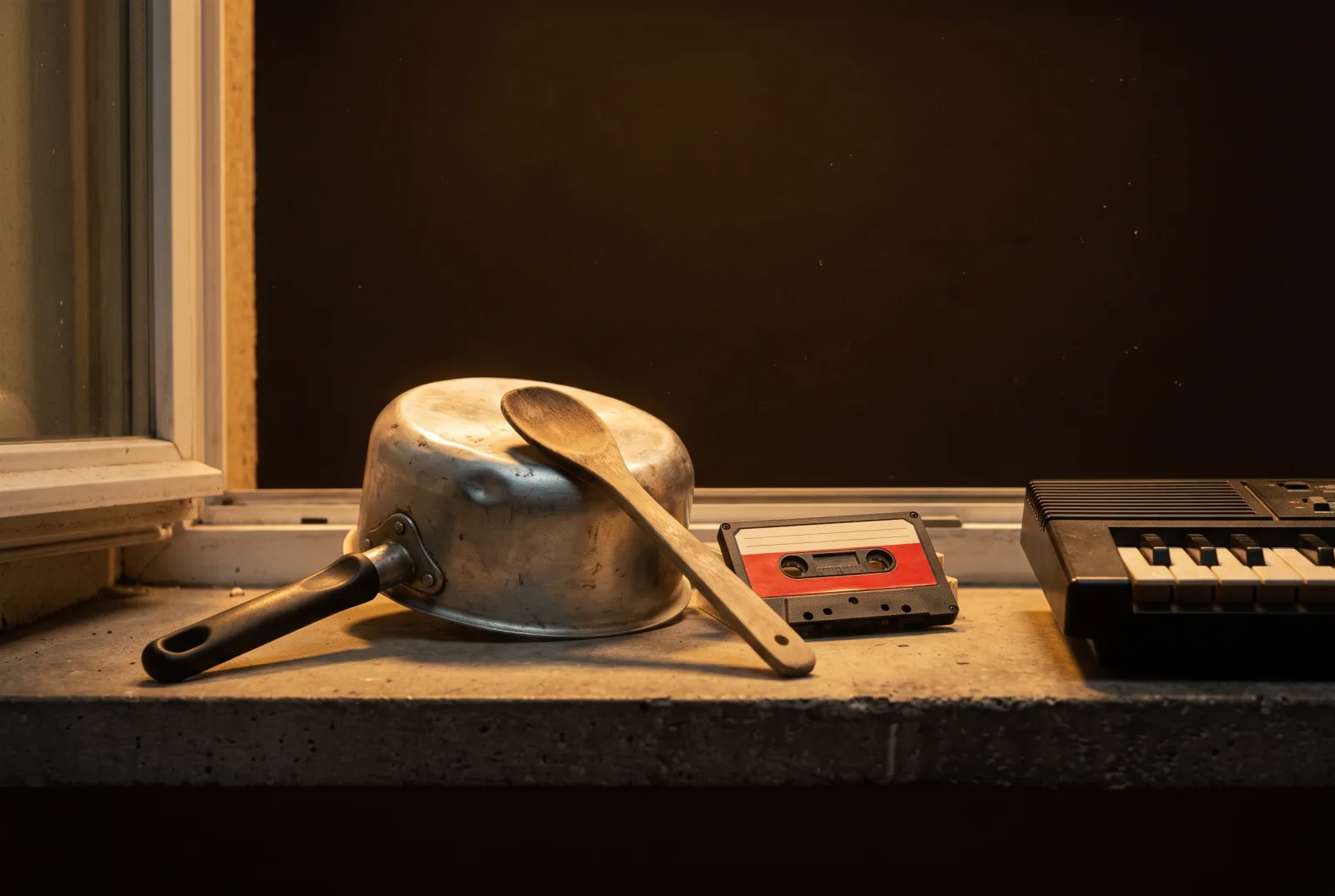
Ilustración: Rebobinados
In 1983, on television screens all over the world, a man crossed a stage gliding backwards as if the floor were moving under his feet. It was Michael Jackson doing the moonwalk, and the planet went wild. That year "Thriller" was everywhere —the best-selling record in history—, MTV was turning every song into a spectacle, and the world was dancing, glossy, happy, lit up. The north had made its music into a party perfectly designed for forgetting.
That same year, in Chile, people were going out into the street to bang pots. In 1982 the dictatorship's "economic miracle" had collapsed: crisis, unemployment, hunger. And in 1983 what had not happened in ten years finally erupted: the national protests. Month after month, people poured into the streets, rattled empty saucepans from their windows, shouted what they had been swallowing since the coup. It was the first mass, open resistance since 1973, and the dictatorship answered with bullets: there were deaths in those protests. The same year, at two points on the globe: the moonwalk and the saucepans. One was dancing to forget; the other was banging to wake up. That gap, that distance between the two clocks, is the heart of this chapter.
Three schoolmates from San Miguel
And in the middle of the saucepans, the voice appeared. It did not come from a great established artist, or from exile, or from a party. It came from three schoolmates in San Miguel, a working-class district in the south of Santiago: Jorge González, Claudio Narea and Miguel Tapia, who had met in 1979 on the benches of Liceo 6 Andrés Bello. They were not militants of anything, they carried no party line; they were three young people from the periphery with a ferocious clarity about what was waiting for them, which was nothing. They called themselves Los Prisioneros. And in December 1984, with no big label and no money, they put out a thousand cassettes of a record called "La voz de los '80".
No code, no metaphor, head-on
What they did, nobody here had done before. They did not sing in code, like the Canto Nuevo. They did not use poetic metaphor, like Argentine rock. They took the imported sound —new wave, the synthesiser, the guitar from the north, the very thing that had arrived over the radio— and aimed it straight, undisguised, at the system that had them squeezed. They sang head-on about inequality, about the country that had no place for them, about the rage of a generation raised under the boot. Where the Canto Nuevo whispered and Argentine rock hinted, Los Prisioneros shouted, naming names. The whisper of the previous chapter had finally become a shout.
The dance of those left over
Their anthem says it all, and it connects to something you may recognise. In 1986, on their second album, came "El baile de los que sobran": a song about young people who do everything they are supposed to do —go to school, study, behave— and discover, on the way out, that the system has no place for them at all. The ones left over. The ones who studied for nothing, pushed to the margins the moment they walk out of formal education. It was not a love song or a party song: it was the diagnosis of a country that manufactured young people and then had no idea what to do with them, that left them outside. That song became an anthem across the continent, because all over Latin America there were kids left over, and for the first time someone was singing it in plain words.
The stadium where they had killed the previous voice
And there is something in that consecration that memory will not let go of. Los Prisioneros presented that record with two packed, sold-out concerts at the Estadio Chile. The Estadio Chile. The same venue where, thirteen years earlier, Víctor Jara had been tortured and murdered. In the exact place where they silenced the voice of the seventies, with broken hands and forty-four bullets, the voice of the eighties rose to a full house. Music came back to the scene of the crime, and it came back louder. I do not know whether they thought of it that way that night, but history wrote it down: they had not managed to kill the song. It came back, young and at full volume, to sing where they had tried to silence it.
Censored, and by then too late
Those in power did not like it, of course. Los Prisioneros were censored, banned from television, blocked in the media the dictatorship controlled. But it was already too late: the whole country was singing them, and no censorship can silence what is already in the mouth of a generation. In 1988 they openly declared for the "No" against Pinochet, and paid for it with more obstacles. They did not care. They had decided, like Jara, to sing what they were living, with no mask, whatever it cost.
Dancing to forget or looking in the mirror
The difference between the two clocks is the lesson. The north used its music to escape: the moonwalk, the lights, the party that lets you forget. Chile used its own for the opposite: to look in the mirror and to fight. Both were "the voice of the eighties". But the north's voice of the eighties could not hear the other one, the one shouting from a Santiago neighbourhood the king of the dancefloor would never set foot in. Sometimes the most important music of an era is not the one playing all over the world, but the one telling the truth to a single country.
Rewind, then, to that Chile of the saucepans, where the mould finally cracked and a voice slipped through the crack. Three young people from San Miguel said out loud, head-on, with no code and no exile, what an entire country had been whispering for ten years. And they said it, of all places, in the stadium where the previous voice had been murdered. The whisper had become a shout, and the shout had a name: Los Prisioneros. The voice of the eighties was not supplied by the man dancing on television. It was supplied by the one banging the pot. And while that voice was shouting through a guitar, in other young people's bedrooms a machine was beginning to hum. But that is the story of the next chapter.
Sources
Los Prisioneros —Jorge González (vocals, bass and main songwriter), Claudio Narea (guitar) and Miguel Tapia (drums)— met in 1979 as classmates at Liceo N° 6 Andrés Bello in San Miguel, Santiago. Their first album, "La voz de los '80", was released independently on the Fusión label, run by their manager Carlos Fonseca, on 13 December 1984, initially as a thousand cassettes. Their second album, "Pateando piedras" (1 November 1986, EMI), presented with two packed concerts at the Estadio Chile —today the Estadio Víctor Jara—, included "El baile de los que sobran", a song about young people pushed to the margins after leaving formal education, which became a continental anthem. The band was censored and banned from television and the media controlled by the dictatorship; in 1988 they declared for the "No". The context: the economic crisis of 1982 and the national protests that began in 1983, violently repressed, with fatalities. On the world clock: the dominance of Michael Jackson's "Thriller" and his moonwalk, performed on the Motown 25 special in March 1983, along with the rise of MTV, Madonna and Prince. Song lyrics are not reproduced, for copyright reasons. Information drawn from Memoria Chilena, MusicaPopular.cl, Wikipedia and press coverage.
Keep rewinding

Series
A History of Chilean Rock · Chapter 16: Music Loses Its Weight
Napster and the mp3 strip music of its weight, and with it goes the distance this series opened with: you cannot arrive late to something that arrives instantly. The door opens both ways, but the same freedom that released the musician destroyed the economy that sustained them.
Series
A History of Chilean Rock · Chapter 15: The Golden Age and the End of the Millennium
As the world crosses into the year 2000, Chilean rock reaches its peak and loses its last inhibition: it stops measuring itself against a distant "real thing". Los Tres say goodbye in Concepción just as the new century begins, and in that same city Los Bunkers had already existed for months.
Series
A History of Chilean Rock · Chapter 14: Joy and Rage
While the world surrenders to Britpop, the echo reverses: through MTV Latino, Chilean rock finally goes out to be heard. And Los Tres, from Concepción, conquer the screen not by copying the north but by taking Roberto Parra's cueca. Yet beneath the joy lay real losses and a rage that would not go away.
Rewind with us
Comments · 0
No one has commented yet. Open the conversation.