
Joaquín Sabina
He was born three times
By Rebobinados · Published on September 9, 2026
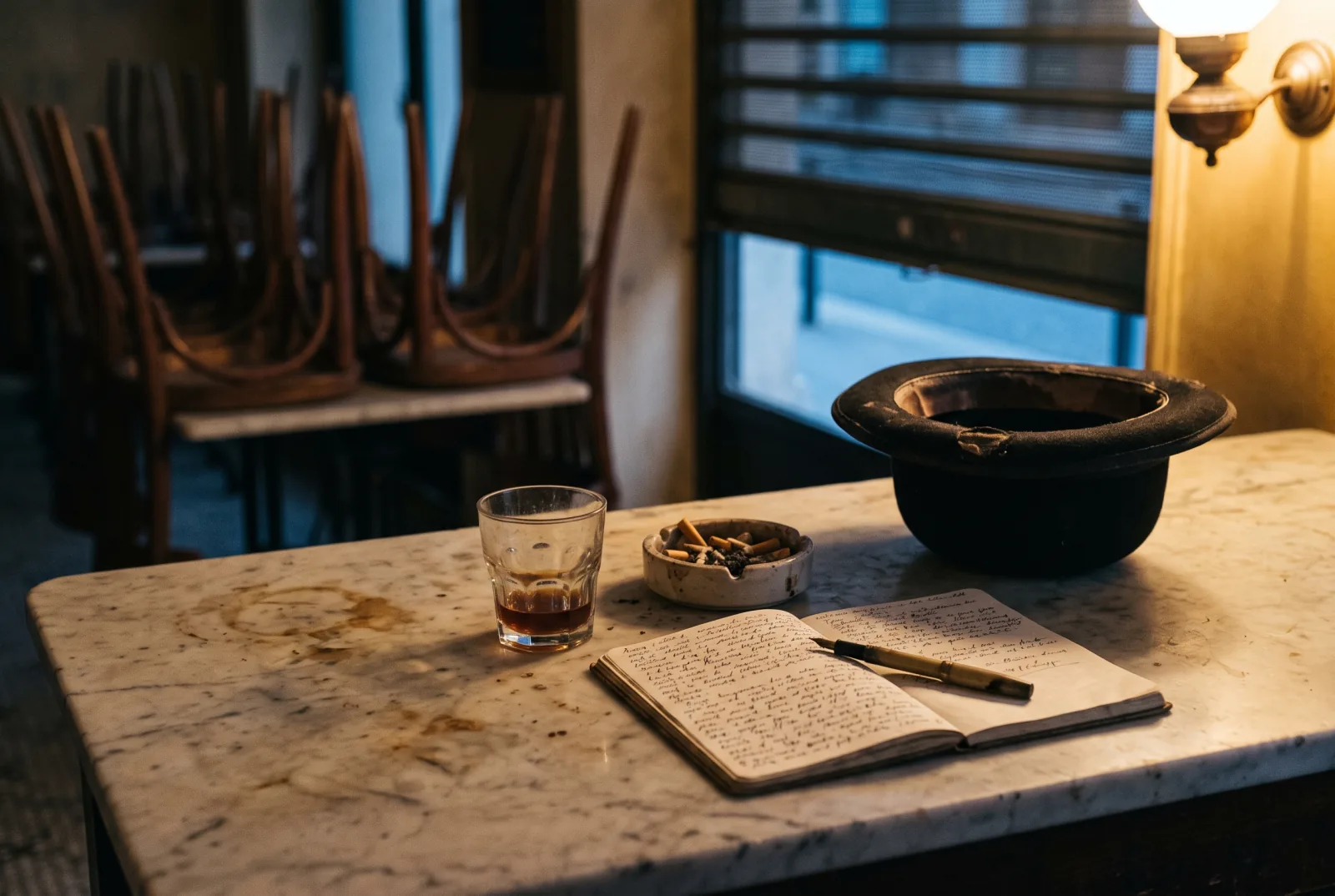
Ilustración: Rebobinados
Joaquín Sabina's father was a police inspector. The son became the most nocturnal, most disreputable and most literary voice in Spanish-language song.
That contradiction at the source — the son of the man who represented order becoming the poet of disorder — is a fair summary of the character. And "character" is the word, because Sabina built his with as much care as he built his verses.
The Molotov cocktail
He was born in Úbeda, in Jaén, in 1949. He had written poems since he was a boy and put bands together, but what split his life open was politics.
In 1970, a student in Granada and an anti-Franco militant, he threw a Molotov cocktail at a branch of the Banco de Bilbao, in protest at the Burgos Trial. That night he stopped being a student with opinions and became someone they were looking for.
He fled. And to get out he used a borrowed passport belonging to another man, Mariano Zugasti, under whose name he lived for a while. He ended up in London, where he stayed until 1976.
They were hard, formative years, the same ones that changed the music of exiles from other dictatorships for good. Squatter, waiter, student. Organising film clubs with other Spaniards to show the films Franco had banned. That is where he wrote his first songs.
The postcard he dismantled himself
And that is also where the most quoted anecdote of those years belongs: that in a London bar, in the seventies, Sabina sang in public for the first time to an audience that included George Harrison, and that the Beatle left him some coins.
It is a perfect postcard: the exile who was still nobody, singing without knowing it to history. Sabina told it many times.
And then he took it apart himself. Asked about the coins he had supposedly kept as a relic, he answered that he had actually drunk them that same night.
It is worth stopping there for a second, because it explains the whole character. Sabina spent his life building his own legend and deflating it in the next sentence. That is the exact mechanism of his songs: the grandiloquent gesture and, right behind it, the joke that brings it back down to earth.
The scoundrel poet
He returned to Spain in 1977, with the dictatorship just ended, and gradually built what he would become.
With his bowler hat, his torn voice and a line as sharp as a razor, he became the chronicler of the night, of loves that end badly, of bars and small hours, of losers with dignity. Hotel dulce hotel, and above all 19 días y 500 noches, from 1999, confirmed him as something rare in popular music: a lyricist who was, genuinely, a poet.
That is not a figure of speech. He published books of sonnets — the kind where you count the syllables — and what he did in his songs was pack into three minutes of radio the same density as a good poem, without their ceasing to be catchy and to be bellowed around any table.
He wrote the soundtrack for several generations who recognised themselves in his failures told with wit, in his tenderness dressed up as cynicism.
The three times he was born
He summed up his own life by saying he had been born three times. The first, in Úbeda. The second, when he came back from exile.
The third was on 24 August 2001, when a cerebral infarction nearly killed him. He woke up feeling that an arm and a leg no longer belonged to him.
He survived, and the body recovered fairly quickly. The mind did not. He fell into a deep depression, with stage panic, and into a pit it took him years to climb out of. Out of it he got, as always, songs: in 2005 he published Alivio de luto, which was at once the record of the fall and the record of the way out. He came back with his voice even more broken than before.
That is Sabina's signature: he does not hide the damage, he sings it. Every blow ended up turned into verse.
Two birds
There is a friendship that has to be named, because it is part of the history of Spanish-language culture: his with Joan Manuel Serrat.
The two giants of song in Spanish came together from 2007 on the tour Dos pájaros de un tiro — two birds with one stone — swapping repertoires with a complicity you could feel from the back row. Watching Serrat and Sabina on the same stage was watching two opposite and complementary ways of being enormous: Serrat, elegance and calm depth; Sabina, the tearing and the sad party. Two poets, two lives, one language.
And it was precisely at a concert with Serrat, at the WiZink Center in Madrid, on 12 February 2020 — the day he turned seventy-one — that Sabina fell off the stage into the pit and suffered an intracranial haematoma. A serious scare, on his own birthday, in front of thousands of people.
Leaving in time
Then came the hardest thing of all, which is getting off. In 2025, after a farewell tour called Hola y adiós, he officially retired from the stage. The man who had always lived on the edge chose the moment to go, with the dignity of someone who does not want to be watched fading out.
Joaquín Sabina is alive, retired, writing. And he is still what he always was: one of the greatest poets popular song has produced in our language, a man who turned his own falls — the exile, the excesses, the stroke, the depression — into the raw material of a body of work that gave millions the words for what they could not name.
If you have ever been awake at four in the morning with a grief too big for your chest, and found in one of his songs exactly the right company, you already know what this is about. Sabina did not sing for the people who had it easy. He sang for the ones who fall and get up, and fall again, and carry on. Which, looked at properly, is nearly everybody.
Go and listen to "19 días y 500 noches". You will find a poet with a barroom voice telling you your own life, and making it sound, for a while, dignified and even beautiful.
Sources
Joaquín Ramón Martínez Sabina (Úbeda, Jaén, Spain, 12 February 1949), singer-songwriter, poet and painter; his father, Jerónimo Martínez Gallego, was a police inspector. An anti-Franco militant, in 1970 he threw a Molotov cocktail at a branch of the Banco de Bilbao in Granada, in protest at the Burgos Trial, which precipitated his exile; he left Spain on a borrowed passport belonging to Mariano Zugasti. He lived in London between 1970 and 1976, where he squatted, worked at various jobs, organised film clubs with other exiles and wrote his first songs. The anecdote of performing in a London bar before George Harrison is documented, although Sabina himself later contradicted the version in which he kept the coins the Beatle left him as a relic, stating that he had in fact drunk them that same night. He returned to Spain in 1977. He released "Inventario" (1978), "La Mandrágora" (1981, with Javier Krahe and Alberto Pérez), "Hotel dulce hotel" (1987) and "19 días y 500 noches" (1999, Ondas Prize), among seventeen studio albums. He published books of poetry, including the volume of sonnets "Ciento volando de catorce". He is known as "the scoundrel poet" and chronicler of the night. On 24 August 2001 he suffered a cerebral infarction; he recovered physically but went through a deep depression and stage panic, reflected in "Alivio de luto" (2005). He maintained a celebrated partnership with Joan Manuel Serrat, with the "Dos pájaros de un tiro" tour from 2007 and a joint album. On 12 February 2020, the day he turned 71, he fell from the stage into the pit during a concert with Serrat at the WiZink Center in Madrid and suffered an intracranial haematoma. In 2025 he officially retired from performing after the farewell tour "Hola y adiós". Externally authored text, edited and verified for Rebobinados. Interpretations of the meaning of his work are offered as the author's reading. No song lyrics are reproduced, for copyright reasons. Information drawn from Wikipedia, the Instituto Cervantes and Spanish and Latin American press coverage.
Keep rewinding
70s
folk
Florcita Motuda
Forty-nine years without a reissue
With "Brevemente… geeente" he won the best Chilean performer prize at Viña 1977, and he won it in the international competition because the folk one was not held that year. The album that contains it, released in 1977 on APRI —Antonio Prieto's label—, spent 49 years without a reissue: never on CD or streaming until it came back on vinyl in April 2026 and on digital on 11 July, the day he returned to the stage. The record for the longest title at the OTI is his, but it is from 1978 and not 1998.
00s
folk
Natalia Lafourcade
Where it said pumpkin she put flowers
The story says she rescued the son jarocho with reverence on *Un Canto por México*, but "La Bruja" is not on that record: she recorded it on *Cancionera*, on 24 April 2025, and rewrote the lyric. Where the son turns the man into a pumpkin, she sings that she filled him with flowers: "a cancionera is a kind of sorceress". Twenty Latin Grammys, a house rebuilt in Jáltipan and a harpsichordist father who left Chile two days after the coup.
70s
folk
Piero
The old man wasn't his
Piero sang "Mi viejo" in 1969, but the words are José Tcherkaski's and the father it portrays was his own: Mario Tcherkaski, a Russian street hawker who died at 52, eight years before the song. CBS released it with Father's Day in mind after several labels turned it down, and the first pressing passed 600,000 copies. Piero died on 7 October 2026, aged 81.
Rewind with us
Comments · 0
No one has commented yet. Open the conversation.