
Suzanne Vega
The voice that tuned the MP3
By Rebobinados · Published on September 17, 2026
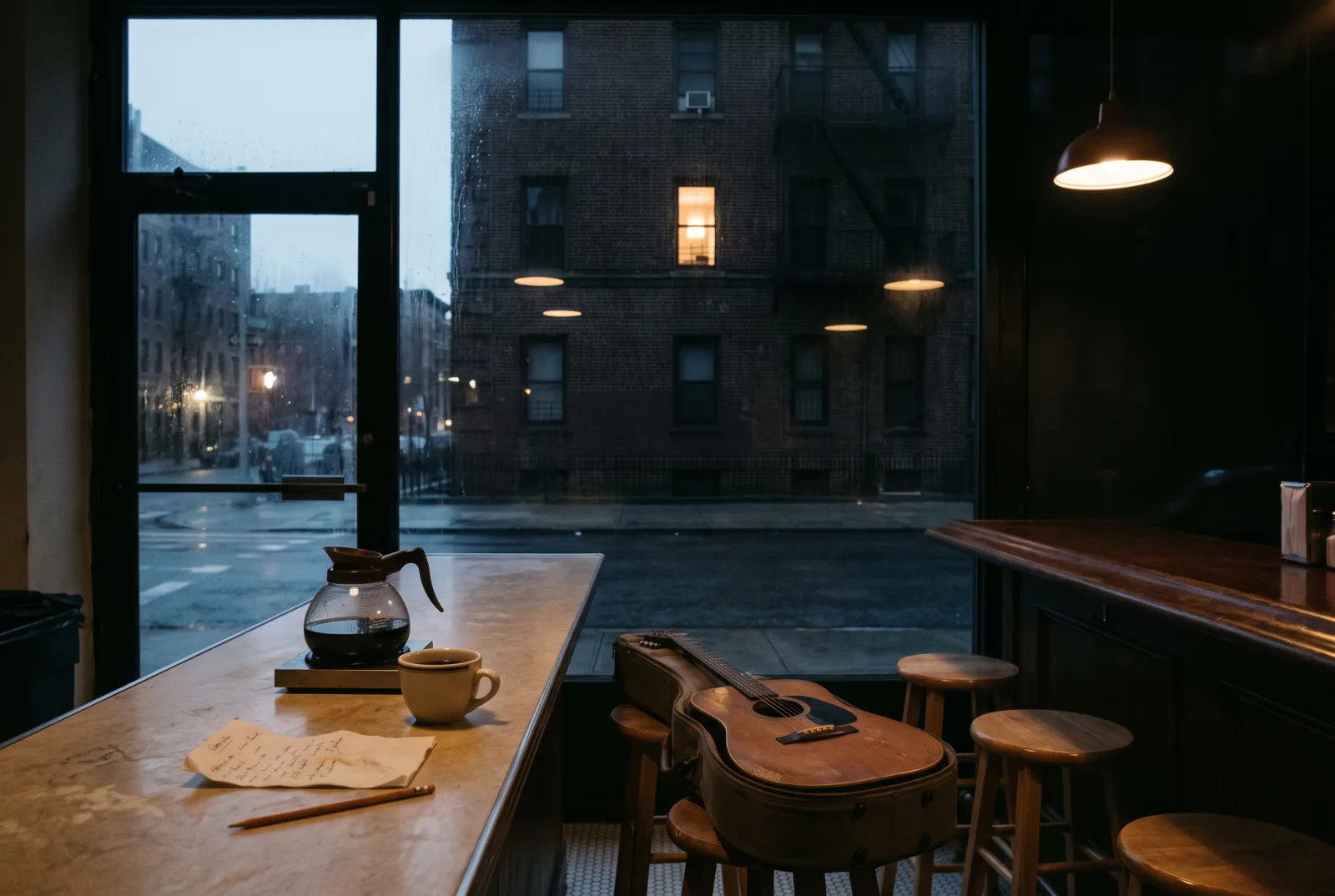
Ilustración: Rebobinados
Suzanne Vega is one of those artists whose songs look small and simple, and hide entire worlds.
With her acoustic guitar and a calm, almost spoken voice, she became one of the great storytellers in music: songs that work like short stories, precise observations of ordinary life in New York.
And within her work there are two songs with stories so incredible they sound made up. Both are true.
The storyteller of Greenwich Village
She was born in Santa Monica, California, in 1959, but she grew up in New York: the family moved when she was two and a half, and she was raised between Spanish Harlem and the Upper West Side.
She emerged in the early eighties in the cafés of Greenwich Village, in the middle of the folk revival. There she sang, alone with her guitar, songs of her own that sounded like nobody else's: instead of grand statements or catchy choruses, she made intimate, detailed, almost literary portraits.
Her first record, in 1985, established her as a distinct voice, cerebral and delicate, and opened the door for a whole scene —Tracy Chapman, Shawn Colvin, the Indigo Girls would come after her—.
But it was her second album, "Solitude Standing", from 1987, that made her a mass artist and that holds the two songs that made her historic.
"Luka", and who Luka was
The first is "Luka", her big hit —number three in the United States, three Grammy nominations— and one of the bravest songs ever to play on the radio.
It is a pop song, with a bright, catchy melody that people hummed everywhere. And it is really about an abused child.
It is sung in the first person, in that child's voice, who with a heartbreaking sweetness asks the neighbour not to ask about the bruises, that it is none of his business, that he brought it on himself.
Nobody had put a subject this painful inside a pop song this gentle and this listenable. People sang it without noticing at first what it was saying, and once they understood, they never forgot it.
And here there is something worth telling in order, because these are two moments thirty-four years apart.
In 1987, when the song came out, Vega explained that the name came from a real boy called Luka she used to watch playing in front of her building, a boy who struck her as different from the rest. And she stated expressly that in the song the child is abused, but that in real life she did not believe he was.
In 2021 she told the other half. A historian interviewing her said he already knew that she was Luka, and she decided to take up the challenge: there was abuse in her family, she said, and she is Luka. She pointed to her stepfather, the Puerto Rican novelist Ed Vega. And she explained why she had chosen that disguise: she picked a character to speak through, and that protected her all those years.
With that song, and with the courage to hold it up first from behind a borrowed name and later face on, Vega gave voice and visibility, on an enormous scale, to a pain almost nobody dared to name.
The song that helped fine-tune the MP3
And the second story is one of the strangest in all of music.
On the same record there was a little a cappella song —just Suzanne's voice, with no instruments at all— called "Tom's Diner", about an ordinary morning in a New York coffee shop. It was an oddity, almost a game.
But two astonishing things happened to it.
First, a British electronic duo, DNA, remixed it without anyone's permission —not hers, not her label's, not her publisher's— and put it out in a limited run for clubs. Instead of suing them, her company decided to license it. That version became a worldwide hit: number five in the United States, number two in the United Kingdom, number one across half of Europe. The same small a cappella voice, now playing in the planet's nightclubs.
And second, even more incredible. A German engineer, Karlheinz Brandenburg, was developing a technology to compress sound, and he used that a cappella recording as one of his reference tracks. The reason is lovely: a lone voice, warm and unadorned, is the hardest thing to compress well, because any artefact is heard immediately. He said he was electrified and that he knew straight away it would be almost impossible.
That technology ended up being the MP3, the format that changed forever how the world listens to music.
It is worth being fair to the facts: the MP3 was not "tuned" to that song, and "Tom's Diner" was one test track among others. But it was the one he listened to most, over and over, while he fine-tuned the algorithm. Among audio engineers a fond, anonymous nickname stuck to Vega: the mother of the MP3.
The coffee shop, by the way, exists: it is Tom's Restaurant on Broadway at 112th Street, which she used to go to as a student. Years later, its façade became world-famous all over again as the exterior of the café in "Seinfeld".
What to remember
Suzanne Vega is proof that the quietest songs can be the most powerful and the most influential.
If you put on "Luka", "Tom's Diner", "Marlene on the Wall" or "The Queen and the Soldier", you will hear an exquisite storyteller, able to tell a whole life in three minutes with a guitar and a calm voice.
And you will be listening to a woman who did two things almost nobody has: she put child abuse into a pop hit and made it impossible to ignore, and she lent her voice, without knowing it, to the technology you listen to all your music with today.
Few artists this seemingly small left a mark this large.
The next time you put a song on your phone, remember: that convenience was fine-tuned, among other things, with the voice of Suzanne Vega singing about breakfast.
Sources
This text mentions child abuse. If you know a child or adolescent at risk, in Chile you can call 147, the Fono Niños run by Carabineros: free, confidential and available 24 hours a day, every day of the year. For situations of domestic violence there is 149, Fono Familia, on the same terms, and in the face of imminent danger, 133. For psychological guidance for children and adolescents there is also Línea Libre, 1515, free and confidential, Monday to Friday between 10:00 and 16:30.
Suzanne Nadine Vega (Santa Monica, California, 11 July 1959), American singer-songwriter. Her family moved to New York when she was two and a half, and she grew up between Spanish Harlem and the Upper West Side. A figure of the eighties folk revival in Greenwich Village, her self-titled debut album (1985) established her as a reference point of that scene, and "Solitude Standing" (1987) took her to mass success. Her two best-known songs come from the latter. "Luka", written from the perspective of an abused child, reached number 3 on the Billboard Hot 100 and received three Grammy nominations in 1988 —Record of the Year, Song of the Year and Best Female Pop Vocal Performance—, winning none. On its origin, Vega offered two versions separated in time: in 1987 she explained that the name came from a boy she used to watch playing in front of her building and specified that, in real life, she did not believe that boy was abused; in 2021 she revealed that the character was herself —"There was abuse in my family… I am Luka"—, attributing the abuse to her stepfather, the Puerto Rican novelist Edgardo "Ed" Vega Yunqué, and explaining that she had chosen a character to speak through and to protect herself. "Tom's Diner", originally an a cappella piece, was remixed without authorisation by the British duo DNA in 1990 in a limited run for clubs; the A&M label chose to license it rather than sue, and the version reached number 5 in the United States, number 2 in the United Kingdom and number 1 in Austria, Germany, Greece, Luxembourg and Switzerland. The engineer Karlheinz Brandenburg used the a cappella recording as one of his reference tracks while developing the compression algorithm of the MP3 format, because it is a lone, warm voice in which any artefact is audible; the format was not tuned exclusively to that song, and the nickname "the mother of the MP3" is an informal tag that arose among audio engineers, with no identifiable author. The Tom's Restaurant that inspired the song is on Broadway at West 112th Street, in Manhattan's Upper West Side; its façade was used as the exterior of the café in the series "Seinfeld", whose interiors were filmed on a set. Externally authored text, edited and verified for Rebobinados. Interpretations of the meaning of her work are offered as the author's reading. No song lyrics are reproduced, for copyright reasons; references to "Luka" are descriptive. Data gathered from Wikipedia, uDiscover Music, Music Republic Magazine, ChileAtiende, Línea Libre and other press coverage.
Keep rewinding

70s
folk
Florcita Motuda
Forty-nine years without a reissue
With "Brevemente… geeente" he won the best Chilean performer prize at Viña 1977, and he won it in the international competition because the folk one was not held that year. The album that contains it, released in 1977 on APRI —Antonio Prieto's label—, spent 49 years without a reissue: never on CD or streaming until it came back on vinyl in April 2026 and on digital on 11 July, the day he returned to the stage. The record for the longest title at the OTI is his, but it is from 1978 and not 1998.
00s
folk
Natalia Lafourcade
Where it said pumpkin she put flowers
The story says she rescued the son jarocho with reverence on *Un Canto por México*, but "La Bruja" is not on that record: she recorded it on *Cancionera*, on 24 April 2025, and rewrote the lyric. Where the son turns the man into a pumpkin, she sings that she filled him with flowers: "a cancionera is a kind of sorceress". Twenty Latin Grammys, a house rebuilt in Jáltipan and a harpsichordist father who left Chile two days after the coup.

70s
folk
Piero
The old man wasn't his
Piero sang "Mi viejo" in 1969, but the words are José Tcherkaski's and the father it portrays was his own: Mario Tcherkaski, a Russian street hawker who died at 52, eight years before the song. CBS released it with Father's Day in mind after several labels turned it down, and the first pressing passed 600,000 copies. Piero died on 7 October 2026, aged 81.
Rewind with us
Comments · 0
No one has commented yet. Open the conversation.