
A History of Funk: The Music That Bet Everything on Rhythm
By Rebobinados · Published on July 30, 2026
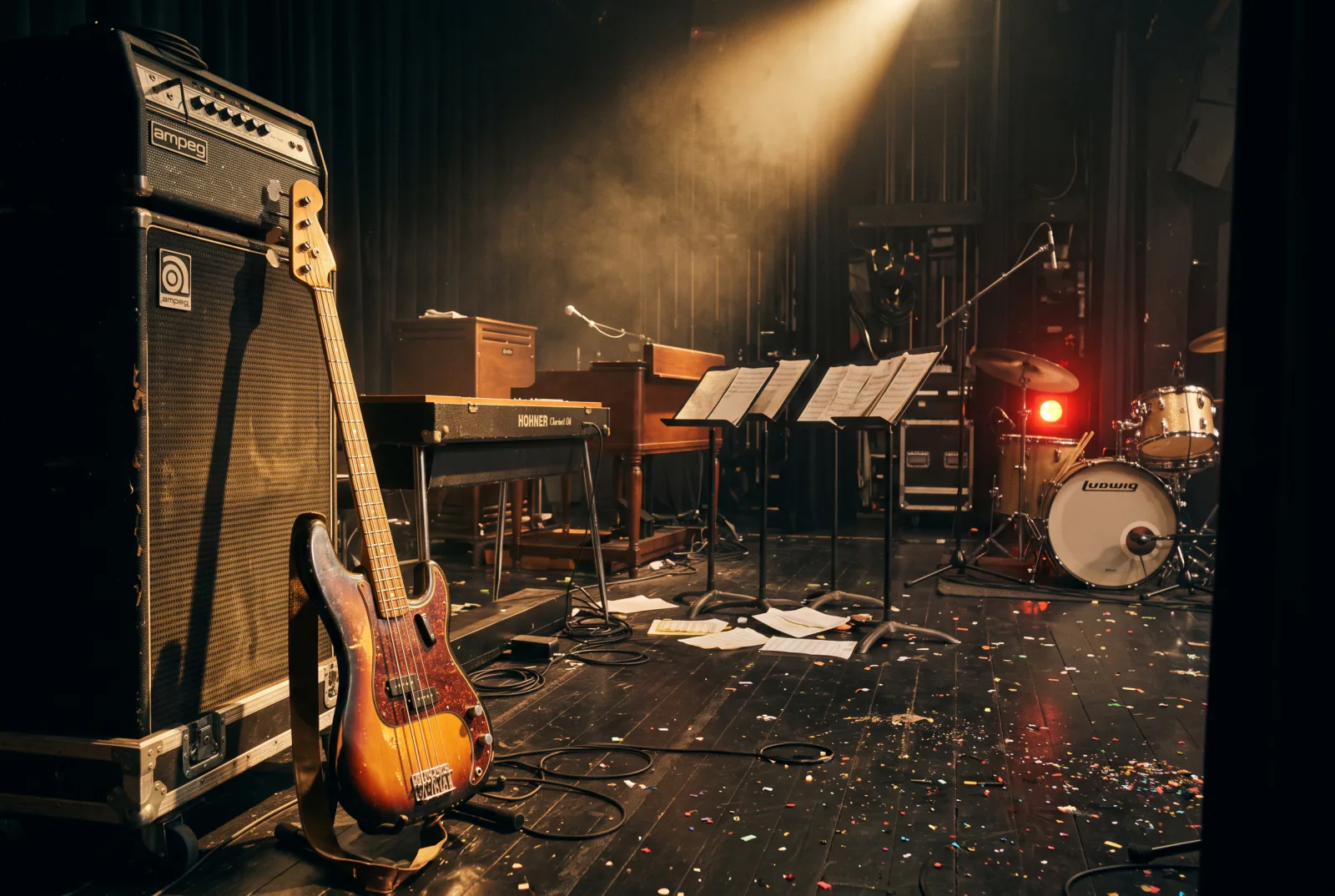
Ilustración: Rebobinados
There is one instruction that sums up funk better than any technical definition, and the man who invented it gave it to a nineteen-year-old bass player. When Bootsy Collins joined James Brown's band, Brown told him: "Son, give me the one. You give me the one, you can do all those other things." It sounds like nothing, and it is an entire revolution. To understand it you have to understand what all music was doing before Brown turned it upside down.
Almost all Western popular music — rock, soul, sixties pop — accented the second and fourth beats of the bar. The famous backbeat: the hit where you clap, the one that makes your head move. Brown did something apparently simple and absolutely radical: he moved the weight to the first beat. To the one. All the emphasis, all the force, falling like a hammer on the first hit of every bar. He explained it his own half-mystical way: "The 'One' is derived from the Earth itself, the soil, the pine trees of my youth. And most important, it's on ONE two THREE four — not one TWO three FOUR, that most blues are written."
That tiny displacement reorganised music around rhythm instead of melody or harmony. The song stopped being a story with chords that move forward and became a groove, a hypnotic rhythmic machine turning on itself. That is funk. And from that small enormous hit came one of the most influential currents in twentieth-century music.
This is its story: where it came from, how it grew, and why — though many don't know it — it lives inside almost everything that plays today.
The birth: James Brown and the discovery of the groove
Funk didn't appear all at once. It distilled slowly inside James Brown's music in the early sixties, until it crystallised into something new.
Brown came from rhythm and blues and gospel. He had triumphed as leader of the Famous Flames with church-style ballads. But in the early sixties he grew restless, looking for a rawer, more rhythmic sound, different from the formula of the day. The signs were already in "Think" (1960) and "Out of Sight" (1964), where something was shifting. But the moment usually named as the birth of funk as a distinct style arrived in 1965 with "Papa's Got a Brand New Bag".
In that song, everything that would define the genre is already there. The horns stop playing melodies and harmonies and become percussion: short, dry, rhythmic stabs. Jimmy Nolen's guitar scratches tight chords that sound almost like a drum. The bass locks onto a line that repeats without changing. And everything, singer and band, hammering the one. On the long version, before the song kicks in, you can hear Brown shout in the studio: "This is a hit!" He was right, doubly so: it was his first pop top ten — number eight — eight weeks at number one on the R&B chart, and in March 1966 it won him his first Grammy, for best rhythm and blues single of the year. But it was more than a hit: it was a genre being born.
Brown pushed it further with "Cold Sweat" (1967), where the groove stretches and breathes across two bars, and with anthems like "Say It Loud – I'm Black and Proud" (1968), where funk fused with the black pride of the moment. His band was a machine of brutal precision, with players like saxophonist Maceo Parker and arranger Pee Wee Ellis, where every instrument was an interlocking rhythmic part. Brown used his own voice as percussion: grunts, screams, rhythmic exclamations that echoed the traditions of African American work songs and, further back, the polyrhythms of West Africa. Because that, at bottom, is what funk is: the return of African rhythm to the heart of American popular music.
The expansion: Sly Stone opens the doors
If Brown invented funk, Sly and the Family Stone blew it outward and filled it with colour.
Sylvester Stewart — Sly Stone — formed his band in San Francisco in the late sixties, and it was unlike anything else. It was interracial when that was almost a provocation, mixed in gender, and it fused Brown's funk with the psychedelic rock that in 1967 was changing everything, with soul and with pop. Songs like "Dance to the Music", "Everyday People" and "Thank You (Falettinme Be Mice Elf Agin)" were massive hits that widened the genre's reach and gave it a message of unity and optimism that chimed with the times.
Sly's contribution was twofold. Musically, he showed that funk could open up, become more melodic, more luminous, without losing the groove. And culturally, he embodied an ideal: a band where black and white, men and women, played together as equals, at the height of the civil rights struggle. Funk wasn't only rhythm; it was a way of being in the world. His bass player, Larry Graham, also invented a technique — slapping with the thumb and plucking the strings — that would become the signature sound of funk bass forever.
The golden age: George Clinton and the P-Funk universe
And then came the man who turned funk into a complete mythology: George Clinton.
Clinton had started in the fifties with a doo-wop vocal group, the Parliaments, rehearsing in the back room of a barbershop in Plainfield, New Jersey, where he straightened customers' hair. But in the seventies he became something without precedent. Under two names — Parliament and Funkadelic, one collective of dozens of musicians — Clinton took the funk of Brown and Sly and crossed it with Jimi Hendrix's psychedelia, rock, science fiction and an overflowing imagination. P-Funk was born.
Funkadelic explored a psychedelic funk-rock, heavy and raw — the album "Maggot Brain" (1971) is a dark, visionary work. Parliament, by contrast, was pure cosmic party: spaceships descending onto the stage, delirious costumes, mythologies of a funk that came from space to save humanity. Records like "Mothership Connection" (1975), with "Give Up the Funk (Tear the Roof off the Sucker)", turned the groove into a joyful religion. The sound was defined by the elastic, theatrical bass of Bootsy Collins — the same man Brown had taught the one — and the keyboards of the brilliant Bernie Worrell.
Clinton understood funk as philosophy. "Funk is anything you need it to be to save your life", he said. "And you can take something bad, apply funk to it, and make it good." Under his command, the genre reached its peak of ambition and spectacle.
The many faces of seventies funk
While Clinton built his empire, funk flowered in a thousand forms. Kool & the Gang delivered party anthems ("Jungle Boogie", "Celebration"). Earth, Wind & Fire fused funk with jazz, soul and a luminous spirituality, with dazzling horn arrangements. The Isley Brothers, War, the Ohio Players, the Meters of New Orleans: each one a variety of the groove. Stevie Wonder, in his most glorious stretch, wove funk into masterpieces like "Superstition", where the clavinet becomes pure rhythm.
And by mid-decade, funk gave birth to its most commercial and massive child: disco. Disco took the funk groove, made it smoother, more regular, more oriented to the dance floor, and conquered the world. Many funk purists eyed it with suspicion, but the kinship is undeniable: without James Brown's one, there is no Saturday Night Fever.
The bridge to the future: Prince and eighties funk
When the eighties arrived with their synthesizers and drum machines, funk didn't die: it transformed. And its great prophet in that new era was Prince.
Prince took the P-Funk groove and fused it with pop, rock, new wave and the nascent electronics, creating the so-called Minneapolis sound. Records like "1999" and "Purple Rain" are built on funk foundations but dressed in the clothes of the future. Prince proved that funk could survive the digital revolution, that the groove could live inside a drum machine as well as in a fifty-piece band. He was the link connecting classic funk to everything that followed. Years later the circle closed in the most literal way: Clinton ended up signed to Paisley Park, Prince's label.
The eternal revival: how funk conquered everything else
And here is the part many people don't know, the one that makes funk one of the most influential genres in history: it didn't stay in its own era. It became the DNA of almost all the popular music that came after.
Hip-hop was built on funk. When hip-hop was born, its producers needed grooves to rap over, and they found them in funk records. The music of James Brown and Parliament-Funkadelic became the most sampled in history. Brown's "Funky Drummer" — twenty seconds of Clyde Stubblefield alone on the kit — has been sampled on more than thirteen hundred songs, from Public Enemy and the Beastie Boys to George Michael, Britney Spears and Ed Sheeran: in hip-hop no break beats it, and overall only the Winstons' "Amen break" disputes the throne. George Clinton, for his part, saw his work recycled by Dr. Dre, Snoop Dogg, Tupac, Ice Cube and Outkast: all the West Coast G-funk of the nineties is, literally, Clinton's funk reprocessed. Funk didn't just influence hip-hop: it is its raw material.
Rock absorbed it. The Red Hot Chili Peppers started as an openly funk band — their second album, "Freaky Styley" (1985), was produced by George Clinton himself — and took the funk groove into mass alternative rock, selling millions. Funk metal, funk rock, a whole current where the bass rules again, descends from here.
Contemporary pop and R&B live off it. From nineties new jack swing to modern R&B, from Bruno Mars and Mark Ronson's "Uptown Funk" — a direct, massive homage to the classic sound — to Daft Punk reviving the groove with "Get Lucky", funk reappears again and again, generation after generation, because its central discovery is imperishable: the primacy of rhythm, the hypnotic power of the groove, music that speaks to the body before the mind.
Why funk matters
Funk is, perhaps, the most important rhythmic contribution of twentieth-century popular music. Its revolution was philosophical before it was technical: it put rhythm at the centre, above melody and harmony, and in doing so reconnected Western popular music with its deepest African roots. It insisted that the groove — that hypnotic repetition, that dialogue between interlocking instruments — could be the heart of a song, not its accompaniment.
And it insisted on something else, something beyond the musical. Funk was born of Black America at a moment of struggle and affirmation, and it always carried that charge: pride, joy as resistance, the dancing body as an act of freedom. "Say it loud", Brown shouted. Funk was music for celebrating your own existence, for reclaiming joy in hard times.
That is why it is still alive, hidden in the pulse of almost everything we dance to. Every time a song grabs you by the hips before you understand the lyric, every time an elastic bass line forces you to move, every time a groove repeats until it turns hypnotic and you don't want it to stop, there is funk, doing what it discovered sixty years ago when James Brown decided to come down, with all the weight of the world, on the one.
Everything else, as the good Doctor Funkenstein would say, is just music. Funk is what saves your life on the dance floor.
Keep rewinding

90s
funk
Jamiroquai
The floor was not moving
In "Virtual Insanity" the floor never moved: it was grey and smooth, and what turned was the whole set on wheels, pushed by stagehands with the camera bolted to one wall. Jonathan Glazer directed it on 12 August 1996 in four takes, for half the 280,000 pounds that moving the floor for real would have cost. It won four VMAs out of ten nominations, including Video of the Year.
80s
funk
Rick James
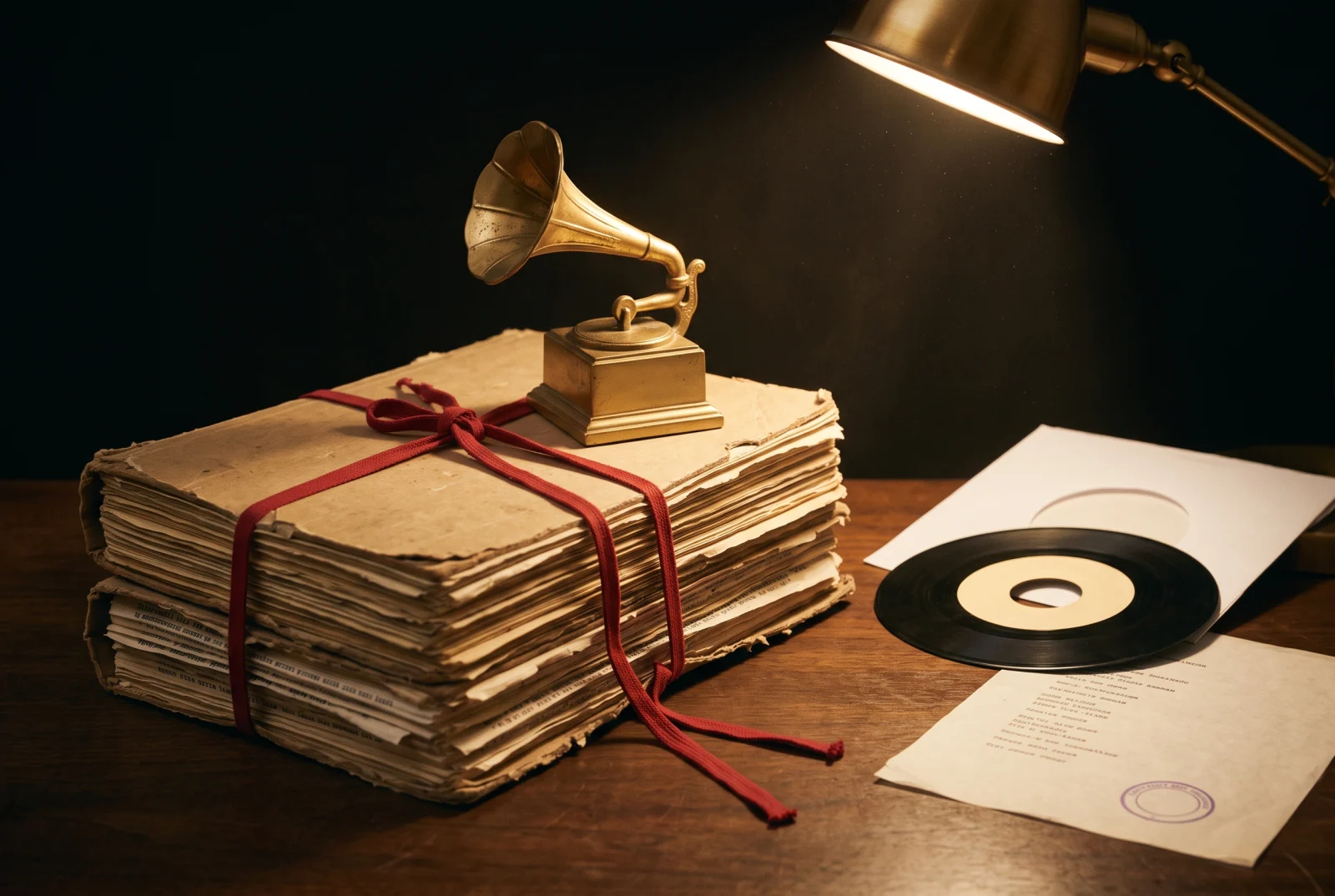
The Grammy came out of a lawsuit
The only Grammy of his life he won for a song he did not record: Best R&B Song on 20 February 1991 for "U Can't Touch This", after suing MC Hammer over the riff of "Super Freak" and settling out of court. Before all that he had a band in Toronto with Neil Young and Bruce Palmer, and Motown cancelled their single in 1966 on discovering that its singer was a fugitive from the Naval Reserve.
90s
funk
Red Hot Chili Peppers
The four from Fairfax High
Red Hot Chili Peppers formed in Los Angeles in 1982 with four classmates from Fairfax High: Kiedis, Flea, Hillel Slovak and Jack Irons. Slovak died of a heroin overdose on 25 June 1988, Irons left because of it and John Frusciante joined that same year, aged eighteen, to replace him. Then came his three spells, two departures and Josh Klinghoffer's ten years.
Rewind with us
Comments · 0
No one has commented yet. Open the conversation.