
How Much Rock Owes Nikola Tesla
By Rebobinados · Published on August 9, 2026
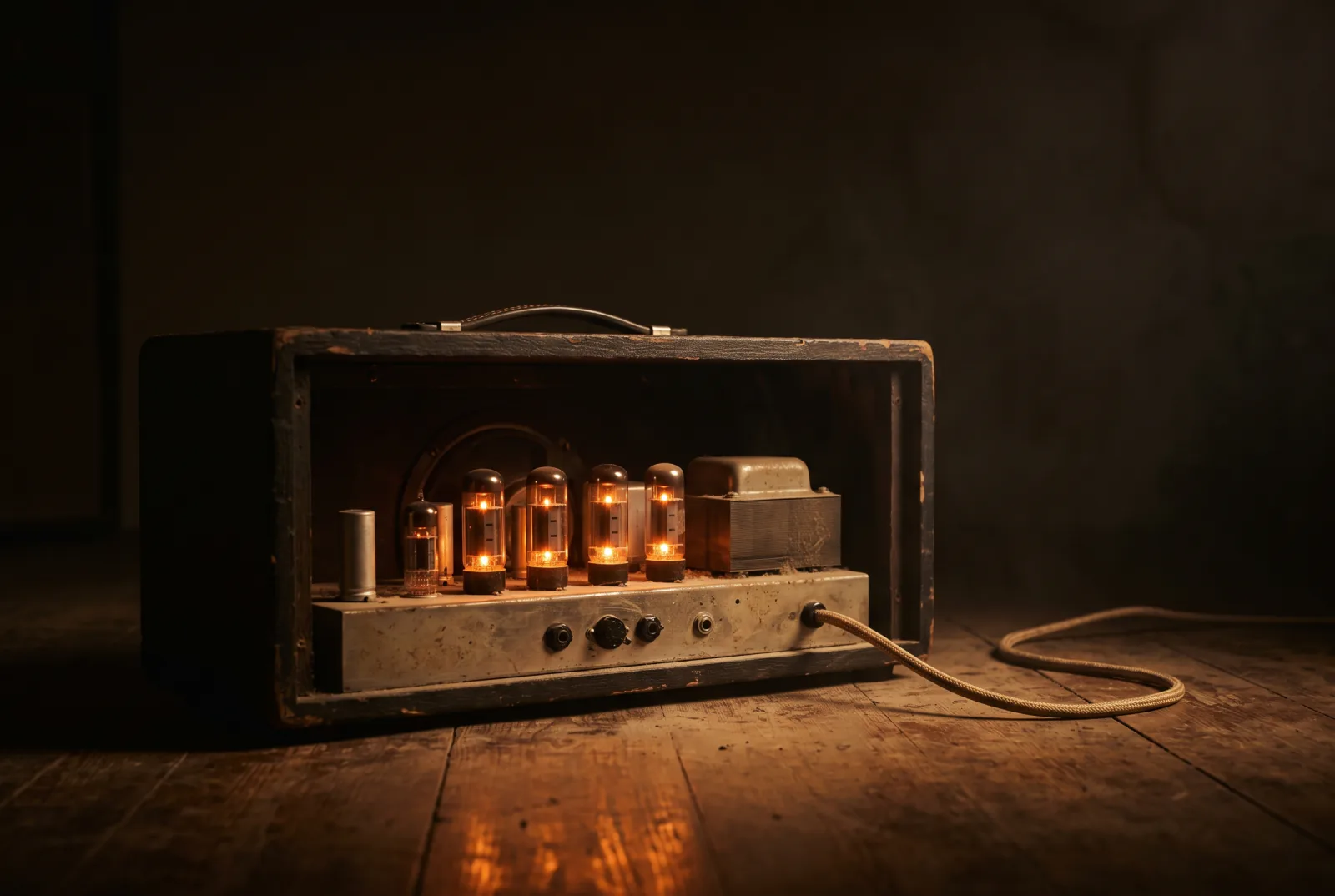
Ilustración: Rebobinados
Think of the most characteristic sound in rock. Not the melody, not the lyrics: the pure sound. A distorted electric guitar roaring through an amplifier, so loud you feel it in your chest, filling a stadium of sixty thousand people. That sound — the very heart of rock — wouldn't exist without electricity. And not just any electricity: without a very specific kind of current that a Serbian immigrant, obsessed since childhood with sparks, helped impose on the world. Rock, the genre that feels like the most visceral and human thing there is, owes its physical existence to electrical engineering. And at the centre of that debt stands Nikola Tesla.
This article traces that hidden debt — how much of what we love about rock rests, literally, on the current Tesla championed — and ends with an entertaining question: if we took Tesla away, which bands would survive? Which depend so completely on electricity that without it they'd go dark, and which would keep sounding almost the same? Because hidden in that question is a way of understanding what rock, deep down, actually is.
First, the truth about Tesla (no myths)
Before apportioning the debt, let's be crystal clear, because Tesla's figure is wrapped in so much mythology that it's worth separating fact from legend.
Nikola Tesla, born in 1856 in what is today Croatia, a Serbian-American engineer, is known above all for his contributions to the design of the modern alternating current system, AC. But it has to be said precisely: Tesla didn't "invent" alternating current all by himself, out of nothing. Alternating current was known before he was born, and the great commercial driver of AC was the industrialist George Westinghouse, who bought and developed the key patents. What Tesla did do, and it is enormous, was to solve the problem that made AC practical: he invented the alternating current induction motor and the polyphase system that made it usable at scale. In 1887, barely three years after arriving in the United States, he filed a series of patents describing a complete AC system. He was the technical genius who made the current that would electrify the world actually work.
This mattered because at the end of the nineteenth century there was a war — the famous "war of the currents". On one side, Thomas Edison, champion of direct current, DC. On the other, the alternating current of Tesla and Westinghouse. The difference was decisive: direct current couldn't be transmitted economically over long distances, while alternating current could — it could travel kilometres with minimal losses, which made it perfect for building electrical grids covering entire cities and countries. AC won. And that's why, to this day, the electricity running through the walls of your house — the same that a band's amplifier plugs into — is alternating current, working on the principles Tesla developed more than a century ago.
There's the first link in the debt. All the electric music that exists plugs, literally, into the alternating current grid Tesla made possible. Without that grid, there's nowhere to plug anything in.
The chain that leads from Tesla to the roar
But the debt runs deeper than "rock uses electricity". Let's follow the chain, link by link, from the current to the roar of a guitar, because every step is necessary.
First, alternating current electrifies the world: it reaches homes, halls, stages. Without that massive, cheap grid, electricity would be a laboratory luxury, not something in every socket.
Second — and this is a lovely detail — in 1906 the inventor Lee De Forest created the triode vacuum tube, a device capable of amplifying weak electrical signals. It was invented for radio, for telecommunications. But that vacuum tube is the heart of the amplifier. Without the ability to amplify a weak electrical signal and make it powerful, there's no way to take the tiny vibration of a string and turn it into a wall of sound. Curiously, Tesla himself, when young and working as a humble employee, once shaped a disc to amplify sound — an early form of loudspeaker. Amplification was in the air of that electrical revolution he embodied.
Third, in the nineteen-thirties comes the problem that sets everything off: the guitarists in jazz and swing orchestras couldn't be heard. They rehearsed as much as the trumpeter or the saxophonist, but got lost in the mix. The acoustic guitar simply couldn't keep up with the demands of modern music. It needed to be made louder. And to make it louder, it had to be electrified and amplified.
Fourth, in the thirties and forties the first guitar amplifiers based on vacuum tubes appear, powered by alternating current from the grid. And in the fifties, men like Leo Fender perfect them and make them practically compulsory for that amalgam of blues, country and jazz that was starting to be called rock and roll. Every original style of rock guitar was developed on tube amplifiers, powered by Tesla's current.
And fifth, the happy accident that defines the sound of rock: those tube amplifiers, when pushed past their limit — when the volume was cranked all the way up — began to distort. The signal broke, dirtied, crackled. At first it was considered a defect, an error to be fixed. But at some point, between the late forties and the fifties, somebody decided they liked that broken, dirty, raw sound. Distortion stopped being a fault and became an aesthetic choice. And out of that distortion — a red-hot vacuum tube, fed by alternating current, pushed to the limit — the sonic heart of hard rock and, later, of heavy metal was born.
There's the complete chain: Tesla's alternating current → mass electrification → amplifying vacuum tube → guitar electrified to be heard → tube amplifier → distortion when pushed to the limit → the roar of rock. Remove the first link and the whole chain collapses. Without the current Tesla made practical there's no grid; without a grid there's nowhere to plug the amplifier in; without an amplifier the electric guitar is a mute toy; without an amplified, distorted guitar there's no rock as we know it.
What Hendrix knew
Nobody understood this debt better, or lived it more intensely, than Jimi Hendrix. Hendrix took the Marshall amplifier — that tower of tubes and current Jim Marshall had developed in England from a Fender design — and turned it into an instrument in its own right. He didn't use distortion, feedback and electrical power as accessories: he played them, sculpted them, made the amplifier sing and howl. Hendrix is living proof that, in rock, electricity isn't the medium: it's part of the message. His music is inconceivable without the whole electrical chain running at full tilt.
There's a line attributed to him that captures the entire relationship between electricity and the liberation rock represented: "I wish they had electric guitars in cotton fields back in the good old days. A lot of things would've been straightened out." Everything is in that line: the electric guitar — daughter of Tesla's current — as an instrument of power, of voice, of vindication. Volume as a way of finally being heard. Electricity as an amplifier not only of sound but of the dignity of those who went unheard. Hendrix sensed that taming the lightning and making it sing was, in some way, an act of justice.
The game: which bands would survive without Tesla?
And now the entertaining question, the one that reveals something deep. If by magic we took away from the world the electrification Tesla made possible — if we went back to a world with no alternating current in every socket — which bands would go completely dark and which would keep sounding?
At the extreme of maximum dependence are the genres that are electricity. Heavy metal is unthinkable without massive amplification and distortion: Black Sabbath, Metallica, Iron Maiden would go completely dark, because their entire sound is tubes pushed to the limit at brutal volumes. Hard rock — Led Zeppelin, Deep Purple, AC/DC (whose very name, ironically, comes from "alternating current / direct current") — would fall mute. All electronic music, progressive rock with its walls of synthesisers, shoegaze built on layers of distortion: without current, absolute silence. These bands don't use electricity; they are made of it. Take it away and there's no band left, just a group of people staring at instruments that make no sound.
In the middle are the bands that would lose a lot but not everything. The Beatles, for instance: much of their work depends on the studio, on amplification and electricity, but songs like "Blackbird" or "Norwegian Wood" would survive in acoustic form, more intimate but recognisable. Many rock bands have a song "skeleton" that holds up played acoustically — indeed, the whole "unplugged" tradition proves there's a core that survives without a plug — even if they lose their electric skin, their power, their roar.
And at the extreme of minimum dependence are those who barely need Tesla at all. Folk music, the acoustic blues of the Mississippi Delta — the original blues, Robert Johnson and his acoustic guitar — singer-songwriters with a wooden guitar, roots music. Bob Dylan in his early folk period would have sounded almost identical without electricity; in fact, when Dylan "went electric" in 1965 and came onstage with an electric band, part of his audience booed him for betraying acoustic purity — living proof that there was a music that didn't need Tesla and saw electricity almost as treason. Los Jaivas in their Andean instrumental passages — quenas, panpipes, percussion — would sound the same, because those instruments are air and wood, not current. Simon & Garfunkel, Violeta Parra, the Chilean canto a lo humano: all of that survives a blackout, because it never depended on the socket.
What the game teaches us
And here's what's revealing about this exercise. How much a band owes Tesla is, deep down, a measure of what kind of music it makes — of where it puts its force.
Music that depends completely on electricity is the music of power: the kind that seeks to overwhelm, to envelop, to fill the space, to strike the body with volume and distortion. It's the music of the roar, of the mass of sound, of the intense physical experience. It owes everything to Tesla because its force is electrical force turned into sound.
Music that barely depends on electricity is the music of intimacy: the kind that seeks closeness, the naked voice, the word you hear because there's silence around it. It's the music of confession, of the story by the fire, of the melody that needs no amplification because it doesn't want to overwhelm but to touch. It owes Tesla almost nothing because its force lies not in power but in the truth of the small.
And most rock lives between those two poles, taking from both: the intimate skeleton of a good song, dressed in the electric skin of power. The best rock records tend to be the ones that have both — a song that would hold up acoustically, played with all the fury electricity allows. They need Tesla for the body, but not for the soul.
So the answer to how much rock owes Tesla is: it owes him the body, the power, the roar, the physical possibility of existing at that volume and with that fury. But it doesn't owe him the soul — that comes from elsewhere, from the blues, from pain, from vindication, from the human need to be heard that existed long before there was a single cable. Tesla gave rock the thunder. The lightning that thunder announces — the emotion, the rebellion, the truth — was already in the human heart, waiting only for enough volume to finally make itself heard. And that volume, that amplification of what people carried inside and couldn't shout, we owe in large part to the boy who stood watching sparks leap from his cat's fur and spent the rest of his life wondering what electricity was.
Keep rewinding
90s
hard rock
Lenny Kravitz
He doesn't play that guitar
The riff of "Are You Gonna Go My Way" (9 March 1993) is not played by him: the guitar is Craig Ross's, the song is co-written with him and the Academy nominated them both for Best Rock Song in 1994. "Always on the Run" was written by Slash for Guns N' Roses. And one of his four straight male rock Grammys, the one of 23 February 2000, he won with "American Woman", by The Guess Who, from which he removed the guitar solo.

60s
hard rock
Steppenwolf
The motorcycle was a Ford Falcon
The century's biker anthem was not written by the band that sings it, and it was not about a motorcycle: Mars Bonfire wrote "Born to Be Wild" as a folk ballad about his battered Ford Falcon, and he had left the group in June 1967, before the name Steppenwolf existed. "The Pusher" is Hoyt Axton's, Easy Rider dropped it in as a temporary track, and the single stalled at no. 2 on the Hot 100 in 1968.
00s
hard rock
Thirty Seconds to Mars
The seven-year law
In August 2008, EMI sued them for thirty million dollars for breaching a 1999 contract they had signed before releasing a single record. They defended themselves with a Californian employment law that voids contracts of more than seven years, closed a settlement on 28 April 2009 and signed with the same label again. The Guinness record they ended up with is not a box-office one: it is three hundred and nine concerts on a single tour.
Rewind with us
Comments · 0
No one has commented yet. Open the conversation.